National Domain of the Palais-Royal: History, Art, Modernity
Welcome to the Palais-Royal National Estate!
This iconic site blends history, art, and elegance just steps from the Louvre. Whether you're an architecture enthusiast, a history buff, or simply seeking a peaceful retreat, this estate will captivate you.
Explore its secret gardens, 17th-century arcades, and Daniel Buren’s striped columns—all set against a backdrop steeped in centuries of royal intrigue.
Note: photos related to this article can be found in the gallery at the end of the text.
Location and Access to the Palais-Royal National Estate
Located in the 1st arrondissement, the Palais-Royal is a central and easily accessible destination.
Just a short walk from the Palais-Royal – Musée du Louvre metro station (lines 1 and 7), it is also near the Pyramides (line 14) and Bourse (line 3) stations. Buses 21, 67, 69, 72, 74, and 81 also serve the area.
For walkers, a stroll from Place Vendôme or the Halles will allow you to discover the charms of Paris along the way. The grounds are open every day, with hours that vary by season. Check the official website for the latest information.
The History and the Domaine National of the Palais-Royal
The Palais-Cardinal
The history of the Palais-Royal dates back to the 17th century, when the Cardinal de Richelieu, then minister to Louis XIII, had a sumptuous palace built in 1628, close to the Louvre and the King’s residence.
Originally named the Palais-Cardinal, it quickly became the center of France’s political and cultural power. Upon the death of Richelieu in 1642, the palace was bequeathed to King Louis XIII, and then to his son, the future Louis XIV.
In 1643, the young Louis XIV spent part of his childhood there, under the regency of Anne of Austria. The palace then took the name Palais-Royal.
The Palais-Royal was granted as an appanage (1) by Louis XIV to Philippe of Orléans in 1692.
Later, it became the residence of the Duke of Orléans, Louis XIV’s brother, and his descendants. The estate was the stage for lavish festivities, political plots, and even the French Revolution.
(1) Entailed estate: an entailed estate passes to the heir of the estate holder until the lineage dies out. The property then reverts to the lineage that granted the entail.
The golden age of the Palais-Royal: the Regency of Louis XV
From 1715 to 1723, the Palais-Royal became the heart of political and artistic life, even surpassing Versailles. The Regent Philippe d’Orléans, nephew of Louis XIV, became regent for the five-year-old Louis XV. The power that had once been centered in Versailles did not move to the nearby Louvre, but to the Palais-Royal, where the Regent resided.
He had the palace transformed by its first architect, Oppenord, one of the leading creators of the rocaille style. Here can be found the Gallery of Aeneas, a masterpiece by Antoine Coypel and the collection of paintings belonging to the Regent.
The palace then comprised the grand apartment, with dining room, state bedroom, grand cabinet where ambassadors were received, the Regent’s private apartments, and the apartments of the Duchess of Orléans.
The Palais-Royal also became a venue for festivities. Official celebrations and intimate suppers followed one another at the Palais-Royal. The Opera was then housed in a hall within the palace. Balls were held there in winter, three times a week, though admission was costly. The Regent attended them incognito, the obligatory wearing of masks helping to blur social distinctions.
Le Palais-Royal au cœur de la Révolution
In the 18th century, the Palais-Royal became a place of entertainment—indeed debauchery—and commerce.
The great-great-grandson of the Regent, Philippe d’Orléans, Duke of Chartres (who would become Duke of Orléans upon his father’s death in 1785, and known as “Philippe Égalité” during the Revolution), received full ownership of the Palais-Royal in 1780. Among his achievements, it should be noted that he voted for the execution of his cousin Louis XVI at his trial in 1792 (1).
Deeply in debt, he turned to real estate speculation. His plan was to divide the area around the garden into plots, rent out the ground floors to shopkeepers, and make the Palais-Royal the hub of attraction for all of Paris. He had shopping arcades, cafés, and theaters installed there. It became a highly sought-after “meeting place.”
These arcades, still visible today, drew a motley crowd: aristocrats, bourgeois, artists, and even revolutionaries. It was here that Camille Desmoulins roused the crowd in 1789, sparking the riots that led to the storming of the Bastille.
(1) Note: But karma struck back—Philippe d’Orléans, known as Philippe Égalité, was guillotined ten months later, after Louis XVI. And to top off this episode, his son Louis-Philippe became King of the French in 1830, only to be driven from the throne in 1848.
Napoleon and the First Empire
Under the First Empire, Napoleon I made the Palais-Royal the seat of the Council of State.
The building underwent major transformations, including the addition of the Galerie d’Orléans, a covered passage linking the two wings of the palace. In the 19th century, the estate continued to evolve, hosting cultural and administrative institutions.
The Palais-Royal National Domain today
Today, the Palais-Royal National Domain is a multifunctional site. It houses the Council of State, the Constitutional Council and the Ministry of Culture.
Its gardens, open to the public, offer a green oasis in the heart of Paris. The arcades, for their part, are home to artisan shops, art galleries and fine dining restaurants.
The Palais-Royal is inseparable from Paris’s artistic history
In the 17th century, it was a major hub of cultural life, hosting theatrical performances and concerts.
Molière created some of his plays here, such as Tartuffe, under the patronage of Louis XIV. The palace also inspired writers like Alexandre Dumas, who set scenes from his novels here.
In the 19th century, the Palais-Royal became a symbol of Parisian bohemian culture. Its arcades and cafés attracted artists like Honoré de Balzac, who found inspiration for his novels. The photographer Eugène Atget immortalized the place in his photographs, capturing the soul of a Paris in transition.
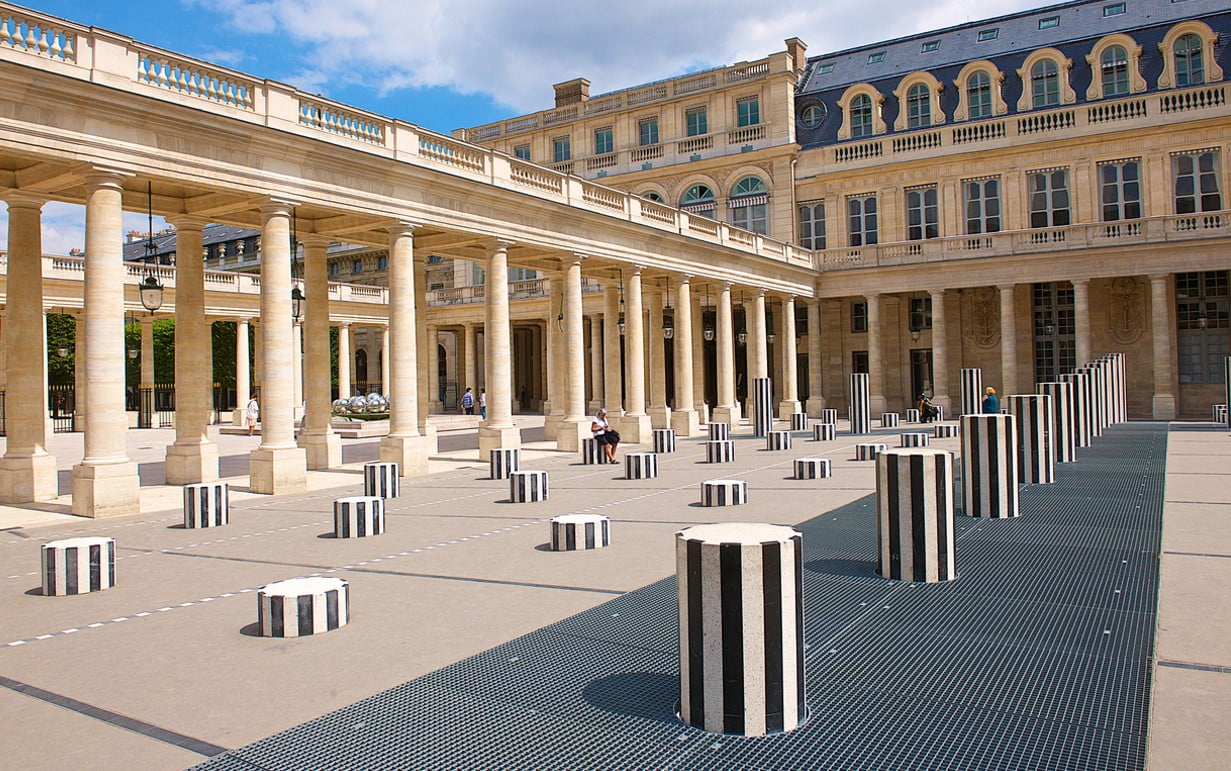
More recently, the Palais-Royal has made its mark on the history of contemporary art with the installation of the Buren Columns. In 1986, artist Daniel Buren created this iconic work, consisting of 260 black-and-white striped columns arranged in the main courtyard.
This installation, titled Les Deux Plateaux, sparked fierce controversy at the time, but it is now regarded as a masterpiece of urban art.
The Gardens of the Palais-Royal
The gardens of the Palais-Royal are a must-see.
Designed in the 17th century, they were redesigned in the 18th century in a classical style, featuring symmetrical pathways, flowerbeds, and fountains.
Today, they offer a peaceful setting for a stroll or a lunch break. The benches scattered beneath the trees invite relaxation, while the fountains add a refreshing touch.
The arcades of the Palais-Royal
It’s a maze of shops and galleries. Here, you’ll find antique bookshops, craft boutiques, and contemporary art galleries.
Among the must-see spots: La Comédie-Française, the world’s oldest national theatre, located at the corner of the palace.
For food lovers, the Restaurant du Palais-Royal offers refined cuisine in an elegant setting. Coffee enthusiasts can settle in at Café Kitsuné, a trendy spot tucked beneath the arcades.
Finally, history buffs will appreciate librairie Delamain, one of Paris’s oldest bookshops, founded in 1700.
An ideal spot for photographers
The Palais-Royal is also a photographer’s paradise. The Buren Columns, with their striking stripes, provide a unique backdrop for unforgettable shots.
The gardens, meanwhile, are perfect for romantic photos, especially at sunrise or sunset. Don’t hesitate to capture architectural details, such as the fountain sculptures or ceiling frescoes.
The Domaine National du Palais-Royal to discover all year round
If you visit Paris in summer, the Palais-Royal is an ideal spot to escape the heat. The gardens are shaded, and the arcades provide a welcome coolness.
In winter, the Christmas lights add a magical touch to the estate. Whatever the season, the Palais-Royal is a place to discover and rediscover.
For a deeper visit, opt for a guided tour. Several organizations offer themed tours, highlighting the history, architecture, or art of the Palais-Royal. Some tours even include access to areas usually closed to the public, such as the Council of State’s salons.
The Palais-Royal is a free and open space for all. The gardens and arcades are freely accessible, while certain parts of the palace (such as the official salons) require a reservation. Check the official website for access details and special events.
In summary
In summary, the Domaine National du Palais-Royal is far more than a simple monument: it is a living place where history, art, and modernity come together.
Whether you're a tourist in search of discoveries or a Parisian in need of inspiration, this area will captivate you. So, ready to dive into the fascinating world of the Palais-Royal?
Don’t forget to share your photos and impressions on social media with the hashtag #PalaisRoyalParis. And if you enjoyed your visit, why not come back to explore other facets of this exceptional place? The Palais-Royal still has many secrets to reveal…
To see nearby
Musée des Arts Décoratifs - Musée des Arts Décoratifs – Not available – Ticket on site
Conciergerie - Book Conciergerie tickets (Sainte-Chapelle combo)
Notre-Dame Cathedral - Notre-Dame Cathedral entry reservation (Free entry but reservation recommended to avoid queues)
Archaeological Crypt of Île-de-la-Cité - Archaeological Crypt of Île-de-la-Cité reservation
Musée de l'Hôtel de la Marine - Réservation entrée Hôtel de la Marine – Appartements des Intendants - Réservation entrée Hôtel de la Marine- Salon et Loggia - Réservation entrée Hôtel de la Marine – Collection Al Thani
Batobus shuttle on the Seine - Louvre stop - Orsay stop - Book Batobus river taxi (9 stops) (Hop-on Hop-off - 1 or 2-day pass - Easy way to travel between museums)
Seine River Cruise - Port Solferino (Tuileries) - Book in Paris: Seine Dinner Cruise with Panoramic Views and Champagne (Port Solférino – near Musée d’Orsay)
Canal Saint-Martin Cruise - Departure Musée d’Orsay / Port Solferino - Book Seine & Canal Saint-Martin – Port Solferino - Musée d’Orsay - Parc de la Villette
Bonus: 5 key tips to help you plan and enjoy your stay in Paris
Have you noticed that our website provides you with tools to help you easily organize your trip to Paris so that your stay is a stress-free success?
1. Phrasebook Translator for those who don’t speak French fluently
Do you struggle to find the right word or phrase in French? Click here on PHRASEBOOK – or at the top right of your screen. It’s a glossary of 100 useful words and/or phrases for a tourist visiting Paris (At the restaurant, Hotel, Shopping, Metro, Greetings, Asking for directions, etc.). Eight languages are available. And here’s the best part? Each word and phrase can also be heard aloud in French.
2. The VPBY Trip Generator
There’s so much to see and do in Paris—it’s fascinating and educational! To make the most of your stay, we highly recommend planning ahead. To help you, we’ve made our Trip Generator available to you—FREE OF CHARGE.
In just 5 minutes and 5 clicks, you’ll get your half-day-by-half-day visit schedule, with all reservations—if you want, no obligation—for the sites you wish to visit. Reservations for your transport (plane, train, or car) and your accommodation are also included. Even suggestions for valuable gift souvenirs for you, your friends, and your family.
How does it work?
Click on "Paris Stay Organizer"—completely free—which will save you the hassle of trying to see as much as possible in the least amount of time. Then you’ll need to choose:
1/ Select your "general interests" by clicking on the list (Museums, Churches, Monuments, Parks, etc.);
2/ The VPBY Stay Generator then suggests all relevant listings;
3/ You select by clicking on the names of the museums, monuments, parks, or activities you wish to include;
4/ The organizer returns a day-by-day itinerary for your stay;
5/ with geographically optimized daily visits—if you so choose—to avoid tiring and tedious travel.
It takes just 5 clicks and 3 minutes. And it’s completely free. To use it, click on "Paris Stay Organizer"
Note: Want to see what users of the VPBY Stay Generator think of their experience? Click on "They planned their trip with VPBY"
3. List of Reservations to Make
To avoid wasting time waiting in line, we recommend making your reservations online a few days in advance. All official reservations are available and can be found on our website:
Reservations to enter museums, monuments, shows, and Seine River cruises
Reservations for your arrival in France: flights, trains, and cars
Reservations for your accommodation: hotels, apartments, and guesthouses – in Paris or nearby
You’ll find links to all these reservations directly in the articles about the attractions that interest you or in the self-guided itineraries of our walks. By clicking on "Reservations" in the header bar, you’ll have access to all the reservations you’ll need during your stay. For example:
Notre-Dame de Paris entry reservation (Free entry, but reservations are recommended to avoid queues)
Versailles Castle: Entry Ticket + Gardens Access + Trianon Estate
4. Collectible Paris Keepsake Photos
These are collectible HD photos available in digital format or as long-lasting prints (75 to 100 years). Their size ranges from postcard to large format (up to 1 meter or more). A lifelong keepsake to decorate your home. A high-quality souvenir (unlike the typical snow globe or plastic Eiffel Tower). At a very affordable price. Click on:
5. Bring back a personalized photo report of your stay in Paris
Reportage by professional photographers in Paris at the locations of your choice or suggested by us. A "family" reportage, wedding, other events. From 1 hour to a full day. The best quality/price ratio. Click on:


