6th arrondissement, Saint-Germain-des-Prés and Luxembourg in Paris
The 6th arrondissement of Paris, nicknamed the “Luxembourg arrondissement” in reference to the seat of the Senate, the upper house of the French Parliament, and its magnificent garden, is located on the Left Bank of the Seine, directly across from the Louvre Museum (Book at the Louvre) and west of the Latin Quarter.
For an overview of Paris’s 20 arrondissements, click on Which is the best arrondissement to stay in Paris?
The 6th arrondissement of Paris, a vibrant and historic neighborhood
Renowned for its intellectual and artistic heritage, the 6th arrondissement of Paris is home to the famous Saint-Germain-des-Prés district, historically frequented by writers, philosophers, and artists such as Jean-Paul Sartre, Simone de Beauvoir and Ernest Hemingway. It blends classic Parisian charm with a vibrant, sophisticated atmosphere.
The Luxembourg Garden
Characterized by its picturesque streets, elegant architecture, and cultural landmarks, the 6th arrondissement of Paris is home to the magnificent Jardin du Luxembourg, offering residents and visitors a peaceful haven with its manicured lawns, statues, and a Fontaine Médicis. It is also one of the most elegant and historically rich neighborhoods in the city, synonymous with intellectualism, literary cafés, chic boutiques, and remarkable architecture.
A legendary café culture
The café culture here thrives, with iconic establishments like Café de Flore and Les Deux Magots serving as meeting places for both intellectuals and tourists. Art galleries, luxury shops, and antique dealers add to the neighborhood’s appeal, making it a paradise for art and shopping enthusiasts.
A university district
It includes higher education institutions such as the École nationale supérieure des Beaux-Arts, the École des hautes études en sciences sociales and the Institut de France. The Sorbonne is nearby, just across Boulevard Saint-Michel. The École des Mines, located at 60 bd Saint-Michel, also borders the Jardin du Luxembourg. This engineering school houses the Mineralogy Museum of the École des Mines, which preserves some of the jewels of the French Crown (see below).
Historic churches
The 6th arrondissement also features historic churches, such as Saint-Sulpice Church, renowned for its remarkable architecture and artistic treasures, and Saint-Germain-des-Prés Church.
With its blend of cultural richness, picturesque landscapes and lively atmosphere, the 6th arrondissement remains one of Paris’s most sought-after and enchanting neighborhoods.
Map of the 6th arrondissement of Paris – Points of interest and hotels
Luxembourg Garden
One of Paris’s most beautiful parks.
Features fountains, statues, the Luxembourg Palace and tree-lined avenues.
An ideal spot to relax, have a picnic or admire the Medici Fountain.
Right in the heart of Paris, these 21.75 hectares are open to the public, including 1.18 hectares for the Luxembourg Palace alone—equivalent to one-tenth of the 6th arrondissement. Open from 7:30 AM to 9:30 PM in summer and from 8:10 AM to 5:00 PM in winter.
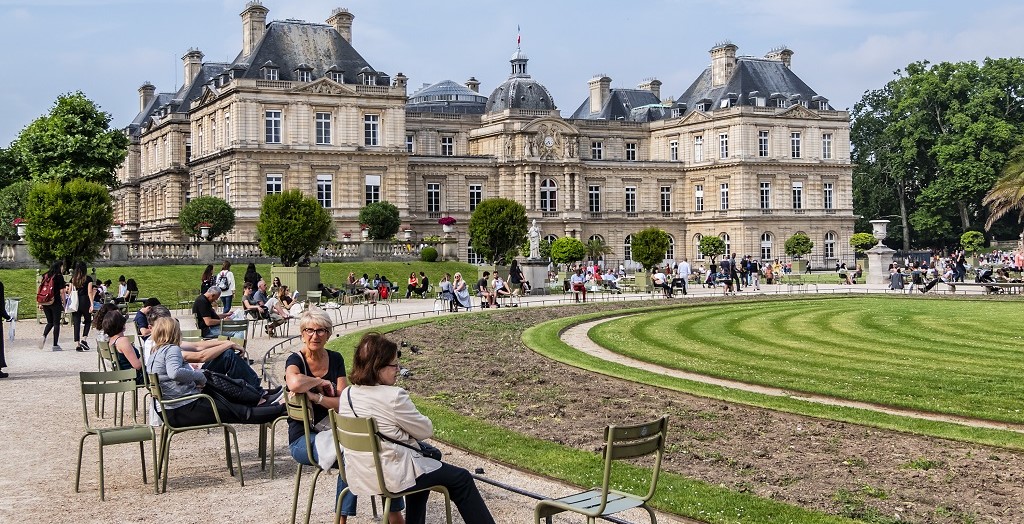
We’ve published a special in-depth article about the Jardin du Luxembourg. To read it, click on Jardin du Luxembourg in Paris, a place of relaxation and beauty. In 2022, according to a ranking by the English-language site HouseFresh, which aggregated reviews from tens of thousands of tourists, it was voted Europe’s most beautiful garden and the third most beautiful in the world, behind Singapore’s Gardens by the Bay and Marrakech’s Majorelle Garden.
In 1611, Marie de Médicis, widow of Henri IV and regent of King Louis XIII, decided to build a palace inspired by the Palazzo Pitti of her native Florence. She acquired the Hôtel du Luxembourg (now the Petit Luxembourg) and began construction of the new palace. She entrusted Salomon de Brosse with designing the palace and a fountain, which still exists today.
The garden is home to just over a hundred statues, monuments, and fountains, scattered throughout its grounds. Around the central green space stand twenty statues of French queens and illustrious women, mounted on pedestals. They were commissioned by Louis-Philippe in 1848.
Musée du Luxembourg: temporary exhibitions (see the website https://museeduluxembourg.fr/fr/agenda)
1. Medici Fountain
A sublime 17th-century fountain built by Marie de’ Medici, surrounded by sculptures and greenery. A peaceful and romantic spot.
2. Palais du Luxembourg
Originally constructed for Marie de’ Medici, it now houses the French Senate. Though not open to the public, its imposing façade enhances the garden’s charm.
3. The Statues
The park features over 100 statues, depicting French queens, artists, writers, and mythological figures. Don’t miss the famous replica of the Statue of Liberty (once displayed in the garden).
4. The Grand Basin (Bassin des Voiliers)
A large octagonal pond where children (and adults) can rent and sail small model boats—a timeless tradition of the garden.
5. The Orchard and Greenhouses
A lesser-known but stunning section, featuring a rare apple orchard, a rose garden, and greenhouses filled with orchids.
6. The Orangery and Davioud Pavilion
Historic buildings often used for exhibitions and cultural events.
7. The Rotunda and Cultural Events
Free concerts, photography exhibitions, and performances are regularly held around the rotunda and along the garden’s fences.
8. Leisure Activities
Enjoy chess games, pétanque, tennis, Guignol shows (children’s puppet theater), and playgrounds.
9. The Famous Green Chairs
Relax like a true Parisian on the garden’s iconic green metal chairs, perfect for sunbathing or reading.
Whether for a peaceful stroll, a picnic, or a cultural exploration, the Jardin du Luxembourg has something to offer everyone.
The Saint-Germain-des-Prés neighborhood, in the 6th arrondissement
The Saint-Germain-des-Prés Quarter is one of the oldest and most famous neighborhoods in Paris.
Home to the Abbey of Saint-Germain-des-Prés (Abbey Church of Saint-Germain-des-Prés), dating back to the 6th century.
Former intellectual hub of philosophers and writers.
Saint-Germain-des-Prés, in the 6th arrondissement of Paris, is a historic and artistic district renowned for its intellectual past, picturesque streets, and iconic landmarks. It’s a world unto itself. Here’s what to explore:
Legendary cafés where philosophers like Jean-Paul Sartre, Simone de Beauvoir and writers such as Hemingway gathered. The perfect spot to soak up Parisian café culture.
Markets brimming with gourmet grocers, fresh produce, and artisan shops. The Saint-Germain Market (indoor) and the Maubert-Mutualité Market, a lively open-air market.
Culture: the Delacroix Museum, an intimate museum set in the former home of Eugène Delacroix, showcasing his paintings, his studio and a charming garden, as well as the French Academy, a majestic building on the banks of the Seine, a must-see for literature and history lovers.
Arts with the Théâtre de l’Odéon, one of France’s oldest theatres, renowned for its classical and contemporary performances, and famous art galleries and bookshops for a taste of Parisian culture.
Luxury shopping at Yves Saint Laurent, Sonia Rykiel and in charming independent boutiques.
Why visit Saint-Germain-des-Prés?
Saint-Germain-des-Prés blends history, elegance and creativity, making it the perfect place to explore art, fashion and culture in Paris. Whether you're admiring contemporary works of art or hunting for exclusive Parisian fashion pieces, this district is a must-visit for art lovers and style enthusiasts.
Saint-Germain-des-Prés Church
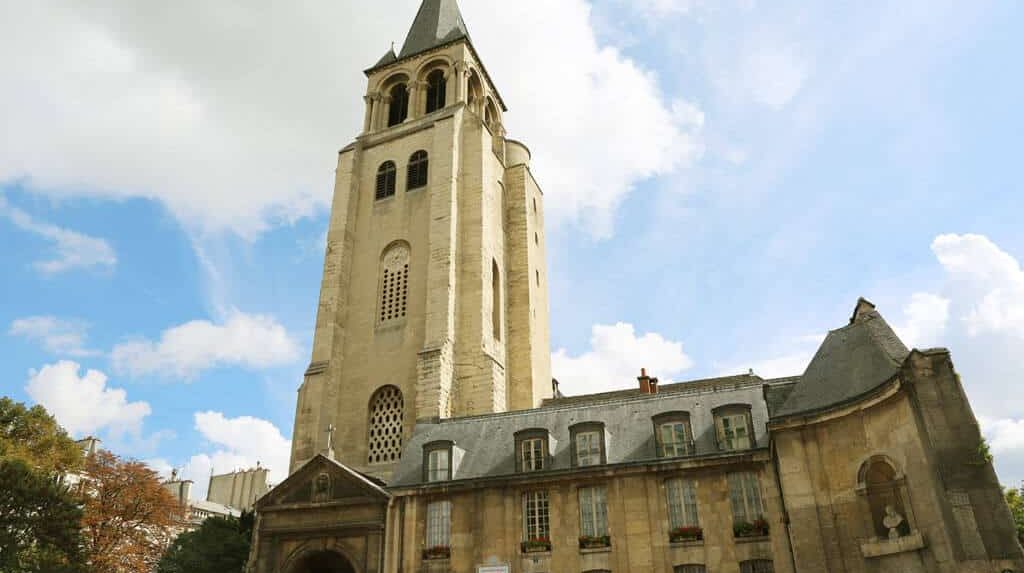
One of Paris’s oldest churches, dating back to the 6th century, it stands out for its Romanesque and Gothic architecture, its magnificent frescoes and its peaceful atmosphere.
Saint-Germain-des-Prés Church is not only one of Paris’s oldest churches but also a symbol of the historic and intellectual heart of the Saint-Germain-des-Prés district, in the 6th arrondissement. Its origins go back to the early 6th century, and it has witnessed the evolution of Parisian society through the ages, from the Merovingian period to the Paris of today.
1. The origins in the Early Middle Ages (6th century)
The church was founded in 542 AD by Childebert I, son of Clovis I, the first king of the Franks.
Originally dedicated to Saint Germain, bishop of Paris and revered as the city’s protector, the initial church was a monastery housing monks. The surrounding district took the name “Saint-Germain-des-Prés” because it lay near a lush meadow (“pré” in French).
By the 7th century, it had become a hub of religious and political power in early medieval Paris.
2. 9th–12th century: Vikings, reconstructions and Romanesque style
In the 9th century, the church suffered Viking raids that damaged the building.
It was rebuilt and expanded in the 12th century, a period when Romanesque style began to shape its architecture.
The church also became closely tied to the royal family, and several French kings were buried there.
3. The Gothic period and the Renaissance
In the 15th century, the church underwent major renovations, with the addition of Gothic elements.
The church gradually became a hub of intellectual and cultural life, especially at the dawn of the Renaissance, which was influencing Paris.
It also became the site of numerous royal burials, and its renown continued to grow during this period.
4. The French Revolution and the Restoration (18th–19th century)
During the French Revolution, many churches in Paris suffered acts of vandalism and desecration, and Saint-Germain-des-Prés was no exception.
The church’s monastic buildings were destroyed, and much of its property was confiscated.
In the 19th century, the church was restored by architect Viollet-le-Duc, who also worked on the restoration of Notre-Dame de Paris. He added the bell tower that can still be admired today.
5. 20th century and the birth of intellectual Paris
The 20th century saw the area around the church become a gathering place for writers, artists and intellectuals.
Iconic figures such as Jean-Paul Sartre, Simone de Beauvoir and Boris Vian frequented the nearby cafés, making the church a key player in the intellectual and artistic life of Saint-Germain-des-Prés.
The church itself became a symbol of the bohemian lifestyle in Paris.
6. Architectural highlights of the church
The church blends several architectural styles, mainly Romanesque and Gothic, with a tower as a striking feature.
It is also renowned for its stained glass windows, some dating back to the 13th century.
The cloister, from the 13th century, is a rarity and a hidden gem of the church.
A cultural and religious icon today
Today, Saint-Germain-des-Prés remains an essential part of Parisian history and culture.
It is an active parish church while also being a sought-after tourist destination for visitors eager to explore Paris’s deep history and intellectual heritage.
The church also hosts classical music concerts, further enhancing its cultural significance.
Saint-Germain-des-Prés is a rich historical site, blending religious, cultural, and intellectual heritage, making it a must-visit for anyone interested in the history of Paris.
The iconic cafés of Saint-Germain-des-Prés in Paris
Café de Flore – A historic café where Sartre and de Beauvoir debated existentialism.
Les Deux Magots – Another legendary literary café, once frequented by Hemingway and Picasso.
Brasserie Lipp – A classic Parisian brasserie serving traditional French cuisine.
Le Procope (Founded in 1686 – Paris’s oldest café) – The café played a role in the French Revolution and remains a historic landmark today.
La Closerie des Lilas (Founded in 1847) – A favorite haunt of Hemingway, Fitzgerald, Apollinaire, and Paul Verlaine.
Saint-Germain-des-Prés is famous for its legendary cafés, which have been at the heart of Parisian intellectual, artistic, and literary life for over a century. These cafés were not merely places to grab a coffee, but true cultural hubs where writers, philosophers, and artists gathered to exchange ideas and shape history.
1. Café de Flore (Founded in 1887)
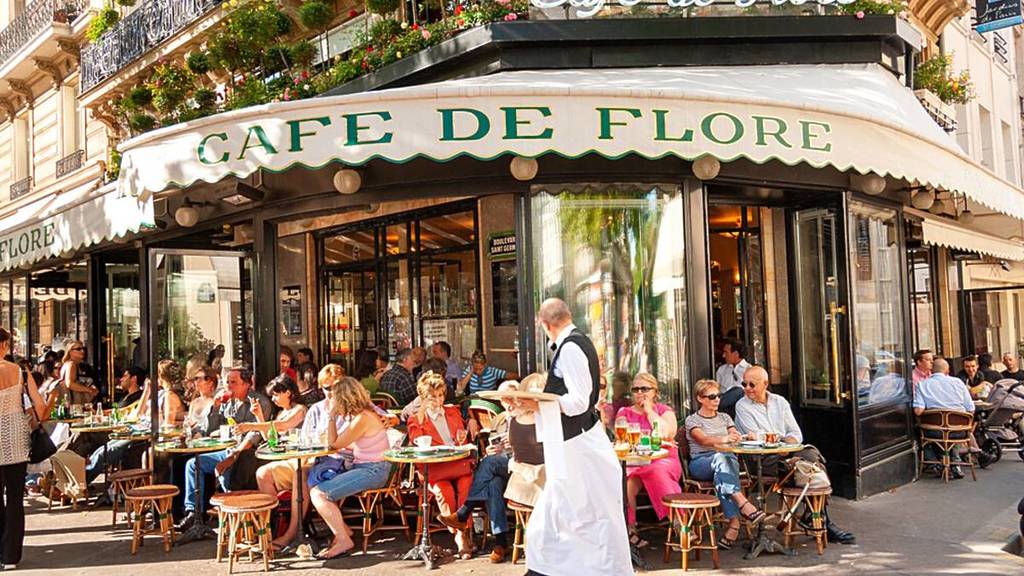
One of Paris’s most iconic cafés, Café de Flore became a must-visit gathering spot for writers, poets, and philosophers in the early 20th century. In the 1940s and 1950s, Jean-Paul Sartre and Simone de Beauvoir made it their second home, developing their existentialist philosophy over countless cups of espresso. Other celebrated regulars included Pablo Picasso, Albert Camus, and Truman Capote. Today, it remains a symbol of Parisian intellectual life.
2. Les Deux Magots (Founded in 1885)
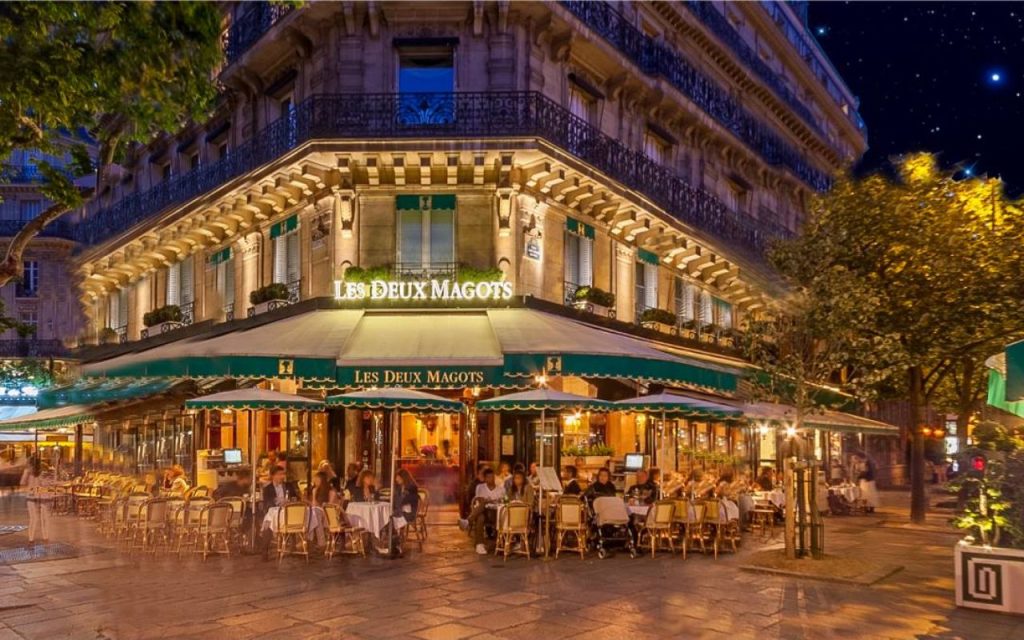
Originally a silk shop before becoming a café, Les Deux Magots was a gathering place for literary giants such as Ernest Hemingway, James Joyce, and André Gide. Like the Café de Flore, it was a hub for existentialists and surrealists. The café also awards the Prix des Deux Magots, a prestigious literary prize established in 1933.
3. Brasserie Lipp (Founded in 1880)
A traditional Alsatian brasserie renowned for its classic French dishes and political connections. Over the years, Charles de Gaulle, François Mitterrand, and Jacques Chirac have dined here, making it a favorite among politicians and journalists. Writers such as Hemingway and Camus were also regulars.
4. Le Procope (Founded in 1686 – Paris’s oldest café)
Although slightly off the main café circuit in Saint-Germain, Le Procope is Paris’s oldest café and a cornerstone of the city’s intellectual history. It was frequented by Voltaire, Rousseau, and later revolutionaries such as Robespierre and Danton. The café played a role in the French Revolution and remains an iconic historical landmark today.
5. La Closerie des Lilas (Founded in 1847)
A quieter café near the Jardin du Luxembourg, it was Hemingway’s favorite writing spot in the 1920s. He mentions it in A Moveable Feast and it was also a favorite of Fitzgerald, Apollinaire, and Paul Verlaine.
6. La Maison du Whisky Odéon
An elegant high-end spirits shop spanning three floors, blending contemporary design with glass, gray, and black. Official importer and exclusive distributor of many brands sourced worldwide, La Maison du Whisky has been guiding whisky, rum, and spirits enthusiasts for over 60 years. Tel: 01 46 34 70 20
Cafés, cultural icons
In the 20th century, these cafés became synonymous with artistic and literary freedom, hosting debates on existentialism, surrealism, jazz, and politics. Today, they remain iconic spots of Parisian café culture, drawing intellectuals, tourists, and locals alike.
Visiting these cafés offers the chance to immerse yourself in history, sip a coffee where Sartre once wrote, and discover the timeless charm of Saint-Germain-des-Prés.
The Théâtre de l’Odéon, the Odéon district, and literary landmarks
Théâtre de l’Odéon – A historic theatre with striking neoclassical architecture.
Shakespeare and Company (nearby in the 5th arrondissement) – A legendary English-language bookstore.
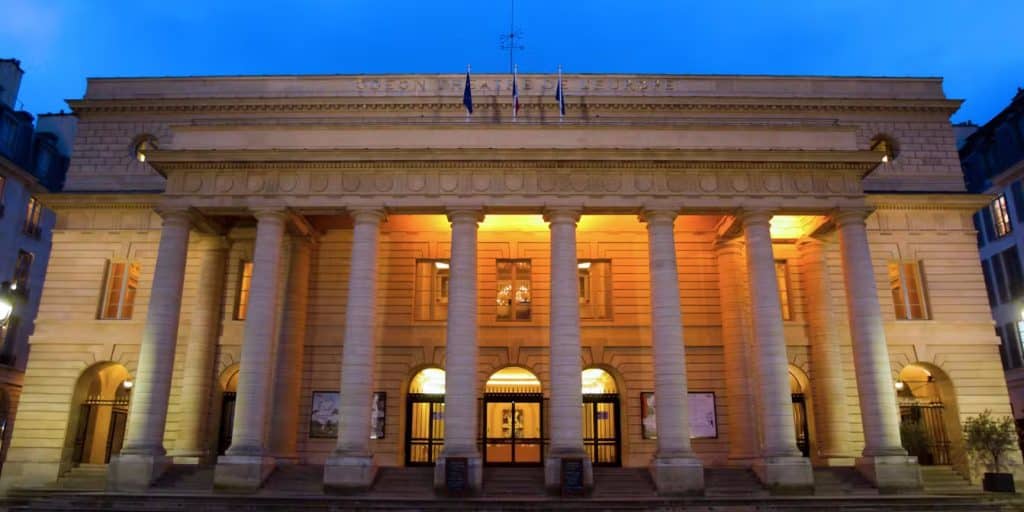
The Odéon district, in the 6th arrondissement of Paris, is a historic and cultural hub, renowned for its theatre, intellectual life and elegant architecture. It takes its name from the Théâtre de l’Odéon, one of Paris’s oldest and most prestigious theatres. Since the 18th century, this neighbourhood has been a hotbed of literature, politics and the arts.
1. The origins and birth of the Théâtre de l’Odéon (1779–1782)
The Théâtre de l’Odéon was commissioned by Louis XVI to serve as a new stage for the Comédie-Française.
Designed by architects Marie-Joseph Peyre and Charles De Wailly, it opened in 1782 as Paris’s first theatre featuring a circular auditorium and a majestic neoclassical façade.
It became a favoured meeting place for Parisian aristocracy and intellectuals.
2. The Revolution and the Napoleonic era (1789–1815)
During the French Revolution, the Odéon was a gathering place for political debates.
The Comédie-Française was expelled from it in 1793, and the theatre was renamed Théâtre de l’Égalité (Théâtre de l’Égalité).
Napoléon Bonaparte later restored its fame by renaming it Théâtre de l’Impératrice in honor of Empress Joséphine.
3. Fires and Reconstructions (19th Century)
The theatre suffered two major fires:
First fire (1799) – Ravaging much of the building, it led to a complete restoration.
Second fire (1818) – Another devastating blaze required a full reconstruction.
The Odéon we know today was rebuilt in 1819, retaining its elegant neoclassical style.
4. 19th and 20th Centuries: A Literary and Artistic Hub
The Odéon district became the intellectual heart of Paris, drawing writers, philosophers, and artists.
Famous literary figures such as Victor Hugo, Honoré de Balzac, and Gustave Flaubert frequented the area’s cafés.
In the 20th century, it was a key location of the Surrealist movement, where writers such as André Breton and Paul Éluard would gather.
The May 1968 student protests began near the Odéon, making it a symbol of political activism.
5. The Odéon today: an iconic cultural hub in Paris’s 6th arrondissement
The Théâtre de l’Odéon is now one of France’s six national theaters, hosting prestigious classic and contemporary productions.
The neighborhood remains a hotspot for literature and cinema, with independent bookshops, the famous Cinéma Odéon, and historic cafés like Café de Flore and Les Deux Magots nearby.
Its elegant Haussmannian buildings, picturesque streets, and lively atmosphere make it a favorite among both Parisians and visitors.
Whether you explore its historic theater, famous cafés, or charming streets, the Odéon is a must-visit for lovers of Parisian culture, history, and the arts.
6. Shakespeare and Company – Paris’s legendary bookstore
Located in the 5th arrondissement, near the Notre-Dame Cathedral, Shakespeare and Company is one of the most famous bookstores in the world. A legendary literary landmark, it has been a haven for writers, poets, and book lovers for over a century. Its history, intertwined with the Lost Generation, the Beat Generation poets, and modern literary culture, is captivating.
The original Shakespeare and Company bookstore (1919–1941) – Sylvia Beach’s vision
The original Shakespeare and Company bookstore was founded in 1919 by Sylvia Beach, an American expatriate.
Based at 12 rue de l’Odéon, it became a gathering place for modernist writers, including:
Ernest Hemingway
F. Scott Fitzgerald
James Joyce (who published Ulysses there in 1922, thanks to Beach’s support)
Gertrude Stein
Ezra Pound
The bookstore also served as a lending library, allowing struggling writers to borrow books.
Unfortunately, it closed in 1941 during the German occupation of Paris during World War II. The Nazis shut it down after Beach refused to sell a book to a German officer. It never reopened under her management.
The modern Shakespeare and Company bookstore (1951–present) – George Whitman’s legacy
In 1951, eccentric American bookseller George Whitman opened a new bookstore at 37 rue de la Bûcherie (near the Seine and Notre-Dame).
Originally called Le Mistral, he renamed it Shakespeare and Company in 1964 in honor of Sylvia Beach.
Like the first, this bookstore became a haven for writers and intellectuals, particularly for the Beat Generation, attracting:
Allen Ginsberg
William S. Burroughs
Jack Kerouac
A haven for writers. Whitman allowed aspiring young authors to sleep among the shelves in exchange for helping out in the shop and reading a book a day. These temporary guests, nicknamed the “Stardust”, have been part of the bookstore’s tradition for decades.
Shakespeare and Company today. After George Whitman’s death in 2011, his daughter, Sylvia Whitman, took over the bookstore, keeping its literary spirit alive. The shop remains a cultural institution, with a small upstairs library where visitors can relax and read.
Shakespeare and Company remains one of the most magical bookstores in the world, preserving a legacy of literature, community, and creative freedom.
Why visit Shakespeare and Company?
A historic meeting place for literary legends.
The chance to buy English books in a charming, history-rich setting.
A place to soak up Paris’s bohemian and artistic atmosphere.
Saint-Sulpice Church in the 6th arrondissement of Paris
One of Paris’s most impressive churches, renowned for its sumptuous interior and grand organ.
Featured in Da Vinci Code.
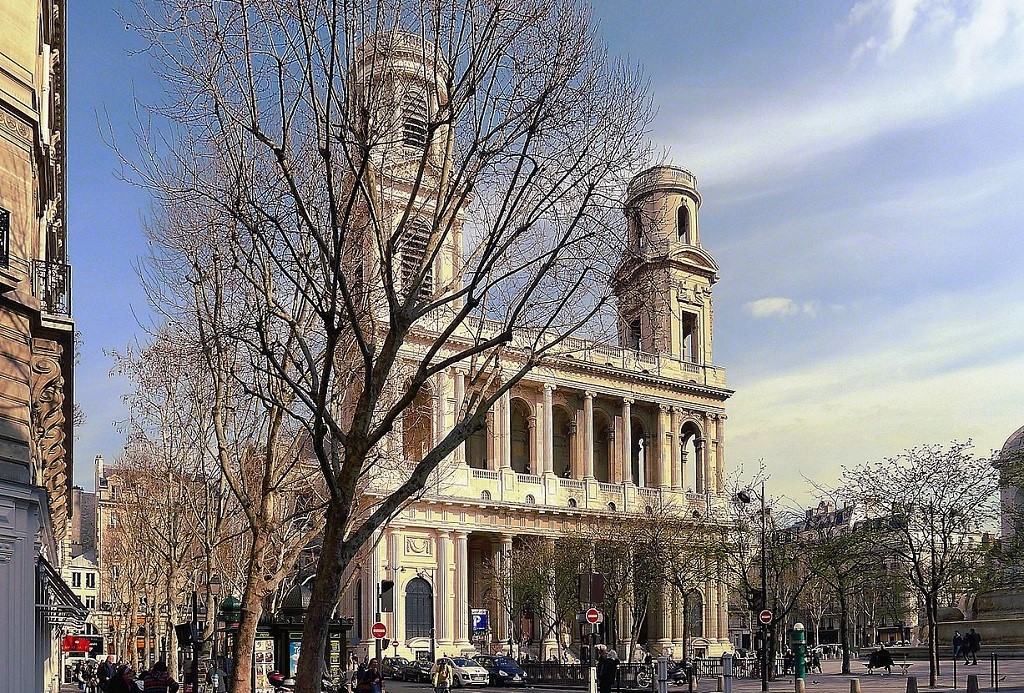
Saint-Sulpice Church, the second-largest church in Paris (after Notre-Dame), is a 17th-century Baroque masterpiece brimming with historical, architectural, and artistic riches. Located in Saint-Germain-des-Prés, this iconic church is a must-see for its Baroque grandeur, Delacroix’s famous frescoes, and intriguing scientific elements.
1. Delacroix’s Masterpiece – The Chapel of the Angels
One of the church’s treasures is the Chapel of the Angels, adorned by Eugène Delacroix in the 1850s. His frescoes here rank among his greatest works, including:
“Jacob Wrestling with the Angel” – A dramatic and powerful scene, full of movement and emotion.
“Heliodorus Driven from the Temple” – A dynamic clash between light and darkness.
“Saint Michael Vanquishing the Demon” – A striking representation of the triumph of good over evil.
These romantic-style frescoes are considered some of the most beautiful murals in Paris.
2. The Monumental Organ – A Musical Marvel
The organ of Saint-Sulpice, built by Aristide Cavaillé-Coll, is one of the largest pipe organs in the world.
It features 6,588 pipes and produces a deep, rich sound, drawing the greatest organists.
Free organ concerts are held every Sunday after mass.
3. The Gnomon and the Meridian Line (featured in Da Vinci Code)
Inside the church lies a fascinating scientific instrument: a gnomon, a kind of ancient sundial.
A brass line runs along the floor, marking the spring and autumn equinoxes.
Designed in the 18th century, this device allowed for precise determination of Easter’s date.
It gained fame through Dan Brown’s novel Da Vinci Code, though its true purpose is astronomical rather than mysterious.
4. The twin towers and the façade
The church’s façade, designed by Giovanni Servandoni, features two asymmetrical towers—a unique trait resulting from construction delays and budget cuts.
Despite this, its grand columns and imposing doors make it one of Paris’s most impressive churches.
5. A sumptuous interior and works of art
Its soaring vaults and elongated nave create a majestic atmosphere.
Several sculptures, paintings, and chapels enrich the church, including a statue of Saint Peter blessing the waters.
The hexagonal baptismal font, crafted in 1733, is another magnificent detail.
Why visit Saint-Sulpice Church?
Saint-Sulpice Church is a hidden gem that blends art, music, history, and science. Whether you admire Delacroix’s frescoes, listen to the majestic organ, or discover the meridian line, this lesser-visited alternative to Notre-Dame promises an unforgettable experience.
Nearby sites
After your visit to Saint-Sulpice, explore
Place Saint-Sulpice – A charming square featuring the Fountain of the Four Bishops.
Musée Delacroix – Just a short walk away.
Jardin du Luxembourg – Perfect for a peaceful stroll.
Musée Delacroix (Musée national Eugène Delacroix)
A small, charming museum dedicated to the Romantic painter Eugène Delacroix.
Housed in the artist’s former home and studio.
The Musée national Eugène Delacroix, located at 6 rue de Furstenberg, in the 6th arrondissement of Paris, is a hidden gem of Saint-Germain-des-Prés. It is devoted to the life and work of Eugène Delacroix (1798–1863), one of France’s greatest Romantic painters.
1. Delacroix’s Studio and Apartment
The museum occupies Delacroix’s former house and studio, where he lived from 1857 until his death in 1863.
Visitors can discover his private rooms, where he created much of his final masterpieces.
The studio, bathed in light, still retains the atmosphere in which he worked.
2. Masterpieces and sketches
The museum houses a collection of paintings, sketches, pastels and drawings by Delacroix, including:
Madeleine in the Desert
Self-Portrait
Studies for his monumental work Jacob Wrestling with the Angel (painted in the nearby Saint-Sulpice Church).
3. Personal items and letters
Visitors can discover Delacroix’s letters, writings and personal effects, offering insight into his thoughts and creative process.
His palette, brushes and tools are also on display.
4. The beautiful garden
A hidden, peaceful garden, designed by Delacroix himself, provides a tranquil retreat in the heart of Paris.
It’s the perfect spot to relax after visiting the museum.
5. Temporary exhibitions and events
The museum regularly hosts themed exhibitions, highlighting Delacroix’s influences, friendships and legacy.
Drawing workshops and lectures
A visit to the Musée Delacroix offers a unique and intimate glimpse into the life of a Romantic master, away from the crowds of Paris’s major museums.
Nearby: what to see after the Musée Delacroix
Église Saint-Sulpice – Home to Delacroix’s famous frescoes, including *Jacob Wrestling with the Angel*.
Place de Furstenberg – A charming square, one of Paris’s most picturesque.
Cafés and bookshops of Saint-Germain-des-Prés – Perfect for soaking up the neighborhood’s artistic atmosphere.
Musée de l’École des Mines de Paris
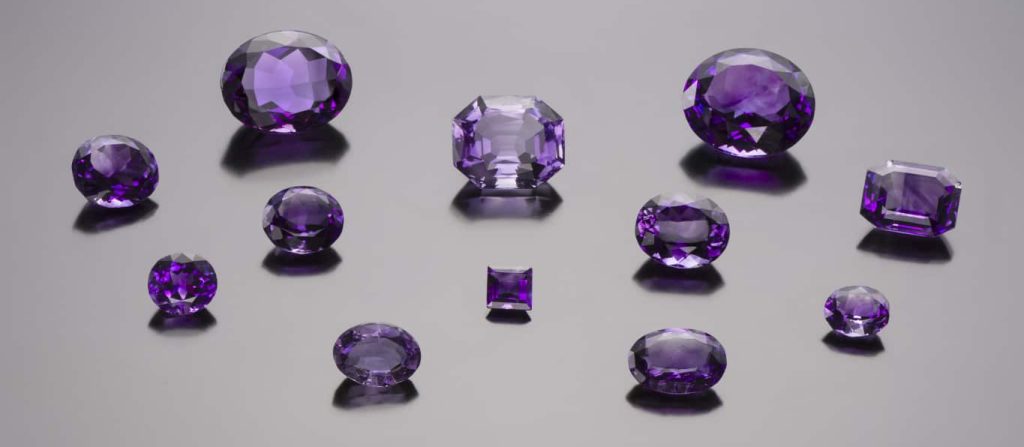
This museum, located in the École supérieure des Mines de Paris, is well worth a visit. In addition to unusual stones and crystals, it houses some of the French Crown Jewels.
It is situated at 60 bd Saint-Michel, 75006 Paris. We have dedicated a special article to it. To find out more, click on “Les joyaux de la Couronne à l’École des Mines de Paris”.
Be aware that other French Crown Jewels are on display at the “Musée d’Histoire naturelle” (5th arrondissement - Jardin des Plantes), as well as at the Louvre Museum. See “Les joyaux de la Couronne aujourd’hui au musée du Louvre”.
Art galleries and shops in the 6th arrondissement of Paris
The 6th arrondissement of Paris is home to numerous art galleries, particularly along rue de Seine and rue Bonaparte.
The streets are lined with high-end fashion boutiques and antique shops.
Saint-Germain-des-Prés is a haven for art lovers and fashion enthusiasts, blending prestigious galleries, independent art spaces, luxury boutiques, and charming concept stores. Whether you're seeking contemporary masterpieces, rare antiques, or high-end fashion, this neighborhood has something to captivate you.
Art galleries in the 6th arrondissement of Paris
Galerie Kamel Mennour(47 rue Saint-André-des-Arts & 28 avenue Matignon)
Leading contemporary art gallery featuring works by Daniel Buren, Anish Kapoor, and Mohamed Bourouissa.
Galerie Lelong & Co.(38 avenue Matignon)
A must-visit for collectors of Joan Miró, Francis Bacon, and David Hockney.
Galerie Diane de Polignac(2 bis rue de Gribeauval)
Specializing in modern and post-war artists, including Jean-Michel Atlan and Pierre Soulages.
Galerie Loevenbruck(6 rue Jacques-Callot)
Known for its avant-garde and conceptual artists in contemporary art.
Galerie Applicat-Prazan(16 rue de Seine)
Focused on French post-war painters, notably Jean Dubuffet and Nicolas de Staël.
Galerie Xavier Hufkens(opening soon in Paris)
Premier contemporary gallery showcasing international artists such as Tracey Emin and Sterling Ruby.
Galerie Vallois(35 & 41 rue de Seine)
Dedicated to Surrealist, modern and contemporary art, featuring works ranging from Duchamp to Keith Haring.
Carré Rive Gauche(several locations near rue de Seine and rue des Saints-Pères)
A collective of art dealers and galleries offering unique sculptures, paintings and furniture spanning different eras.
Musée Zadkine – 100bis rue d’Assas, 75006 Paris – tel 0155427720 – Museum and garden dedicated to 20th-century sculptor Ossip Zadkine, in his former home and studios.
Luxury and concept boutiques
Yves Saint Laurent Rive Gauche(6 place Saint-Sulpice)
The first YSL boutique, opened in 1966, now an iconic Parisian shopping destination.
Sonia Rykiel(175 boulevard Saint-Germain)
The flagship store of the legendary “Queen of Knitwear”, offering timeless Parisian fashion.
Isabel Marant(1 rue Jacob)
Perfect for a bohemian and casual Parisian style.
Christian Louboutin(38 Rue de Grenelle)
Iconic red-soled high heels, handcrafted with artisanal precision.
Le Bon Marché(24 Rue de Sèvres)
The world’s first department store, offering luxury fashion, accessories and an impressive gourmet food hall (La Grande Épicerie).
A.P.C. (Atelier de Production et de Création)(38 Rue Madame)
A renowned minimalist French brand celebrated for its high-end jeans and understated elegance.
Goyard(352 Rue Saint-Honoré – Near Saint-Germain)
Exclusive luxury luggage and handbags, entirely handcrafted.
Astier de Villatte(173 Rue Saint-Honoré – Near Saint-Germain)
A ceramics and interior design boutique famous for its artisanal pottery and scented candles.
Merci(111 Boulevard Beaumarchais – A short walk from Saint-Germain)
A concept store blending fashion, interior design, and a stylish café-bookshop.
Shakespeare and Company (Bookstore) (37 Rue de la Bûcherie – Near Saint-Germain)
A legendary English-language bookstore and a must-visit literary landmark since the 1950s.
The Pont des Arts, in the 6th arrondissement of Paris
A picturesque pedestrian bridge linking the Left and Right Banks of the Seine.
Famous for its views of the river, especially at sunset.
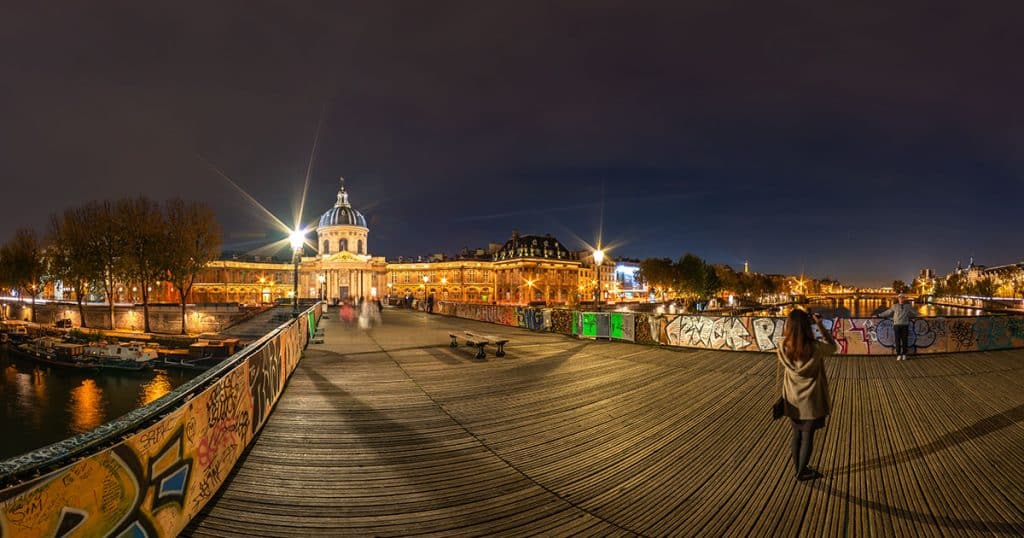
The Pont des Arts is one of Paris’s most famous pedestrian bridges. It spans the Seine and connects the Institut de France to the Louvre Museum. With a rich history dating back to the early 19th century, it has become a symbol of romance, art, and Parisian charm.
Origins and construction (1802–1804)
The Pont des Arts was the first metal bridge built in Paris. Commissioned by Napoleon Bonaparte in 1802, it was designed by engineer Louis-Alexandre de Cessart and architect Jacques Dillon. Originally, it featured nine elegant arches and was meant to resemble a suspended garden, complete with trees and benches, offering a peaceful crossing over the Seine.
19th and early 20th centuries
For over a century, the bridge served as a pedestrian passage between the Right Bank (Louvre) and the Left Bank (Institut de France and Saint-Germain-des-Prés). It was a favored spot for artists, poets, and strollers, embodying the essence of Parisian life.
Destruction and reconstruction (1979–1984)
After surviving two world wars, the bridge suffered severe damage from boat collisions and structural weaknesses. In 1979, part of the bridge collapsed, leading to its total demolition.
A new Pont des Arts was rebuilt between 1981 and 1984, designed to closely resemble the original, but with seven arches instead of nine for better stability and to facilitate river traffic on the Seine.
The love-lock phenomenon (2008–2015)
In the early 2000s, the Pont des Arts gained worldwide fame thanks to the tradition of “love locks.” Couples from all over the world would attach padlocks to the bridge’s railings and toss the keys into the Seine as a symbol of eternal love. By 2015, the weight of the locks—nearly 45 tons!—posed a structural concern, prompting the city to remove them and replace the railings with glass panels.
Today: an iconic cultural and romantic spot in Paris’s 6th arrondissement
Freed from its love locks, the Pont des Arts remains a much-loved cultural and artistic space, hosting exhibitions and open-air performances. It offers one of the most beautiful panoramic views of Paris, especially at sunset, and continues to be a favorite spot for photographers, artists, and lovers.
Whether it’s its Napoleonic history, its artistic legacy, or its romantic atmosphere, the Pont des Arts is an icon of Parisian heritage.
Bonus : 5 aides précieuses pour bien organiser et réussir votre séjour à Paris
Avez vous noté que notre site met à votre disposition des outils pour vous aider à organiser facilement votre voyage à Paris afin que votre séjour soit une réussite sans stress ?
1. Traducteur Phrasebook pour ceux qui ne parlent pas couramment le français
Vous avez des difficultés pour trouver le bon mot ou la bonne expression en français ? Cliquez ici sur PHRASEBOOK – ou en haut à droite de votre écran. Il s’agit d’un lexique de 100 mots et/ou expressions utiles pour un touriste en visite à Paris. Vous serez à l’aise au restaurant, Hôtel, Shopping, Métro, Salutations, Demander son chemin, etc.. Huit langues sont disponibles. Et vous savez quoi ? Vous pouvez en plus écouter chaque mot et expression en français.
2. Le Générateur de Séjours de VPBY
Il y a beaucoup de choses intéressantes et instructives à voir à Paris. Une bonne organisation de votre séjour est fortement recommandée. Pour vous aider nous avons à votre disposition et GRATUITEMENT, notre Générateur de Séjours.
En 5 mn et 5 clics vous obtenez votre programme de visites demi-journée par demi-journée. Et en plus, toutes les réservations - si vous voulez, sans obligation - des sites que vous voulez visiter. La réservation pour vos transports (Avion, train ou voiture), la réservation de votre hébergement sont également prévues. Même des suggestions de cadeaux souvenirs de valeur pour vous, vos amis, votre famille.
Comment cela fonctionne ?
Cliquez sur "Organisateur de séjour à Paris" entièrement gratuit qui vous évitera de vous casser la tête pour voir le maximum de choses dans le minimum de temps. Ensuite vous aurez à choisir :
1/ Vous choisissez vos "désirs généraux" en cliquant sur la liste (Musées, Eglises, Monuments, Parks, etc.) ;
2/ Le Générateur de Séjours par VPBY vous propose en retour l'ensemble des fiches pertinentes ;
3/ Vous sélectionnez en cliquant sur les noms des musées, monuments, parcs, ou des activités etc. que vous souhaitez ;
4/ L'organisateur vous retourne la planification pour chaque jour de votre séjour ;
5/ avec l'optimisation géographique des visites journalières - si vous le désirez - afin d'éviter des déplacements fastidieux et fatigants.
Cela se fait en 5 clics et en 3 mn seulement. Et c'est vraiment gratuit. Et pour l'utiliser, cliquez sur "Organisateur de séjour à Paris"
Note: vous voulez savoir ce que les Utilisateurs du Générateur de Séjours par VPBY pensent de leur expérience ? Cliquez sur "Ils ont crée leur voyage avec VPBY"
3. Liste des Réservations à faire
Vous avez un accès gratuite à notre base de données pour "apprivoiser" Paris (Cliquez sur Guide de Paris) et connaître Paris (Cliquez sur Lieux à voir). Et pour ne pas perdre votre temps à faire la queue, nous vous recommandons de faire vos réservations directement en ligne quelques jours à l'avance . Toutes les réservations officielles sont utiles et disponibles sur notre site :
Réservations pour entrer dans les musées, monuments, spectacles, croisières su la Seine
Réservations pour votre arrivée en France : avions, trains, voitures
Réservations pour votre hébergement : hôtels, appartements, gîtes - dans Paris ou à proximité immédiate
Vous trouverez le lien de toutes ces réservations sont disponibles, directement dans les articles des visites qui vous intéressent ou sur les parcours auto-guidées de nos promenades. En cliquant sur "Réservations" dans la barre de l'entête vous obtiendrez toutes les réservations qui vous seront nécessaires pendant votre séjour. A titre d'exemple:
Réservation entrée Notre-Dame de Paris (Entrée gratuite mais réservation recommandée pour éviter la queue)
Réservation Château de Versailles : Billet d'entrée + Accès aux Jardins + Domaine de Trianon
4. Rapporter des Photos Souvenirs de Collection de Paris
Ce sont des photos HD de collection disponibles sous forme numérique ou en tirage longue durée (75 à 100 ans). Leur taille est disponible entre la carte postale et la photo-tableau de 1 m de côté ou plus. Un souvenir à vie pour décorer votre intérieur. Un souvenir de qualité (qui change de la boule à neige ou de la Tour Eiffel en plastique). A un prix très très abordable. Cliquez sur :
5. Revenir avec un reportage photos personnalisé sur votre séjour à Paris
Reportage par des photographes professionnels dans Paris aux endroits de votre choix ou que nous vous suggérons. Un reportage "famille", mariage, autres événements. De 1 h à la journée entière. Le meilleur rapport qualité/prix. Cliquez sur :