Place de la Concorde, born in blood, the heart of Paris
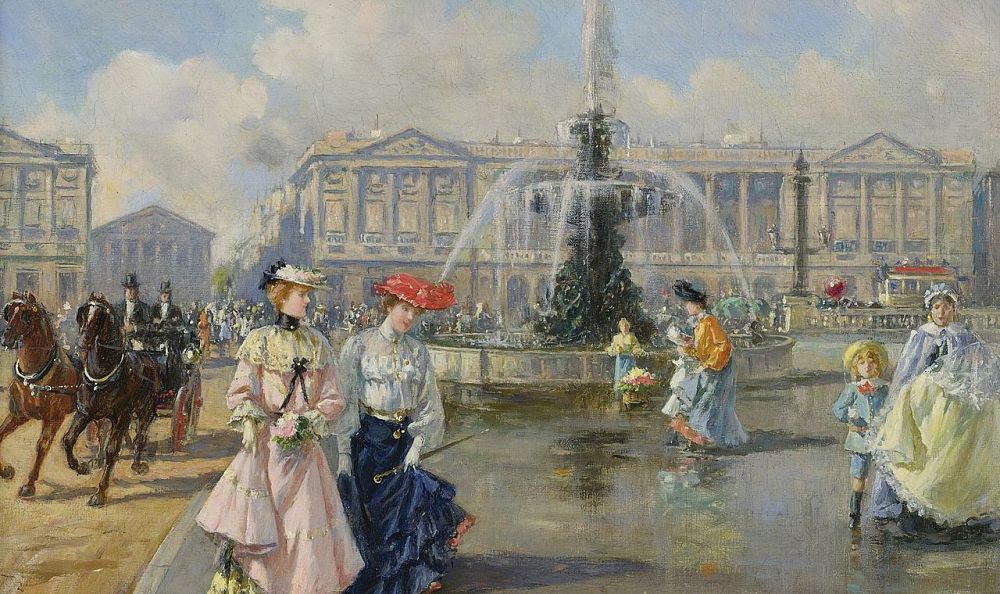
Place de la Concorde is located just a few hundred meters from the Louvre, at the bottom of the Champs-Élysées avenue. It borders the Tuileries Garden.
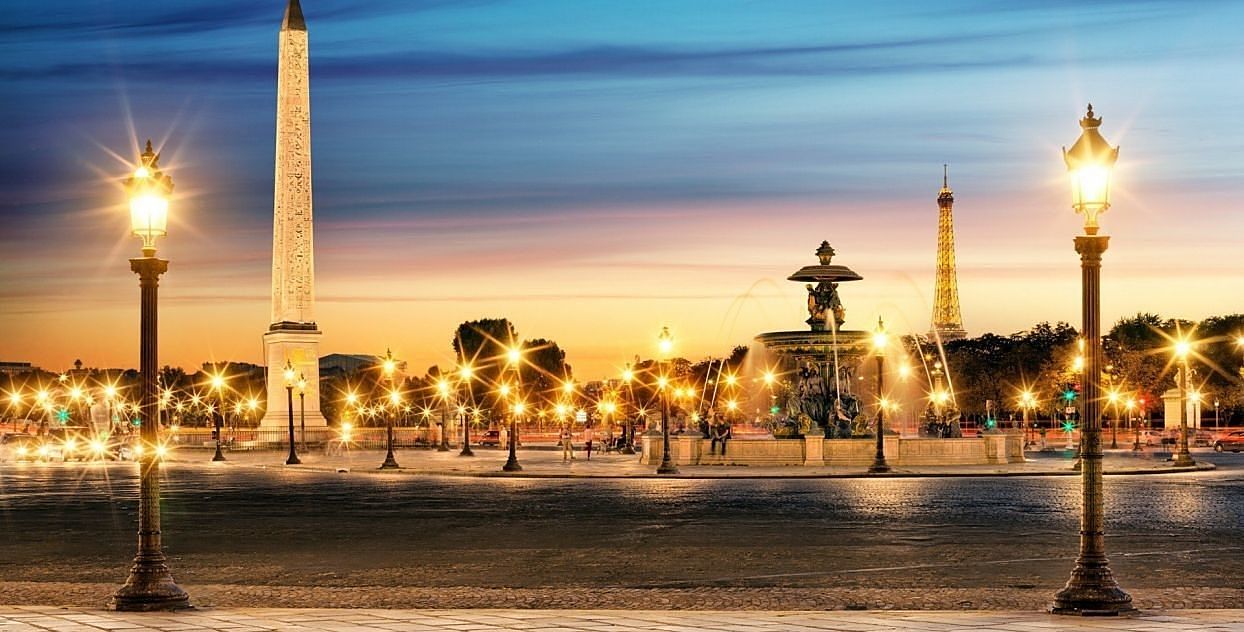
Today, it is distinguished by the Luxor Obelisk at its center, dating back 3,300 years (13th century BCE) and erected in 1836 on Place de la Concorde. See our article “Luxor Obelisk, Place de la Concorde: A Gift from Egypt.”
The prestigious hotels that line it, along with the two monumental fountains (Fountain of the Rivers and Fountain of the Seas), add to its grandeur.
Created in 1772, the Place de la Concorde was first known as one of the execution sites of the French Revolution. Louis XVI and Marie-Antoinette (among others) were guillotined here.
Architects who designed the Place de la Concorde: Ange-Jacques Gabriel and Edme Bouchardon (original sculptor of the equestrian statue of Louis XV).
An exceptional Parisian landmark
Spanning 8.64 hectares, the Concorde is Paris’s largest square.
Its current name is said to have been given to it by the Directory. This was the assembly in place during the French First Republic, from 26 October 1795 (4 Brumaire Year IV) to 9 November 1799 (18 Brumaire Year VIII).
This choice was intended to mark the reconciliation of the French people after the excesses of the Terror.
It was between 1836 and 1846 that the architect Jacques-Ignace Hittorf shaped the square into what we know today.
The square is very close to central Paris
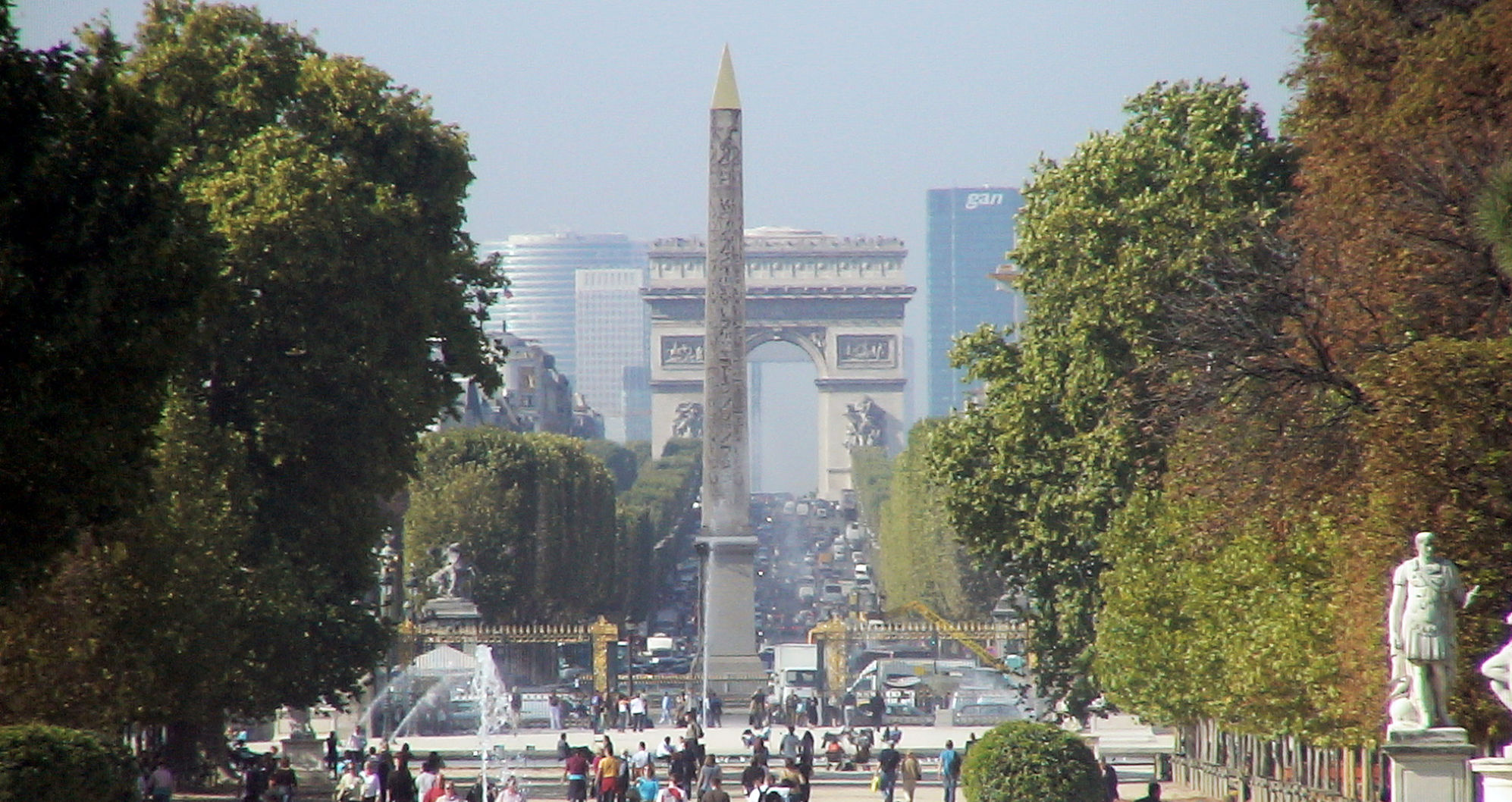
The Place de la Concorde occupies a prime location, as it punctuates two major axes:
Axe nord-sud
It is made up of Montmartre, the department stores on Boulevard Haussmann, the Church of the Madeleine, the Pont de la Concorde, and the National Assembly.
Axe ouest-est
It includes the Grande Arche de la Défense, the Arc de Triomphe, the Champs-Élysées avenue, the Tuileries Garden and the Louvre Museum.
The beginning, a painful story linked to the future Louis XVI
In the 18th century, it was nothing more than an esplanade surrounded by a moat and two large open sewers.
The architect Gabriel, as director of the Academy in his capacity as First Architect to the King, was tasked with designing a project drawing on the best ideas from the competitors’ proposals.
This final project was approved in 1755 and the statue of Louis XV was inaugurated on June 20, 1763.
On May 30, 1770, Place Louis XV (future Place de la Concorde) became the scene of a tragedy
As fireworks were set off in honor of the wedding of the Dauphin (the future Louis XVI) and Archduchess Marie-Antoinette of Austria, 133 people were trampled or asphyxiated. This was the result of a panic caused by a fire triggered by a rocket that had fallen to the ground.
It was not until 1772 that Place Louis XV was completed. An octagonal enclosure, fitted with a balustrade, bordered by 20-meter-wide moats and surrounded by sentry boxes, was set up to mark out this space. Only the northern part of the square was built, offering an unobstructed view of the Seine.
The Revolution, a dark memory
On July 11, 1789, the crowd looted the weapons from the Garde-Meuble (located in the northeastern building) to “go to the Bastille”—today the site of the Hôtel de la Marine.
On October 6, Louis XVI, Marie-Antoinette, and the dauphin (the future Louis XVII, who would never reign) were brought back from Versailles to Paris by the people. They made their entrance into the Palais des Tuileries (destroyed on May 23, 1871, by other revolutionaries: the Communards!) by crossing Place Louis XV.
The square was renamed “Place de la Révolution.”
The guillotine was temporarily installed there in October 1792.
On January 21, Louis XVI was executed here. After being dismantled, the guillotine was set up again on Place de la Concorde from May 11, 1793, to June 9, 1794.
Of the 2,498 people guillotined in Paris during the Revolution, 1,119 were executed on Place de la Révolution.
In addition to Louis XVI, Queen Marie-Antoinette was also executed here (October 16, 1793). Philippe d’Orléans (known as Philippe Égalité), who voted for the death of his cousin Louis XVI, was guillotined here. So too were Madame Du Barry (the last mistress of King Louis XV of France), as well as revolutionaries such as Charlotte Corday, Madame Roland, the Girondin deputies, Danton, Malesherbes, and the chemist Lavoisier.
The guillotine was later moved to Place du Trône-renversé (now Place de la Nation). It returned to Place de la Révolution for the execution of Maximilien Robespierre (10 Thermidor, Year II – July 28, 1794). A fitting end for the man who sent thousands to their deaths.
The 19th Century and Place de la Concorde
Louis XVIII (died in 1824) had planned to erect a monument at the center of the square in memory of his brother Louis XVI, who was guillotined.
The revolution of 1830 led to the abandonment of this project.
In 1831, the Viceroy of Egypt, Muhammad Ali, offered France the two obelisks that marked the entrance to the Luxor Temple in Thebes.
Only the first one was brought to France. It arrived in Paris on December 21, 1833, and was erected on October 25, 1836, in the location where it stands today.
The final design of Place de la Concorde
Between 1836 and 1846, architect Jacques-Ignace Hittorff transformed the square while preserving the original concept imagined by Gabriel.
He added two monumental fountains (bold in their use of cast iron in their construction) on either side of the Luxor Obelisk.
He framed the square with street lamps and rostral columns. These rostral columns feature ship prows, also evoking the emblem of the City of Paris.
Allegorical statues representing eight French cities also delineate the octagon imagined by Gabriel.
In 1854, the moats, preserved by Hittorff, were filled in to better adapt the square to traffic.
Architecture surrounding the Square
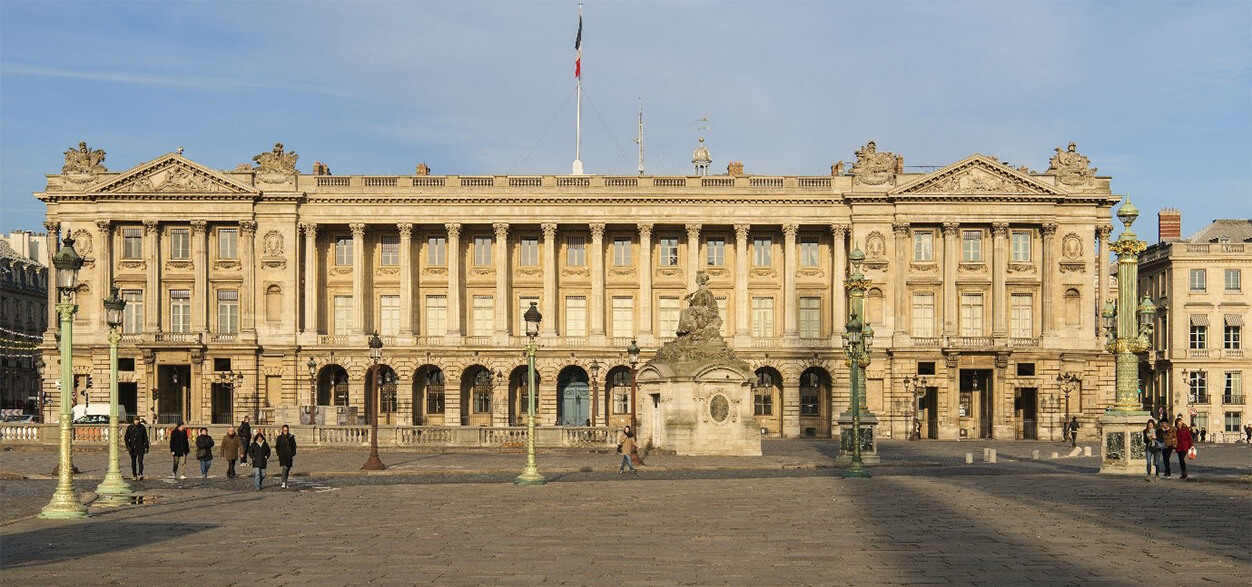
To the north (along Rue Royale), two vast identical stone buildings frame the vista. Separated by Rue Royale, these structures rank among the finest examples of 18th-century architecture.
Their façades were designed by Gabriel and erected between 1766 and 1775.
The building to the east of Rue Royale
Commonly known as Hôtel de la Marine, it was built according to Gabriel’s plans under the direction of Jacques-Germain Soufflot. The Hôtel de la Marine, located on the square, underwent a four-year restoration by the Centre des monuments nationaux. Since June 2021, it has been open to the public as the Musée de l’Hôtel de la Marine. This is a magnificent restoration of its original grandeur, with three themed tours available. To learn more about the hotel, click on Hôtel de la Marine.
To book a visit, click on “Musée Hôtel de la Marine.” See below: Places to visit nearby
The building to the west of Rue Royale
It was originally intended to house the “new Mint,” construction of which had been planned since 1768.
However, this location was deemed too far from the business district.
The land behind the western colonnade was then divided into four lots and sold to private owners.
One of these hotels, at the corner of rue Boissy-d’Anglas, was purchased in 1907 by the Société des Grands Magasins du Louvre. It was later transformed into the luxury hotel Hôtel de Crillon.
To the northeast, on rue Saint-Florentin, the Hôtel de Talleyrand (or Hôtel de Saint-Florentin) now houses the United States Embassy.
To the northwest of the square, on rue Boissy-d’Anglas, stood until 1775 the Dépôt des marbres de la Couronne, followed by the Hôtel Grimod de La Reynière. Similar to the Hôtel de Saint-Florentin, it was disfigured by successive additions.
It was demolished and replaced by a neoclassical pastiche built between 1931 and 1933 to accommodate the United States Embassy.
This building, which harmonizes perfectly with the Hôtel de Talleyrand, restored the symmetry of the northern side of the square as originally conceived by Gabriel.
Notably, the Hôtels de la Concorde retain the oldest street numbering in Paris. They were introduced in 1805, in accordance with the decree of February 4, 1805, by which Prefect Frochot established street numbers within Paris.
The statues of the square
The Chevaux de Marly by Guillaume Coustou, which once adorned the watering trough of the Château de Marly (about 30 km from Paris), were installed at the entrance to the Champs-Élysées in 1795.
At each corner of the octagonal square stands a statue representing a French city: Brest, Rouen, Lyon, Marseille, Bordeaux, Nantes, Lille and Strasbourg.
It is said that the model for the Strasbourg statue was Juliette Drouet, who was the lover of the sculptor James Pradier before becoming that of Victor Hugo.
The statue of Strasbourg was long draped in black crepe and flowers as a sign of mourning for Alsace-Lorraine, annexed by the German Empire in 1871. These two regions returned to France in 1919, after World War I.
The monumental fountains of Place de la Concorde
Between 1836 and 1846, Place de la Concorde underwent its final major transformation under the direction of architect Jacques-Ignace Hittorff.
The two fountains on the square, located on either side of the obelisk, are indeed the work of this architect: the Fountain of the Seas, to the south (facing the Seine), and the Fountain of the Rivers, to the north (facing Rue Royale).
At the time of their creation – and still today – the construction of these fountains was a true feat. We have dedicated a special article to them, which you can read by clicking on “Fontaines de la place de la Concorde, compagnes inséparables de l’Obélisque”.
To reach the base of the Obelisk at the center of Place de la Concorde, it is essential to use the pedestrian crossings!
To see near the Concorde and rue Royale
You can explore the surrounding area by following our self-guided walks from Place de la Concorde:
Self-guided walk from the Opéra Garnier to the Grands Magasins Lafayette and Place de la Concorde
Self-guided walk from the Arc de Triomphe to the Concorde via the Champs-Élysées
Stroll from the Louvre to the Place de la Concorde via the Tuileries and Vendôme
But you can also see or visit (and book online when available) the following Points of Interest:
Cruise departures are also available nearby:
Batobus Shuttle - River Taxi(Stop: Place de la Concorde) - Book Batobus River Taxi tickets (9 stops) (Hop-on Hop-off - 1 or 2-day pass - Easy way to travel between museums)
Seine River Cruise with Bateaux-Mouches - Pont de l'Alma - Book Seine River Cruise – Departure Pont de l’Alma 75008 – Port de la Conférence – Bateaux-Mouches
Canal Saint-Martin Cruise from Musée d'Orsay - Book Seine & Canal Saint-Martin Cruise – Port Solferino – Musée d'ORSAY – Parc de la Villette
Paris Sightseeing Cruises - Paris Booking: Seine Dinner Cruise with Panoramic Views and Champagne (Port Solférino – approx. Musée d’Orsay)
Bonus: 5 Essential Tips to Help You Plan and Enjoy Your Stay in Paris
Have you noticed that our website provides you with tools to help you easily organize your trip to Paris so that your stay is a stress-free success?
1. Phrasebook Translator for Those Who Don’t Speak French Fluently
Having trouble finding the right word or phrase in French? Click here on PHRASEBOOK – or at the top right of your screen. It’s a glossary of 100 useful words and/or expressions for a tourist visiting Paris (at the restaurant, hotel, shopping, metro, greetings, asking for directions, etc.). Eight languages are available. And guess what? Each word and phrase can also be heard in French.
2. VPBY’s Stay Generator
There are many interesting and educational things to see in Paris. A well-organized stay is highly recommended. To help you, we offer you FREE OF CHARGE our Stay Generator.
In just 5 minutes and 5 clicks, you’ll get your half-day by half-day itinerary, with all reservations—if you want, no obligation—for the sites you’d like to visit. You can also book your transport (plane, train, or car) and your accommodation. Even suggestions for valuable souvenirs for yourself, your friends, and your family.
How does it work?
Click on "Paris Trip Organizer"—completely free—which will save you the hassle of trying to see as much as possible in the shortest time. Then you’ll need to make your choices:
1/ Select your "general interests" by clicking on the list (Museums, Churches, Monuments, Parks, etc.);
2/ The VPBY Stay Generator then suggests all relevant listings;
3/ You select by clicking on the names of the museums, monuments, parks, or activities you wish to include;
4/ The organizer returns a day-by-day itinerary for your stay;
5/ with geographically optimized daily visits—if you so choose—to avoid tiring and tedious travel.
It takes just 5 clicks and 3 minutes. And it’s completely free. To use it, click on "Paris Stay Organizer"
Note: Want to see what users of the VPBY Stay Generator think of their experience? Click on "They planned their trip with VPBY"
3. List of Reservations to Make
To avoid wasting time waiting in line, we recommend making your reservations online a few days in advance. All official reservations are useful and available on our website:
Reservations to enter museums, monuments, shows, and Seine cruises
Reservations for your arrival in France: planes, trains, cars
Reservations for your accommodation: hotels, apartments, guesthouses – in Paris or the immediate vicinity
You will find links to all these reservations available directly in the articles about the attractions that interest you or in the self-guided routes of our walks. By clicking on "Reservations" in the header bar, you will have access to all the reservations you will need during your stay. For example:
Notre-Dame de Paris entry reservation (Free entry but reservation recommended to avoid the queue)
Versailles Castle: Entry Ticket + Gardens Access + Trianon Estate
4. Collectible Paris Keepsake Photos
These are collectible HD photos available in digital format or as long-lasting prints (75 to 100 years). Their size ranges from postcard to large format (up to 1 meter or more). A lifelong keepsake to decorate your home. A high-quality souvenir (unlike the typical snow globe or plastic Eiffel Tower). At a very affordable price. Click on:
5. Bring back a personalized photo report of your stay in Paris
Reportage by professional photographers in Paris at the locations of your choice or suggested by us. A "family" reportage, wedding, other events. From 1 hour to a full day. The best quality/price ratio. Click on: