Paris, the City of Light. But also a bloody city during the French Revolution. Between 1792 and 1795, the guillotine severed thousands of heads. The Terror reigned. From crowned heads to ordinary citizens, no one was spared. Here, we explore the famous guillotined figures of the Revolution in Paris.
The death penalty before the guillotine
Under the Ancien Régime, the method of execution depended on the condemned person’s social rank. Nobles were beheaded by sword or axe (a death considered “noble” and swift), while commoners were hanged, broken on the wheel, or burned. These were long and agonizing ordeals, varying according to the executioner’s skill—which was far from uniform from one city to the next (each major town had its own executioner).
The invention of the guillotine: a follow-up to Dr. Guillotin’s humanitarian idea
This humanitarian idea, framed by the principle of equality among men, was transformed under the Terror into a veritable factory of political assassination. Nearly 3,000 people were guillotined in Paris during this period. The courts condemned from morning to night without respite (and even at night—the trial of Marie-Antoinette did not end until 4 a.m.). The sentences were often flimsy, based on "testimonies" that were falsified or bought.
A dark chapter for France. Shame on those who took part in this bestial frenzy or on their modern-day admirers.
The most famous executioner in French history: Charles-Henri Sanson
Charles-Henri Sanson
He is the most famous executioner in French history. Chief executioner of criminal sentences in Paris from 1778 to 1795, and dying in Paris in 1806, he witnessed and played a central role in the executions and the transition from the tortures of the Ancien Régime to the advent of the guillotine.
During the French Revolution, he executed nearly 3,000 people, shifting from the role of the King’s executioner to that of the Republic’s.
The man who executed the King and the Queen
Although he had been a loyal subject of King Louis XVI, the upheavals of the Revolution forced Sanson to obey the orders of the new republican government. He himself even "narrowly escaped" the death penalty, accused by some extremist deputies of being a traitor.
Due to his role, he had to execute Louis XVI and Marie-Antoinette. But also Danton and several other revolutionaries he personally knew.
Exhausted physically and mentally, he resigned from his position in 1795 and retired to his "country" home in Brie-Comte-Robert (Seine-et-Marne - 77710).
Key execution sites in Paris during the Revolution
Execution sites: several in Paris
Paris became the stage for executions during the Revolution. The guillotine, symbol of the Terror, was set up in several iconic locations. These places mark the history of the city and its victims. In total, 2,498 people were guillotined in Paris (recorded) during the Revolution!
The Place de la Révolution (now Place de la Concorde) is the most famous. The exact location of the guillotine on Place de la Concorde was to the west of the square, at the entrance to what is now the Champs-Élysées. It was here that Louis XVI and Marie-Antoinette lost their heads. The crowd gathered to watch the executions—a macabre spectacle that both fascinated and terrified. A total of 1,120 people were guillotined here in just 13 months.
Place du Trône-Renversé (now Place de la Nation) also hosted the guillotine. It became a site of mass slaughter during the Great Terror, with hundreds of condemned prisoners executed in just a few weeks—1,306 victims in 43 days.
Place de la Bastille: 73 executions in four days in 1794.
The Place de Grève (now Place de l’Hôtel-de-Ville) is another historic site. Before the Revolution, it was already used for public executions. During the Revolution, the Place de Grève primarily served for common-law criminals (while political opponents were sent to Place de la Révolution / Place de la Concorde). The guillotine made a few appearances there before being moved.
The execution sites: a macabre spectacle
Imagine Place de la Concorde—then Place de la Révolution. A silent crowd. The sharp crack of the blade falling. Then the screams. Public executions became a macabre spectacle. A symbol of revolutionary violence.
Today, these places are peaceful. Yet they still evoke a dark period in history. A visit to Paris would not be complete without understanding their past.
The famous guillotined of the 1789 Revolution
Louis XVI and Marie-Antoinette: the most emblematic guillotined of the Revolution
On January 21, 1793, Louis XVI ascends the scaffold in Place de la Révolution. He is 38 years old. His crime? Betraying the nation, apparently. The crowd roars its anger. The king, calm, attempts a final address. Too late. The blade falls at 10:22 AM. It is Sanson who orchestrates Louis XVI’s execution in Place de la Révolution. He is the most famous of the famous guillotined figures of the Revolution.
Faced with rumors claiming the king had resisted or that the executioner had shown disrespect to the sovereign, Sanson would write a memorable letter to the press to set the record straight, praising the king’s courage and composure in the face of death.
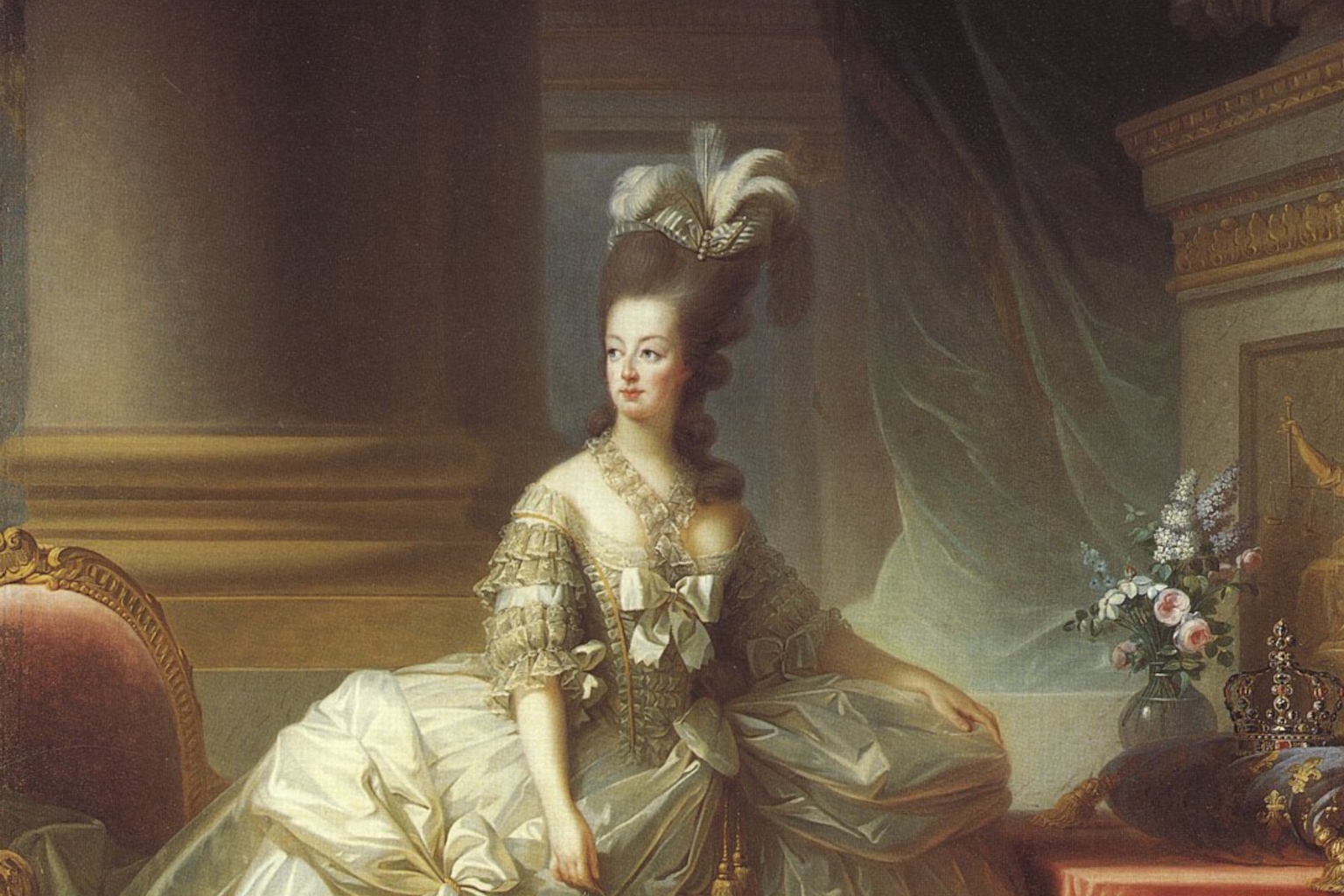
Marie Antoinette follows her husband to the scaffold on October 16, 1793. She is 37 years old. Her trial is swift. Accused of treason and depravity, she embodies the hatred toward the Old Regime. She is sentenced at 4 AM and guillotined the same day at 12:15 PM. Her last words are to the executioner, as she accidentally steps on his foot: “Sir, I beg your pardon, I did not mean to do it.” Her execution marks the end of an era. The monarchy collapses amid cries of “Long live the Republic!” She remains one of the famous guillotined figures of the Revolution.
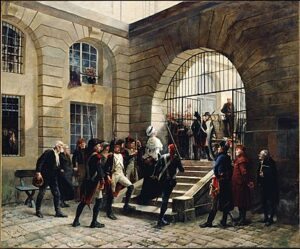
It should also be noted that Louis XVI was granted a carriage to be taken to Place de la Concorde for his execution. Marie-Antoinette did not receive the same preferential treatment. She traveled the distance between her prison at the Conciergerie and the Concorde in an open cart, like any common condemned criminal. Accompanied by a priest appointed by the Revolutionaries, to whom she refused to confess. This 4 km journey through a hostile crowd, which began at 10 a.m., lasted over two hours.
Their deaths sealed the definitive break with the past. The Revolution entered a more radical phase. The Terror began.
Note
In response to rumors claiming that the king had resisted or that the executioner had shown disrespect to the sovereign, the executioner Sanson wrote a memorable letter to the press to set the record straight, praising the king’s courage and composure in the face of death.
Today, Place de la Concorde (formerly Place de la Révolution) stands as a reminder of their fate. To explore other historically rich locations, discover our Marais to Bastille stroll. Or dive into the history of the Crown Jewels, symbols of a vanished power.
Olympe de Gouges: the feminist guillotined for her avant-garde ideas – 3 November 1793 – 45 years old
Olympe de Gouges was a pioneer of feminism. Born in 1748, she defied the norms of her time. She died at the age of 45. Her most famous work remains the Declaration of the Rights of Woman and of the Female Citizen in 1791, a revolutionary text advocating for gender equality.
She dared to criticize Robespierre and the Terror. Her ideas were unsettling. She was arrested in 1793 for "sedition." Her trial was swift. The guillotine awaited her on 3 November 1793 at Place de la Révolution, now Place de la Concorde.
Her execution marked a dark turning point. The Revolution devoured its own children. Yet her legacy endures. Today, a commemorative plaque honors her memory near the Bourse de Commerce-Pinault, a place to discover as a family. Visit this iconic site to learn more.
Olympe de Gouges remains a symbol. A woman who paid for her fight for justice with her life. Her courage still inspires struggles for equality. Paris preserves traces of her passage, between history and memory.
Charlotte Corday: Marat’s assassin – 7 July 1793: 24 years old
Charlotte, the young woman from Normandy who assassinated the revolutionary Marat in his bathtub on 13 July 1793.
As she was led to the guillotine, she stared at it with wide eyes: “I have every right to be curious, I’ve never seen one before!”
Philippe-Égalité – Executed on 6 November 1793 – 46 years old
Descendant of Louis XIV and father of the future Louis-Philippe I, he is credited with the galleries of the Palais-Royal and a few extravagant whims. See also the Domaine National du Palais Royal.
His real name was Philippe d'Orléans, cousin of Louis XVI (who disliked him for his frivolity and irresponsibility) and leader of the Orléans branch of the royal family. Elected to the Estates-General in 1789, he changed his name to Philippe-Égalité to "align" with the revolutionary movement. He voted for the death of Louis XVI, even though he could have abstained without risk to his life. And without his vote, other deputies might also have shirked their duty(1). Perhaps Louis XVI would not have been guillotined.
On January 21, 1793, the day of Louis XVI’s execution, Philippe-Égalité did not "officially" attend the decapitation. However, historians have written that he was hiding in a carriage parked on the Pont de la Concorde, watching his cousin’s death from afar.
On April 4, 1793, his eldest son the Duke of Chartres (the future Louis-Philippe Ist), who was then lieutenant-general in the Army of the North, defected to the Austrian enemy alongside his commander, General Dumouriez, who had attempted a failed coup. Philippe-Égalité then became suspect in the eyes of the Montagnards.
All members of the Orléans family were arrested on April 7, 1793. The measure concerned the Duke of Orléans, his two other sons, the Duke of Montpensier and Louis-Charles d’Orléans, Count of Beaujolais, and his sister Louise-Bathilde (who had chosen the name Citoyenne Vérité).
He was tried by the Revolutionary Tribunal, presided over by Herman, on November 6, 1793. There was no evidence against him, but during this period, mere suspicion was enough. Note that Herman would himself later die on the scaffold on
Irony of fate, despite the plea by Voidel, he is sentenced to death and guillotined the same day, November 6, 1793. His unfortunate companions include Pierre Coustard de Massi, a Girondin representative from Loire-Inférieure in the Convention and leader of the National Guard of Nantes, along with three unknowns. This occurred 11 months after Louis XVI and 20 days after Marie-Antoinette.
To the assistant executioner trying to remove his boots, he whispered: “Leave them! You’ll do it more easily after my death.”
Before slipping into the executioner’s grasp, he urged: “Hurry, then.”
(1) The unconditional death sentence for Louis XVI was passed by 361 votes to 360 (favoring other penalties or reprieves) in the first vote. A majority of just one vote out of 721 deputies present at the National Convention.
Madame Roland – Executed on 8 November 1793 – 39 years old
The radiant muse of the Girondins is said to have cried out on the scaffold, turning toward the statue of Liberty that adorned the square at the time: “O Liberty, what crimes are committed in your name!”
Madame du Barry - Executed on December 8, 1793 – 50 years old
She was the last mistress of Louis XV (grandfather of Louis XVI), born Jeanne Bécu de Cantigny.
She was dragged to the scaffold. She wept, begged, wailed, prayed, thrashed about like a wild horse in harness.
Her final words were terrible: “Just one more moment, Mr. Executioner!”
Duke of Lauzun - Executed on December 31, 1793 – 46 years old
Armand-Louis de Gontaut Biron, Duke of Lauzun (unrelated to Lauzun of Louis XIV, though from the same family), whose rumors claimed he was the lover of Marie Antoinette...
When the guard came to fetch him for the guillotine, Lauzun took his time to finish a dozen oysters washed down with a glass of white wine, all calm and collected, even toasting his jailers (Histoire des Girondins, Lamartine, 1870)!
Georges Danton: the revolutionary tribune, victim of his own excesses – Executed on April 5, 1794 – Age 34
Georges Danton embodies the raw energy of the Revolution. A charismatic lawyer, he electrifies the crowds. His eloquence ignites the Jacobin clubs. He becomes Minister of Justice in 1792.
Danton drives the fall of the monarchy. He organizes Paris’s defense against the Prussians. His cry, *"De l’audace, encore de l’audace, toujours de l’audace!"* (Audacity, more audacity, always audacity!) echoes through history. Yet his taste for luxury and excess seals his fate.
Robespierre judges him too moderate. Danton advocates clemency toward the Revolution’s enemies. His adversaries accuse him of corruption. Arrested in March 1794, he is guillotined at the place de la Révolution, now place de la Concorde.
His trial is swift. Danton tells his judges: "You will show my head to the people. It is worth seeing." His death marks a turning point. The Terror intensifies. Robespierre, his former ally, soon follows him to the guillotine.
Camille Desmoulins and Lucile Duplessis: idealism betrayed by the Revolution – April 5, 1794 for Camille and April 13 for Lucile Desmoulins – Ages 34 and 24
Camille Desmoulins was one of the first to shout “To arms!” on July 12, 1789. This fiery young lawyer embodied the hope of a liberating Revolution. His newspaper, Le Vieux Cordelier, championed clemency against the excesses of the Terror.
His wife, Lucile Duplessis, shared his ideals. She wrote letters brimming with love and rebellion. Their marriage, celebrated in 1790, symbolized the union of revolutionary hearts and minds. Yet their dream was shattered beneath Robespierre’s blade.
Accused of moderation, Camille was arrested in March 1794. Desperate, Lucile tried to save him. She was arrested in turn for “conspiracy against the Republic.” Both were guillotined on April 5 and 13, 1794, in the place de la Révolution (now place de la Concorde). On April 13, 1794, as Lucile stood on the guillotine at the Concorde, her soul finally rejoined the love of her life.
Their story reminds us that the Revolution devoured its own children. To explore other historic sites, discover our Marais walking tour, where their memory still lingers.
Today, their symbolic grave lies in the Père-Lachaise cemetery. A tribute to an idealism tragically cut short.
Malesherbes – Executed on April 22, 1794 – 72 years old
Malesherbes lost his head for defending Louis XVI at his trial.
On the day of his execution, as he left prison to be taken to the scaffold, his foot struck a cobblestone and threw him off balance.
He groaned: “Oh, what a bad omen. In my place, a Roman would have gone home.”
His son-in-law, his daughter, his granddaughter and her husband, as well as his elder sister, would be guillotined a few days after him.
Charles-Henri d’Estaing – 28 April 1794 – 64 years old
Vice-admiral during the American War of Independence, he lived in his ancestral château of Ravel.
His last words? “When you have cut off my head, send it to the English—they will pay dearly for it.”
Antoine Lavoisier: the father of modern chemistry sacrificed in the name of raison d’état – 8 May 1794 –
Antoine Lavoisier revolutionized science. He discovered oxygen and founded modern chemistry. Yet the French Revolution condemned him to death. His crime? Having been a tax farmer under the Old Regime.
Arrested in 1793, Lavoisier was summarily tried. The revolutionary tribunal declared him an "enemy of the people." His scientific work changed nothing. On May 8, 1794, he mounted the scaffold at the Place de la Révolution (now Place de la Concorde).
His execution shocked Europe. The mathematician Lagrange declared: "It took them but an instant to cut off his head. A hundred years will not suffice to produce another like it." Today, his name remains etched in the history of science and in that of France.
Madame Élisabeth - Executed May 10, 1794 – 30 years old
She was the sister of Louis XVI, imprisoned with him in the Temple prison.
On the scaffold, her fichu slipped from her frail shoulders. She fixed her gaze on the executioner’s and said: “In the name of your mother, cover me, sir!”
Maximilien de Robespierre: the architect of the Terror guillotined by his peers - Executed on July 28, 1794 - 34 years old
Maximilien de Robespierre embodies the French Revolution. This lawyer from Arras becomes the face of the Terror. He sends thousands of people to the guillotine. Ultimately, his reign ends brutally in 1794.
Nicknamed "the Incorruptible," Robespierre dominates the Committee of Public Safety. He imposes repressive laws to "save the Revolution." The Law of Suspects allows arrests without evidence. Executions multiply at the place de la Révolution, now place de la Concorde.
His allies eventually turn against him. On July 27, 1794 (9 Thermidor), the Convention declares him an outlaw. Arrested, he attempts suicide. The bullet shatters his jaw without killing him.
The next day, Robespierre mounts the scaffold. The crowd cheers his downfall. His body is buried in the mass graves of the cimetière des Errancis, near the current Parc Monceau. Irony of history: he dies with his head severed, like his victims.
The end of public executions in Paris: from the Terror to the abolition of capital punishment
The Terror came to an end in August 1794 with the execution of Robespierre. Public executions dropped sharply after his fall.
The guillotine, however, remained in place. It continued to claim lives, though less frequently and more often for political reasons.
In 1832, executions left the historic Place de Grève. They moved south of Paris (Barrière Saint-Jacques, near Denfert-Rochereau). The death penalty became less visible, but no less real.
At the same time, the law of 28 April 1832 introduced the concept of extenuating circumstances into the Penal Code. This allowed juries to more easily avoid imposing the death penalty, thereby reducing the number of executions.
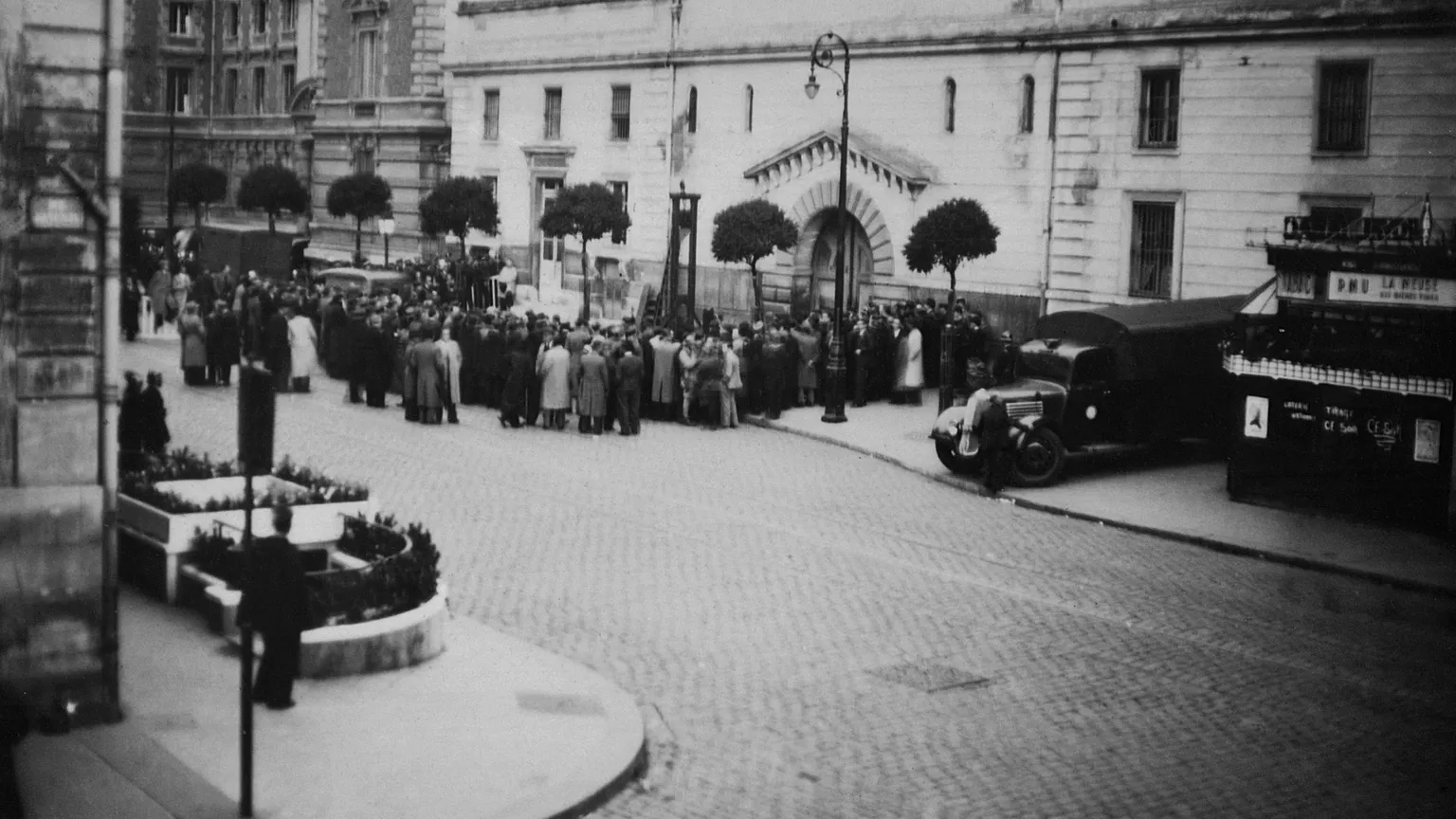
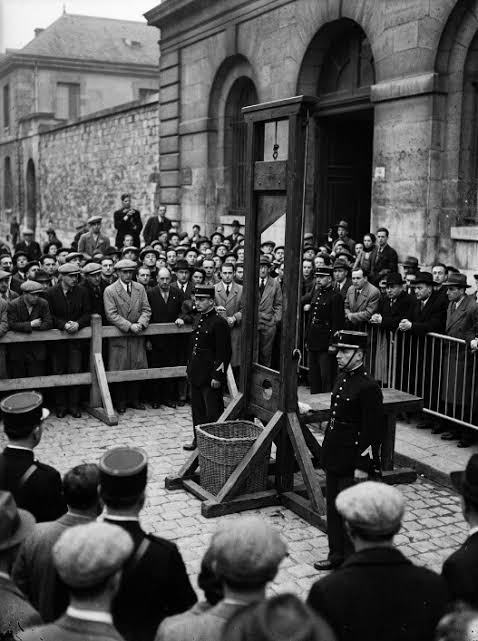
The guillotine vanished from the streets for good in 1939. The last public execution took place on 17 June 1939 in Versailles, with the beheading of Eugène Weidmann outside Saint-Pierre prison. The chaotic spectacle and the crowd’s outbursts that day prompted the government to act. The killing machine was confined to the prison grounds.
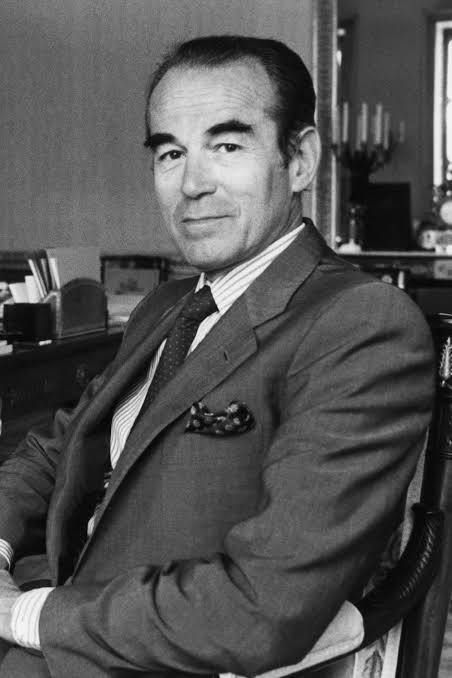
The end of the death penalty: The last execution in France (in prison) took place on September 10, 1977, before the total abolition of the death penalty on October 9, 1981, championed by Robert Badinter.
Today, execution sites are historical landmarks. They evoke a past where justice was meted out amid the shouts of the crowd. For a family visit, check out these 60 unique places in Paris.
To explore other iconic sites of the Revolution, follow our self-guided walks. Discover where history was written in blood.
Why do these names still resonate today? Robespierre, Louis XVI, Danton… Their stories are intertwined with the history of Paris. Their tragic fates mark the iconic places of the capital. A stroll through the Marais or toward the Bastille will immerse you in this troubled era.
To explore other historically rich locations, discover our Marais to Bastille walking tour. Or immerse yourself in 19th-century Paris with our covered passages of Paris.