Hôtel de Ville de Paris, a history of uprisings, born from the fire of 1871
Theodore Ballu
Édouard Deperthes
Hôtel de Ville, Place de l’Hôtel-de-Ville
(tel. 01 42 76 43 43, visits by appointment at 01 42 76 50 49)
The Parisian municipality was born from the corporation of water merchants. Granted a monopoly on river transport by the king in 1170, they gained considerable power, as trade was then conducted mainly by waterway. In 1246, Saint Louis established the first municipality: the Parisian bourgeoisie elected aldermen to represent them before the king. Their leader bore the title of “prevôt des marchands” (provost of the merchants), and the seal of the corporation of water merchants—the most powerful—was adopted: it was the famous ship that “floats and does not sink” (“Fluctuat nec mergitur”), still featured today on the coat of arms of the City of Paris. For a century, meetings were held around the Abbey of Sainte-Geneviève, on the Left Bank. In 1357, Étienne Marcel, provost of the merchants, purchased a house overlooking the small Place de Grève. The “Maison aux piliers” (House of Pillars) was a Gothic building adorned with arcades on the ground floor, hence its name.
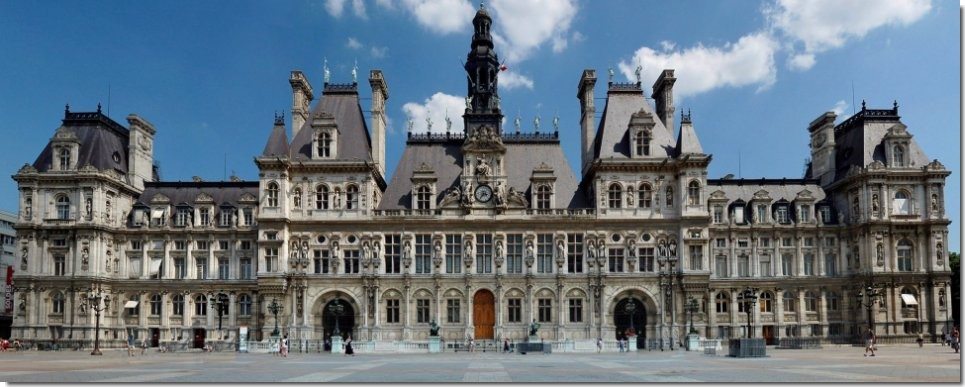
Rebuilt in the 16th and then 17th centuries, it was extensively renovated, enlarged, and decorated (with paintings by Ingres and Delacroix) in the 19th century under the reign of Louis-Philippe, before being entirely destroyed during the Commune in 1871. A national subscription enabled its reconstruction in 1882, in its original style (by Théodore Ballu and Édouard Deperthes). Numerous niches and columns house 108 statues of celebrities born in Paris. Above the building’s cornice stand the statues of 30 French cities—excluding Strasbourg and Metz. The "clock pediment" adorning the center of the main façade depicts several female allegories: the Seine and the Marne flanked by Labour and Education, topped by the figure of the City of Paris. The interior, adorned with gold leaf, woodwork, and Baccarat chandeliers, reflects the grandeur of the Third Republic. The Council of Paris, which usually meets on Mondays, is open to the public. The mayor of Paris’s office is located on the Quai de l’Hôtel-de-Ville.
https://en.wikipedia.org/wiki/H%C3%B4tel_de_ville_de_Paris