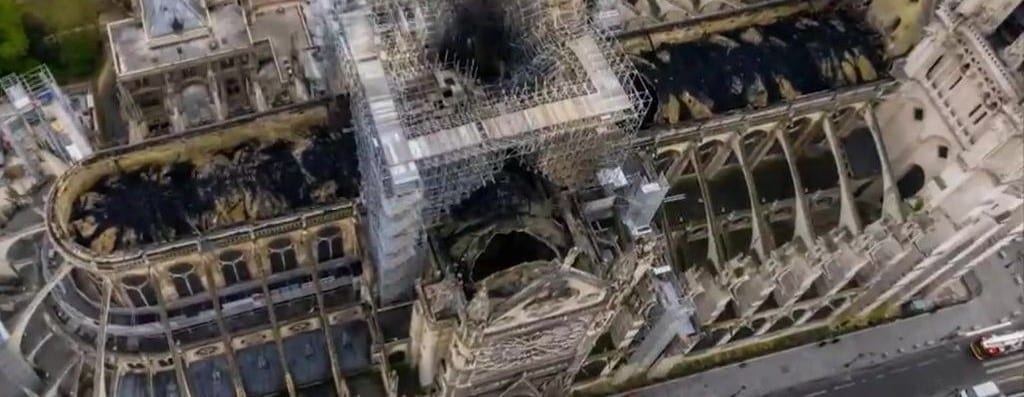
Notre-Dame reconstruction, after it has been made safe between 2019 and 2021, has been a huge undertaking, most of it over 50 m above ground, with the spire reaching a height of 96 m. It was also a time of prowess in the art of restoring works of art damaged in the fire. Last but not least, it was a meticulous and intelligent organization of a worksite, with over 500 journeymen working at the same time in tight spaces, and suppliers spread all over France.
More detailed information is available on our website:
- Notre Dame in fire – What happened ? Which consequences ?
- Securisation of Notre Dame after the fire of 2019
- Notre-Dame interior rehabilitation, a delicate, giant and unique renovation
- Notre-Dame Reopening on December 8th, 2024 – An awaited moment
- 15 of the best hotels near Notre-Dame-de-Paris
The problem of buttresses in the Notre-Dame reconstruction
In large Gothic churches, buttresses serve to counterbalance the horizontal thrust exerted by the vault and roof structure on the walls, by creating an equivalent but opposite thrust.

Notre-Dame’s flying buttresses are the largest ever built in the Middle Ages. They give the cathedral a particular momentum. But since the loss of the roofs, they have been weighing heavily on the side walls.
Engineers decided to relieve the flying buttresses of their own weight by placing heavy wooden framework structures underneath them. These will remain in place until the cathedral’s vaults and great roof are rebuilt.
Giant structures designed to the nearest millimetre
Surveyors carried out 3D measurements of each of the 28 arches, all of which are different. Thanks to these measurements, the design offices can then design each arch individually, so that it fits not only the arch for which it is intended, but also the support points available in its future location. It’s precision work!
These gigantic larch-wood structures, each weighing over 8 tonnes, are manufactured in Lorraine. Pre-assembled, the hanger is brought to the Notre-Dame site in two parts.
Spectacular installations
The installation of each arch support is a new challenge. Assembled definitively on the ground, it is attached to a spreader bar, designed to lift it while keeping it vertical. Indeed, it must be lifted perfectly straight and deposited smoothly in its place. There is only a 6-meter gap between each bow, so there’s no room for hesitation or improvisation when lifting!

Once the arch has been erected on the concrete footings poured on the cathedral’s terraces to keep it upright and distribute the weight it will have to bear, rope accessory workers attached to the flying buttress place couchis (long wooden wedges) between it and the flying buttress. The latter is now supported and no longer in danger of collapsing the vaults.
From July 2, 2019 to February 28, 2020, 28 hangers will be installed under the buttresses of Notre-Dame de Paris.
Restoration of choir walls and vaults
In 2021, with the structural consolidation phase complete, restoration work began on the vaults and damaged sections. It was then decided to rebuild the cathedral as it was before the fire:
- Reconstruction of the vaults :
The restoration team began repairing, and in some cases rebuilding, the vaults affected by the fire. A total of 1,300 m3 of stone had to be found to rebuild collapsed vaults, replace stones weakened by the heat of the fire in the coffered walls, and completely re-sculpt some of the statues in the gables and the window infills.
- Restoration of sculptures and ornaments:
Numerous stone elements and sculptures, damaged by the intense heat, were cleaned and restored.
The search for compatible stones in Notre-Dame reconstruction
Since the cathedral was built, its stones have frequently been replaced, respecting as far as possible the properties of the original stones, limestone from the “bancs francs parisiens” but from quarries further and further from the capital.
A total of 1,300 m3 of stone had to be found to rebuild the collapsed vaults, replace stones weakened by the heat of the fire in the coffered walls, and completely re-sculpt some of the statues in the gables and the window infills.
The stone supply was the subject of two studies. Firstly, the Laboratoire de Recherche des Monuments Historiques (LRMH) analyzed the stones removed from the cathedral and those still in place, in order to define their characteristics.
Search for compatible stone quarries
The Bureau des recherches géologiques et minières (BRGM – geological and mining research bureau), commissioned by the public institution, then identified quarries likely to supply stones that were aesthetically and physicochemically compatible with the original stones. This research program demonstrated that certain quarries in the Lutetian geological basin, the historical source of the cathedral’s stone supply, were capable of supplying all the stones required for the restoration work.

The La Croix-Huyart quarry in Bonneuil-en-Valois, Oise, proved to be the only one able to supply the type of hard stone needed to rebuild the arches of the collapsed vaults and restore the wall-baults. Contrary to usual practice, the public institution chose to purchase the stones itself, in order to secure their supply.
Eight other quarries, located in the Saint-Maximin (Oise) and Soissons (Aisne) areas, will supply the softer stones for rebuilding the vaults of collapsed or damaged vaults, and for interior stone restoration work.
Stone extraction
A quarry, whether underground or open-cast, is a stack of mineral layers known as “benches”. To extract the stone you’re looking for, you first have to clear the bed in which it’s located by excavating the layers above.

Then the quarryman comes head-on with a cutter, a kind of large chainsaw mounted on a mechanical arm measuring nearly 3.5 meters, to cut the block, then he divides it perpendicularly to the natural fissures with a hydraulic shovel, finally separating the two qualities, hard and semi-hard, before sending the whole to the factory where the blocks are “washed”, i.e. cut to small thicknesses in order to identify potential cracks that may not have been visible before.
Quality control and quarry preparation in the Notre-Dame reconstruction
As Notre-Dame demands the highest quality, BRGM, at the request of the public establishment, carries out quality controls throughout the extraction of the stones from the La Croix-Huyart quarry and the first phase of stone processing in the factory.
Blocks cut on 6 faces are then brought to the workshop, or, for those intended to replace figurative elements such as keystones or statues, to the sculpture loge installed on the cathedral forecourt. They have already begun to be sculpted there.
Notre-Dame reconstruction : vault consolidation
After the fire, some vaults were in danger of collapsing due to cracks caused by the intense heat. Consolidation work was carried out with great care to avoid further damage to the original structure:
- Installation of wooden hangers:
Temporary hangers were placed under certain parts of the vaults to support their weight, ensuring the safety of workers working underneath and stabilizing fragile areas.
- Mortar injection:
A special mortar was injected into the cracks to strengthen the stones and solidify the whole. This mortar, developed especially for this project, was designed to be compatible with the medieval materials originally used.
- Use of glass-fibre reinforcements:
Glass-fibre reinforcements were added in certain sections for discreet, lightweight consolidation.
Restoration of choir stones
The choir, partially affected by the fire, required thorough cleaning and, in some cases, replacement of damaged stones
- Stone selection and cutting
Experienced stonemasons reconstructed the damaged stones using materials from French quarries, selected to perfectly match the medieval stone
- Repair technique
Eroded or partially burnt stones were repaired using a repair technique, where a layer of restoration mortar was applied to fill in the gaps.
- Complex lifting and access methods:
- Special scaffolding, designed to fit the cathedral’s specific dimensions, was installed to enable craftsmen to access the most difficult areas without risk to the surrounding structure.
- Drones and 3D scanners were used to map and analyze inaccessible areas and prepare the restoration stages in complete safety.
Reintegration of sculptural elements in the choir and vaults
Damaged sculptures, ornaments and other elements of the choir and vaults were restored or recreated using traditional techniques.
- Cleaning and restoration of sculptures: Stone sculptures that had been covered in soot and ashes were cleaned with soft brushes and micro-abrasion techniques to prevent further damage.
- Reconstruction of architectural details: For sculptures and motifs that had been completely destroyed, restorers used 3D models and old photographs to recreate lost ornamentation.
Installation of structural monitoring sensors
Sensors were installed in the vaults and choir to monitor structural stability at all times. These sensors detect the slightest movement or vibration, ensuring continuous monitoring of the structure as work progresses.
End of vault and choir consolidation
In 2022, the consolidation of the vaults and choir was completed, marking a crucial stage before the reconstruction of the framework and spire. Conservation experts were thus able to guarantee that the most fragile parts of the building would be ready for the other phases of the project.
Notre-Dame reconstruction of the spire (2022 – 2023)
The reconstruction of Notre-Dame’s roof structure and spire, an emblematic stage in the cathedral’s restoration, was carried out between 2022 and 2023. Meticulous attention was paid to materials, traditional techniques and faithfulness to the original plans. This phase brought together craftsmen and engineers, combining ancient know-how and modern technologies to restore the cathedral’s unique silhouette, as it had been conceived in the 19ᵉ century by architect Eugène Viollet-le-Duc.
- Timberwork:
Oak trees from all over France were selected to faithfully recreate the framework, nicknamed “the forest” because of its complexity and size.
- Spire:
Reconstruction of the spire, the cathedral’s landmark and highest point, began in 2022, with precision faithful to Viollet-le-Duc’s original plans.
Selecting materials and oaks for the frameworks
Notre-Dame’s framework, nicknamed “the forest” because of the density and quantity of wood required, was almost entirely destroyed in the fire. The first step in the reconstruction was the selection of materials:
- Oak selection
Over 1,000 hundred-year-old oaks were selected from all over France. The quality, size and straightness of the trees were essential to recreate the massive beams of the original structure.

- Felling and drying the wood
The trees were felled in early 2021, then left to dry for several months to ensure their structural stability. This natural drying process was essential to ensure that the beams would not warp over time.
Manufacture of framework elements
The highly complex framework required meticulous assembly using medieval techniques:
- Using traditional carpentry techniques:
Craftsmen worked the old-fashioned way, using hand tools to shape each piece according to medieval methods. This included sawing, shaping and mortise-and-tenon assembly without metal nails, respecting the historic authenticity of the structure.

- Blank assembly:
Before being transported and assembled on the cathedral site, the frame parts were pre-assembled “blank” in workshops. This method ensured that each part fitted perfectly, minimizing the need for adjustments once on site.
Notre-Dame reconstruction : the spire
The spire, an emblematic part of the cathedral, was rebuilt according to Viollet-le-Duc’s original plans, but with improvements for safety and durability:
Preventive ground excavations:
Following preventive excavations carried out at the transept crossing by the Institut national de recherches et d’archéologie préventives (Inrap), scaffolding will be erected in autumn 2022 directly above the future spire. At a height of 26 m, carpenters erected four wooden half-arches to rebuild the arches of the vault.
Oak structure and lead coating:
The spire was rebuilt in oak, like the original, with a lead coating to restore its traditional appearance while protecting it from the elements.
Once the basic scaffolding had been erected, it was raised again as the spire’s framework was built, until it reached a height of around 100 metres. To do this, the carpenters identify, calculate and implement assemblies adapted to the structure of the spire, taking into account the timber collected.
Workshop work

Carpentry is carried out in the workshop, based on calculation notes supplied by the engineers. Carpenters draw up plans for the structural components. They start with a blueprint drawn on the ground to scale 1. This drawing stage is a very old skill, which was listed as part of humanity’s intangible cultural heritage in 2009, under the title “tradition du tracé dans la charpente française”. At the same time, the oak logs are trimmed to adapt their dimensions to the framing pieces. This stage is called lignage.
The framing pieces are then presented on the outline and oriented in their final position to determine the assembly cuts. This stage is crucial, as it determines the final position of each part in the overall structure.
A blank assembly is then carried out in the workshop to ensure that sizes have been correctly made and interlocking is compatible. This anticipates any problems that may arise during final assembly on the cathedral’s heights.
The base of the spire: the stool
The first structural elements that will make up the spire’s stool, i.e. its base resting on the walls at the corners of the crossing, was delivered to Notre-Dame in the spring of 2023.
Transporting and assembling the spire required a high degree of precision
- Precision lifting:
The prefabricated elements of the framework were lifted by special cranes, enabling them to be positioned precisely and safely. Drones and 3D scanners were also used to check the fit of the beams.
- Spire assembly:
The spire was progressively assembled on the cathedral, with specialized teams ensuring that each part fitted perfectly. The heaviest parts were lifted with cranes, and the carpenters completed the assembly at height.
Completion of the spire
Once the spire has been erected, the scaffolding is dismantled, the cross vaulting is finally completed, and the Diocese of Paris can finalize the installation of the liturgical furnishings.
Ornamentation and statues
Finally, the 16 copper statues, forming a college of Apostles and Evangelists, rescued from the fire because they had been sent for restoration just before, are once again installed at the base of the spire. The famous statue of the Archangel Saint Michael at the top of the spire has also been recreated.
Notre-Dame reconstruction : the nave and choir roofs and frames
Carried out in parallel with the reconstruction of the spire, these two projects will take place in the Paris skyline. They will be the visible symbols of the rebirth of the entire monument over the months of reconstruction.
The first logs to arrive at the selected sawmills were squared using conventional electric saws. Then, to obtain a usable beam corresponding to the heart of the wood, and in accordance with the methods in force at the beginning of the 13th century, the squaring was finished by hand using a “doloire”, a carpentry axe.

Medieval framing is based on a “rafter-former-frame” system. A truss is a triangular load-bearing structure. This system means that complex main trusses alternate in the frame with simpler rafters. Each truss is different: the steps involved in cutting and assembling them are the same as for the construction of the spire, from drawing to delivery to the building site.
Once the trusses had been raised, they were covered with sand-cast lead plates. They protect the cathedral from the elements. They are then topped with a lead ridge cap.
Notre-Dame reconstruction: the challenges and innovations
Challenges related to securing and stabilizing the structure
- Stabilizing weakened vaults and walls
After the fire, the urgent task was to stabilize the vaults and walls, which were in danger of collapsing. The enormous heat and the collapse of the spire had created cracks and damaged the structure.
- Solutions implemented
Solid wooden hangers were placed under the vaults, and scaffolding was erected to protect and secure the most fragile areas. This temporary structure enabled crews to work in safety, and gave them the time they needed to assess the damage.
Rebuilding the framework using traditional materials and techniques
- Reconstructing the original timber “forest”
Notre-Dame’s medieval framework, known as “the forest” for its complexity and the quantity of timber used, was almost entirely destroyed. Reproducing this historic framework using traditional methods required specific materials and know-how.
- Innovation and construction techniques
Over 1,000 hundred-year-old oak trees were selected from French forests to recreate the beams. Carpenters used medieval pruning and assembly methods, which are rare on this scale today. The pieces were first assembled “à blanc” in the workshop to check fit before being installed on site.
Reconstruction of Viollet-le-Duc’s spire
- Faithfully recreate the destroyed spire
The emblematic spire, designed in the 19ᵉ century by Eugène Viollet-le-Duc, was destroyed in the fire. Its reconstruction required precise research and faithful reconstruction to preserve its original appearance.
- 3D models
Thanks to 3D models made before the fire, restorers were able to recreate the spire and its sculptures with great precision. The use of digital modeling accelerated the reconstruction process and ensured absolute fidelity to the original project.