Montmartre Hill, the Montmartre district, a world apart
Montmartre Hill and the Montmartre Village perched at 130 meters is much more than just a Parisian neighborhood: it’s a soul, a village within the city, a place where history, art, and bohemian spirit have intertwined for centuries. With its cobbled streets, hidden staircases, and timeless atmosphere, this 18th arrondissement district draws millions of visitors each year in search of authenticity. Discover why Montmartre is unmissable for anyone wishing to experience the very essence of Paris.
To make your stay easier, an exclusive free feature on our site that’s worth its weight in gold:
This site offers a free "Paris Trip Organizer" that will save you the headache of trying to see the maximum number of things in the minimum amount of time.
1/ You indicate your "general" preferences (Museums, Churches, Monuments, Parks, etc.),
2/ the organizer suggests all relevant listings,
3/ you click on what you’d like to visit,
4/ the organizer generates a day-by-day itinerary for your stay,
5/ with geographical optimization of daily visits—if you choose—so you avoid tedious and tiring travel.
It all takes 5 clicks and just 3 minutes. And it’s completely free. To use it, click on "Paris Trip Organizer"
A touch of history: between legend and revolution
Montmartre takes its name from the Mont des Martyrs, in reference to Saint Denis, the first bishop of Paris, who was beheaded here in the 3rd century. In the Middle Ages, it was no more than a modest wine-growing village, surrounded by fields and windmills. But everything changed in the 19th century: as Paris expanded, Montmartre—still outside the city walls—became a haven for artists, writers, and revolutionaries.
In 1871, the district was the stage of the Paris Commune, a popular uprising that left its mark on French history. Barricades rose in its narrow streets, and the hill became a symbol of resistance. Today, commemorative plaques recall these events, while Montmartre’s rebellious spirit lives on in its cafés and art galleries.
🗺️ Map: 10 parks in Paris to recharge in the heart of nature
Location and access to the Butte Montmartre: how to get there?
Located in northern Paris, Montmartre is easily accessible by metro via the stations Abbesses (line 12), Anvers (line 2), or Blanche (line 2). For a more picturesque arrival, take the Montmartre funicular, which will take you straight to the foot of Sacré-Cœur from Anvers station. The most determined can climb the 222 steps of the Rue Foyatier staircase for a breathtaking view as soon as they arrive.
If you prefer gentle transport, buses (lines 30, 31, 54, 80 and 85) also serve the area. Finally, for a 100% Parisian experience, why not come by bike? Cycle paths and Vélib’ stations are available nearby.
The Sacré-Cœur and Montmartre’s faith
Dominating Paris from the heights of its hill, the Basilica of Sacré-Cœur is one of the capital’s most iconic landmarks. Built between 1875 and 1914 as atonement for the crimes of the Commune, this Romano-Byzantine-style church draws the eye with its pristine white marble. Inside, the largest mosaic in France (475 m²) depicts Christ in glory, while the dome offers a 360° view over Paris.
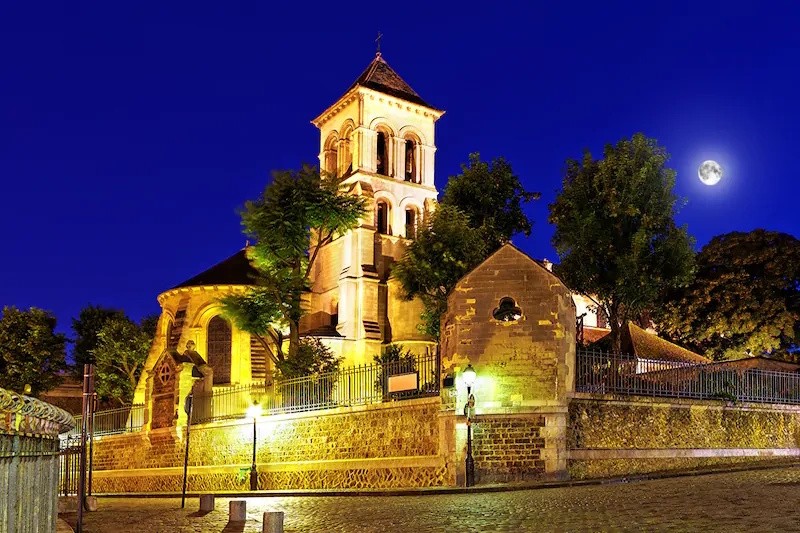
Yet Montmartre is more than just Sacré-Cœur. The Church of Saint-Pierre de Montmartre, one of Paris’s oldest (12th century), bears witness to the area’s religious history. More discreet, the Chapel of the Martyrs marks the spot where Saint Denis is said to have been beheaded. A dive into the sacred, far removed from the tourist bustle.
Museums and cultural sites: art on every corner of the Butte Montmartre
Montmartre is an open-air museum. The Montmartre Museum, housed in the former studio of Suzanne Valadon and Maurice Utrillo, traces the history of the neighborhood through works by Toulouse-Lautrec, Modigliani, and even Picasso. Don’t miss its Renoir Garden, a peaceful haven inspired by the painter.
Just a stone’s throw away, Dali Paris showcases over 300 works by the surrealist master, while the Espace Dalí features unusual sculptures and engravings. For literature lovers, the Dalida House (rue d’Orchampt) and the Moulin de la Galette (immortalized by Renoir) are must-see stops.
Place du Tertre: the beating heart of Montmartre
No visit to Montmartre would be complete without a stop at Place du Tertre, its artistic and tourist epicenter. Here, street painters capture passersby in a few brushstrokes, while caricaturists compete with humor. Take the time to sit at a café terrace, sip a coffee, and soak in this lively scene—just as it was in the days of Picasso or Van Gogh.
However, be mindful of the crowds during peak season: arrive early in the morning or in the late afternoon to fully enjoy the atmosphere. And if you’d like to take home an original piece, negotiate the prices—some artists offer portraits for less than €50!
Cemeteries: Stories and Legends
Montmartre is home to one of Paris’s most beautiful cemeteries, the Cimetière de Montmartre. Less crowded than Père-Lachaise, it is nevertheless the final resting place of many celebrities: Dalida (whose grave is always adorned with flowers), Émile Zola, François Truffaut, and Heinrich Heine. Its shaded paths and intricately carved funerary monuments lend it a poetic, almost romantic air.
Nearby, the Cimetière Saint-Vincent, smaller and lesser-known, offers an even more intimate atmosphere. A stroll off the beaten path for history lovers and those seeking tranquility.
A Breathtaking View of Paris
If Montmartre attracts so many visitors, it’s also for its breathtaking view of Paris. From the Sacré-Cœur forecourt, the panorama stretches across the entire capital: the Eiffel Tower, Les Invalides, the Panthéon… At sunset, the sky is tinged with pink and gold, offering a magical spectacle. For an even more memorable experience, climb to the basilica’s dome (paid access) or settle on the steps with a glass of wine.
Photography enthusiasts will also love the square Marcel-Bleustein-Blanchet, a discreet little garden with an unobstructed view of northern Paris. A perfect spot to capture the hill and its typical rooftops.
Terraces and restaurants: where to eat on the Butte Montmartre?
Montmartre is brimming with typical bistros and restaurants where you can enjoy traditional French cuisine. For an authentic experience, head to Le Consulat, a historic establishment frequented by artists since the 19th century. Its Belle Époque decor and sunlit terrace make it the ideal spot for a romantic lunch.
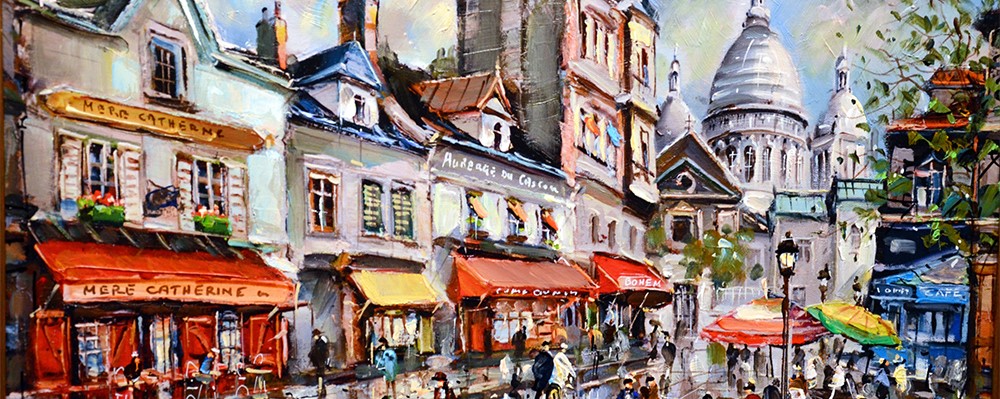
Food lovers won’t want to miss Chez la Mère Catherine, Montmartre’s oldest restaurant (1793), nor Le Moulin de la Galette, where dishes inspired by old-time recipes are served. For a quick snack, Breton crêperies and artisan bakeries (like Boulangerie Utopie) are ideal.
And for a drink on the terrace, head to Le Café des Deux Moulins (made famous by the film Amélie Poulain) or La Maison Rose, a charming little pink house that’s a symbol of the neighborhood.
Souvenirs and painters: Montmartre’s craftsmanship
Montmartre is a paradise for those hunting for unique souvenirs. On the streets of Rue Lepic or Rue des Abbesses, you’ll find vintage frames, antique prints, retro postcards, and handcrafted items made by local artists. Don’t miss La Boutique du Sacré-Cœur, where reproductions of paintings and basilica-themed merchandise are sold.
For art lovers, the art galleries on Rue Saint-Rustique or Rue de l’Abreuvoir showcase contemporary works. And if you dream of bringing a little Montmartre home with you, why not treat yourself to a portrait painted by an artist from Place du Tertre?
Village atmosphere: Montmartre, a unique neighborhood
What makes Montmartre so special is its village-like ambiance. Here, shopkeepers know each other, neighbors greet one another, and time seems to have stood still. Stroll down Rue de l’Abreuvoir, one of Paris’s most picturesque streets, or discover the hidden passages like Passage des Abbesses or Village Saint-Paul.
The neighborhood has managed to preserve its bohemian soul despite tourism. The local markets (such as Marché Saint-Pierre at the foot of the Butte for fabrics) and the small artisan workshops (shoemakers, bookbinders, cabinetmakers) remind us that Montmartre is, above all, a place of life where art and everyday living intertwine.
Montmartre’s vineyard: a winemaking heritage
Did you know that Montmartre has its own vineyard? The Clos Montmartre, located on rue Saint-Vincent, produces a few hundred bottles of red and white wine each year, 100% made in Montmartre. The harvest, held every October during the Fête des Vendanges (Harvest Festival), is a lively event that draws thousands of visitors.
Although the wine isn’t sold commercially (it’s reserved for charity auctions), you can taste it during certain events or in local wine cellars. A tradition that keeps alive the area’s winemaking past, when Montmartre was still covered in vineyards in the Middle Ages.
Why is Montmartre a must-see?
Montmartre is far more than just a tourist stop—it’s a sensory and emotional experience. With its rich history, breathtaking views, artistic atmosphere, and village-like charm, this neighborhood embodies the soul of Paris. Whether you’re an art lover, history buff, foodie, or simply seeking authenticity, Montmartre will captivate you.
So take your time, wander its winding streets, admire the view from the steps of Sacré-Cœur, and let the magic of this one-of-a-kind place sweep you away. As Toulouse-Lautrec once said: “In Montmartre, you breathe art and freedom.”
And you, what’s your favorite spot in Montmartre? Share your favorites in the comments!