Napoleon I's Tomb beneath the Dome of the Invalides
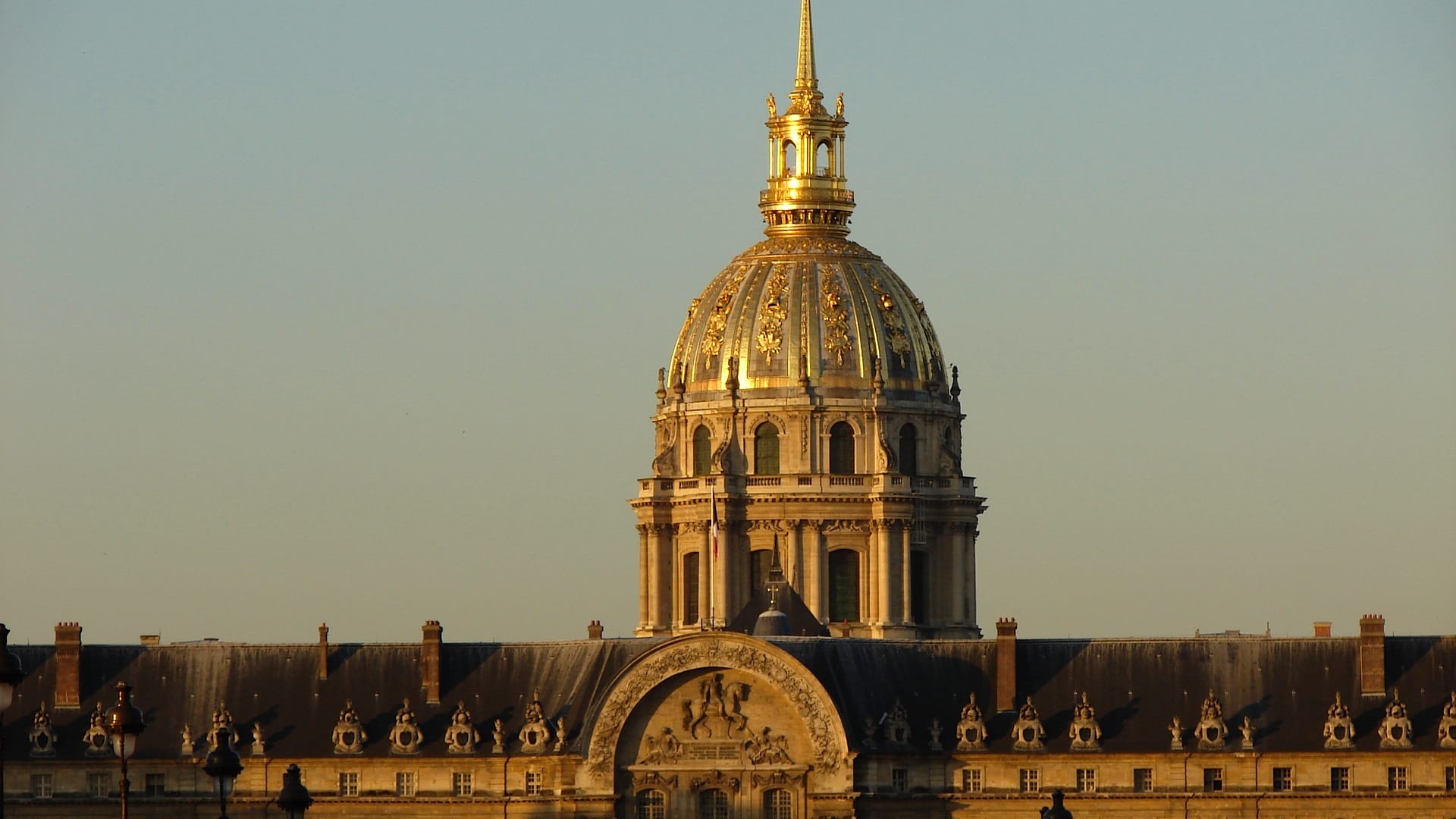
Napoleon I’s tomb is located beneath the Dome of the Invalides, visible from all over the capital. Several great French military leaders also rest in this part of the Hôtel des Invalides. The Dome of the Invalides can be considered France’s military pantheon.
Two churches at the Hôtel des Invalides
The Hôtel des Invalides complex includes, among other things, two churches:
Saint-Louis-des-Invalides Church, originally built for soldiers and war invalids. It became the cathedral of the French Armed Forces diocese in 1986. Constructed in 1676, this church, which served as a parish church in the Diocese of Paris until 1791, was open to disabled soldiers, residents of the Hôtel des Invalides, as early as 1679 (under Louis XIV). The bell summoned them to spiritual duties: morning and evening prayers, mandatory Sunday and feast day Mass and vespers. This church is still in use today.
The chapel, built for the exclusive use of the royal family and known as the Dome of the Invalides, is now desacralized. Its construction was completed in 1708, during the reign of Louis XIV, 27 years after the laying of the first stone. It is here that Napoleon’s tomb is located today.
The two buildings are contiguous and directly connected, but separated by a glass roof built in 1873.
The distinctive construction of the Dôme des Invalides for the tomb of Napoléon Ier
The dome was redecorated in 1807, 1830, 1839, 1937, and most recently in 1989, requiring 12 kilograms of gold on that occasion.
Inside, beneath the dome that protects from the rain and is visible from the outside, are two stone domes, open at their centers, made of ashlar. They are adorned with frescoes depicting saints painted by Jean Jouvenet and a vast composition by Charles de La Fosse featuring Saint Louis in an ermine-lined cloak, with royal emblems (the fleur-de-lys), handing his sword to Christ surrounded by angelic musicians.
The tomb of Napoléon Ier
Since April 2, 1861, the tomb of Napoléon Ier has been housed in the Dôme building. His body rests along the vertical axis at the center of the dome.
The remains of Napoléon Ier, who died in 1821 at the age of 51 on the island of Saint Helena, were temporarily placed in the side chapel of the Dome known as "Saint-Jérôme." His return to France took place on December 15, 1840. On that date, the tomb of Napoléon, commissioned from Louis Visconti by King Louis-Philippe, was not yet completed, and the open-air crypt had not yet been dug. The leaders of the July Monarchy sought to rally supporters of the late emperor. At the same time, the Arc de Triomphe was also completed.
Napoléon’s body, enclosed in six successive coffins inside the outer sarcophagus, was not placed in its current location until April 2, 1861. At that time, the sovereign was Napoléon III, nephew of Napoléon Ier. Only members of the imperial family and a few dignitaries were present.
It is a monumental sarcophagus made of red Finnish quartzite or "metamorphic sandstone," extracted from a quarry in Karelia belonging to Tsar Nicholas I of Russia. It rests on a green granite pedestal from the Vosges, with the ensemble installed in a circular open-air crypt at the center of the Saint-Louis chapel, beneath the dome (the same king had the Sainte-Chapelle built on the Île de la Cité).
The original tombstone of Napoléon Ier on the island of Saint Helena, repatriated from the island in 1840, is now located near the "Jardin de Nîmes," a green space bordering the church of Saint-Louis-des-Invalides.
Other notable figures resting in the Dôme church On 15 December 1940, the ashes of Napoléon’s only son, nicknamed the "King of Rome," Napoléon II or "the Eaglet," were transferred from Vienna (Austria) to be placed in a funerary urn. This initiative was suggested by Adolf Hitler, advised by Otto Abetz, in the presence of Fernand de Brinon representing the Vichy government (Paris being then in the German-occupied zone).
The remains of Napoléon’s brothers, Joseph and Jérôme Bonaparte, as well as the heart of the Queen of Westphalia, his wife, and other members of the Bonaparte family, also rest there.
Several chiefs of staff from the First and Second World Wars are buried at the Invalides: the French marshals Ferdinand Foch, Hubert Lyautey, Philippe Leclerc de Hauteclocque, Alphonse Juin, the generals Robert Nivelle, Charles Mangin, Pierre Auguste Roques and Henri Giraud, the admirals Boué de Lapeyrère and Gauchet.
The governors of the Hôtel des Invalides, which remains a military domain, are also interred there.
Just over 70 remains (or their hearts, in some cases) of military figures rest today in this church (deconsecrated).
A national tribute site The National Tribute, or Tribute of the Nation, is an official distinction in France granted exceptionally to a deceased person during their funeral. This ceremony takes place in the "Cour d’Honneur" (Courtyard of Honour), just after the main entrance.
The Hôtel des Invalides, as a military Panthéon, is above all the resting place of those who died for their country. Since Napoleon’s ashes were returned to the Invalides in 1840, the national tribute has most often been held in the establishment’s Courtyard of Honour.
It usually honours soldiers who died in combat, but many civilians have also been honoured after their deaths: Commander Cousteau in 1997, politicians, writer Jean d’Ormesson in 2017, singer Charles Aznavour in 2018, and President Jacques Chirac in 2019. This official distinction also applies to victims of terrorist attacks, such as Gendarme Arnaud Beltrame in 2018.
During this national tribute, ceremonies take place in the "Cour d’Honneur": detachments from the three armed forces and the military band march past in formation, while civilians stand facing them as guests. The ceremony, presided over by the President of the Republic, traditionally follows these steps: military honors, then a review of the troops by the Head of State (who is also Commander-in-Chief of the armed forces), arrival of the coffin draped in the national flag, speeches by the deceased’s loved ones, a funeral eulogy delivered by the Head of State, military honors rendered to the deceased, departure of the coffin, and salutes to the flags.