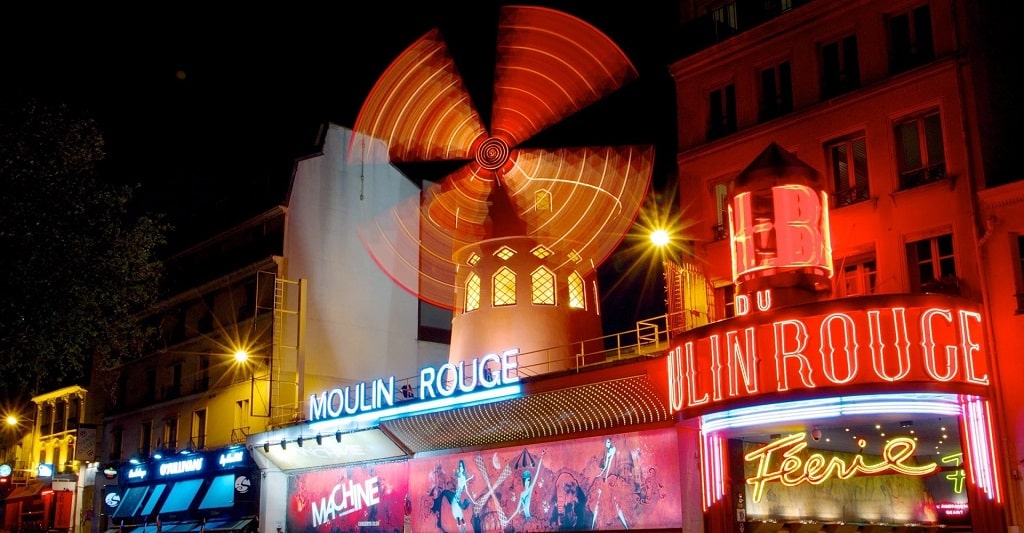
The walk from Pigalle to Sacré-Cœur via the southern side of Montmartre Hill takes you to the summit of the Butte Montmartre, an area steeped in history dating back to the 11th century. The Montmartre hill stands 1.5 km north of the Île de la Cité and Notre-Dame, the historic heart of Paris.
This 2 km walk starts in the Pigalle district, at the foot of Montmartre hill – right by the Musée de la Vie romantique – and passes just 200 m from the Moulin Rouge cabaret. It takes about 2 hours and ends at Place du Tertre. You’ll see the Basilica of Sacré-Cœur, the stunning view of Paris from the Parvis of Sacré-Cœur, Place du Tertre with its artists, and 14 other points of interest. It’s intentional: you’ll learn more about Montmartre than on a standard tour. Plus, we’ve included 18 relaxing stops along the way, at reputable local shops known for their quality service and tourist-friendly prices.
This walk from Pigalle to Sacré-Cœur involves some uphill sections. We offer 4 possible routes to make it as easy as possible for you.
All the information you need to complete this walk can be found on the map or by clicking on it; further details and an FAQ are available below the map.
🗺️ Interactive walk map
Points of interest along the walk
1. Musée de la Vie romantique
Hôtel Scheffer-Renan16 rue Chaptal
75009 Paris
Tel. +33 (0) 1 55 31 95 67
https://museevieromantique.paris.fr/fr
Rose Bakery Salon de thé du musée
16 rue Chaptal
Paris 75009
Access to the tea room is through the courtyard of the Musée de la Vie romantique
For more information, please call our direct telephone number : 01 71 19 24 08
Access
- Métro : Saint-Georges (line 12), Pigalle (line 2 ou 12), Blanche (line 2)
Bus - 30, 54, 68, 74
Short description
The Museum of the Romantics (Musée de la vie romantique) located near the Pigalle District, traces the Romanticism that emerged in the middle of the 19th century and affected all of Europe. It is built around principles such as sensitivity, expression of feelings and melancholy. France is a major pole of romanticism in the 1830s. At that time Paris was a major center of artistic creation.
2. Little-trains-of-Montmartre
There are two competing Little-trains-of-Montmartre to climb the Butte Montmartre: The "Petit train Montmartrain" and "Le Petit train de Montmartre". Hard to tell the difference in name. Both make a detour through "lower Montmartre", stopping at Pigalle, the Moulin Rouge and Place Blanche. However, there's a small difference to be grasped between the two options.Access
- Metro: line 2 - Place-Blanche station
- Top of the funicular
Short description
The Petit Train Montmartrain
Starting point for the 30-minute circuit which normally starts on the Hill at 1 Parvis du Sacré-Cœur, 75018 Paris and return to the starting point. Also stop at Place Blanche (low part of la Butte)
The "Tour of the Montmartrain" is a 30-minute circuit, starting on the Parvis du Sacré-Coeur and returning to the starting point on the Parvis. During the tour, you'll have the opportunity to see :
- Saint-Pierre church
- The Moulin Rouge
- Montmartre cemetery
- Pigalle train station
- Montmartre vineyard
- Au Lapin Agile" cabaret
Between Pigalle and the Sacré-Cœur, you'll pass through places steeped in history: from the Place du Tertre to the Lapin Agile cabaret, or from Aristide Bruant's house to Dalida's. Stops include the Moulin Rouge and Pigalle metro station. This pleasant train journey will give you a new way of seeing the streets that Picasso, Utrillo and Modigliani walked.
- Price: €4.50 for children and €8 for adults.
- Payment by cheque or cash directly on site at 1 Parvis du Sacré-Coeur.
The Petit train de Montmartre: 2 departure points
- Place Blanche (departure from the bottom of the Butte, near the Moulin Rouge - metro Blanche line 2) to Place du Tertre (journey time: 15 minutes)
- Place du Tertre to the top of the Butte Montmartre (2nd departure point) and back to Place Blanche (journey time: 30 minutes).
- The tour can be done in 2 stages with an intermediate stop (same day - same ticket).
The Petit Train de Montmartre offers a musical tour and explanations in 2 languages (French - English), in the heart of the Butte Montmartre with a stop / departure Place du Tertre AND a departure in front of the Moulin Rouge. The tour is in 2 "independent" parts (but a single combined ticket). Each part can be done at two different times of the day, at your convenience.
- The entire tour includes : Place Blanche / Moulin Rouge / Basilique du Sacré-Cœur / Amphithéâtre / Arènes / Eglise Saint-Pierre / Place du Tertre / Espace Dalí / Musée de Montmartre / Le Lapin Agile / Cimetière Saint-Vincent / Place Constantin Pecqueur / Marché Saint-Pierre / Anvers/ Return to Place Blanche
- Price: €4.50 for children and €8 for adults.
Tip: take the 2-stop tour with unlimited stops at the intermediate stops to visit Montmartre. You can start the tour at the starting point of your choice, stay as long as you like and take the little Montmartre train in the other direction for the return trip later in the day.
- Opening hours: daily 10 am - 6 pm. Nocturne in summer until midnight. December to April: variable according to dates and school vacations.
- Price: Adults (over 12): €8. Children (aged 2 to 12): €4,50.
3. Moulin Rouge
82 Boulevard de Clichy75018 Paris
Access
- Metro: line 2 (Blanche station)
- Bus: 30 / 54 / 68 / 74
- Parking: Clichy-Montmartre - 12 Rue Forest, 75018 Paris - Rédélé Parking - 11 Rue Forest, 75018 Paris
Short description
Moulin-Rouge Show is a Parisian cabaret founded in 1889 by Joseph Oller and Charles Zidler, who already owned the cabaret Olympia. The Moulin Rouge celebrated its 100th anniversary in 1989.
Located on the boulevard de Clichy, some 250 m from the Place Pigalle in the 18th arrondissement of Paris, at the foot of the Montmartre hill, its style and name have been imitated and borrowed by other cabarets around the world. Its dance symbol is the French Cancan.
4. Villa-des-Platanes
58 boulevard de Clichy75018 Paris
Cité-du-Midi
48 boulevard de Clichy
75018 Paris
Access
- The distance between the Villa-des-Platanes and the Cité-du-Midi is about 50 m.
- Metro : Blanche station (line 2) and Pigalle station (lines 2 and 12)
- Bus 40, 54, N02
Short description
Villa-des-Platanes and Cité-du-Midi : two spaces not to be missed on the way from Place Blanche to Place Pigalle, two green and original cul-de-sacs for the neighborhood that overlook Boulevard de Clichy:
- at 58, La Villa-des-Platanes, an upscale 19th century building complex and green space
- and 50 m further on, at 48, La Cité-du-Midi, a green corner with a country charm
These two totally different and opposed spaces meet in their originality in this otherwise famous tourist district of Pigalle.
5. Place Pigalle (Square)
Pigalle QuarterPlace du Quartier Saint Georges
75009 Paris
Access
- Metro: lines 2 and 12 - Pigalle or Anvers station (Equal distance from La Cigale)
- By bus : get off at Rochechouart - Martyrs - Lines 30, 54, 67
- Vélib' : terminal in front of la Cigale. There is a bicycle path all along the boulevard Rochechouart
Short description
The Pigalle Quarter is the name of a district of Paris, located around the Pigalle square, it includes the streets located on both sides of the boulevards of Clichy and Marguerite-de-Rochechouart, and extends on the 9th and 18th districts. The square is named after the sculptor Jean-Baptiste Pigalle (1714-1785).
The district is renowned for being a tourist mecca (it is located at the foot of the Montmartre hill). Even if the time when mobsters, policemen and clients met in Pigalle seems long gone, there are still some sex shops and specialized bars. However, the nightclubs, the famous cabarets, the multicolored and neon signs that give the image of a hot district are for many today a decor for tourists.
To be seen nearby : Café de la Nouvelle Athènes. 9 place Pigalle
Café de la Nouvelle Athènes. 9 place Pigalle, Paris (France). From 1871 to the end of the 19th century, it was a meeting place for painters of the Impressionist movement. It was the setting for several famous paintings, including Degas's L'absinthe and Manet's La Prune. Suzanne Valadon can be seen in the painting "Au café la Nouvelle Athènes" by Italian Divisionist painter Federico Zandomeneghi in 1885.

6. La Cigale (Theater)
120, Boulevard de Rochechouart75018 Paris
Tel 01 49 25 89 99 (no reservation by phone)
La Cantine de la Cigale
French restaurant - Bistro - Resto
124, boulevard de Rochechouart
75018 Paris
Tel: +33 (0)1 55 79 10 10
Access
La Cigale (Theater)
120, Boulevard de Rochechouart
75018 Paris
- Metro: lines 2 and 12 - Pigalle or Anvers station (Equal distance from La Cigale)
- By bus : get off at Rochechouart - Martyrs - Lines 30, 54, 67
- Vélib' : terminal in front of la Cigale. There is a bicycle path all along the boulevard Rochechouart
- By car: The surrounding parking lots are located near the Anvers metro station or rue Dancourt. We recommend the Mappy website to find the best possible route.
Short description
The La Cigale Theater is a café-concert hall located on the boulevard Marguerite-de-Rochechouart, in the Pigalle district, at the bottom of the Hill of Montmartre. Built in 1887 on the site of the Ball de la Boule noire (1) (built in 1822). It has a capacity of about 1000 seats and specializes immediately in the review.
7. Théâtre de l'Atelier
1 place Charles Dullin75018 Paris
Access
Théâtre de l'Atelier
1 place Charles Dullin
75018 Paris
- Metro
- Line 2 (Anvers or Pigalle stations)
- Line 12 (Abbesses or Pigalle stations)
- Bus : Line 54 (Stop Anvers / Sacré-Coeur)
Short description
The Theater of Atelier is located at the foot of Montmartre. It was inaugurated on November 23, 1822 under the name of "Théâtre Montmartre". This performance room was one of the first built by Pierre-Jacques Seveste holder of the privileges of exploitation of the theaters of "suburb". This company also built the Théâtre Montparnasse, the Théâtre des Batignolles and the Théâtre de Belleville. The decoration was made by Pierre Cicéri and Evariste Fragonard. It is a small theater with only 563 seats.
8. Théâtre Trianon
80 Boulevard Rochechouart75018 Paris
Tél. 01 44 92 78 00
Théâtre Elysée Montmartre
72 Boulevard Rochechouart
75018 Paris
Tél. 01 44 92 78 00
Access
- Metro: Anvers station, (line 2)
- Bus: Anvers-Sacré-cœur stop (lines 30 & 54)
- Parking Saemes Anvers, 41 bd de Rochechouart - 24h/24 7d/7
Short description
The Trianon and the Elysée-Montmartre theater: two adjoining theaters, communicating, flexible, transformable for any event, with a capacity of 1000 people each. They are located at 72 and 80 Boulevard Rochechouart, at the foot of the Butte Montmartre.
The Trianon and Elysée-Montmartre theaters, both from the 19th century, but inaugurated 87 years apart. Indeed, the Trianon theater was established in 1894 in the gardens of the Elysée-Montmartre, a popular ballroom opened in 1807.
9. Marché Saint-Pierre et Place Saint Pierre
2 rue Charles Nodier75018 Paris
Tel. +33 (0) 1 46 06 92 25
https://www.marchesaintpierre.com
Access
- Metro - Anvers station (line 2)
- Bus - 40, 54, 85
Short description
Saint-Pierre Market and the Halle Saint-Pierre are located on the Place Saint-Pierre (Saint Peter's Square). But everything is special in this small space at the foot of the funicular of Montmartre ! First it is a market of fabrics... Second point, it is not a real square, only a street.
But it is sure that it is still the reference and an institution for fabrics, textiles and haberdashery at bargain prices.
In addition, a few meters away, there is the Halle Saint-Pierre Museum at 2 rue Ronsard, is a metal structure built in 1868 in a style close to the Halles Baltard in Paris. Today it houses the Max Fourny Museum of Naïve Art, with more than 600 paintings and 80 sculptures. It is unique.
10. Funicular of Montmartre
Place Suzanne Valadon75018 Paris
- The lower station of the funicular is Place (allée) Suzanne Valadon near Place (rue) Saint Pierre
- The high station leads directly into the rue du Cardinal-Dubois
Access
- Access to the lower station:
- Metro - Line 2 (Anvers station at 200 m) - Line 12 (Abbesses station at 350 m)
- Bus - 30, 54
- Access to the upper station - Stop rue du Cardinal-Dubois
- Bus - 40 (Only connection on the Butte Montmartre)
Short description
The current funicular of Montmartre is the 3rd since its installation in 1900 and after the renovations of 1935 and 1991. It joins the "Rue Foyatier" at the height of the upper station. You just have to take the street Lamarck on the right, the Parvis du Sacré-Coeur is at about 50 m. The view is superb going up by the funicular. But it is from the Parvis that the view on Paris is the most beautiful.
11. Staircases of Montmartre Hill
(Les escaliers de la Butte)75018 Paris - Montmartre
Access
- Metro - Line 12 (Abbesses, Lamarck-Cautaincourt - Pigalle stations) - Line 2 (Anvers - Pigalle station)
- Bus - 30, 54, 40. (40 is the only line that runs on the Montmartre hill)
- Funicular of Montmartre : High Station
Short description
Going up the Butte Montmartre by the stairs to the Sacré-Coeur is a variant of the funicular. It's a sportive ascent.
The main and direct staircase is the one along the funicular. The entrance to the stairs is at 1 Place Valadon (which is actually a street, not a square). It is located at the junction between the street Tardieu and the street Saint Pierre (called "Place Saint Pierre"!?).
The "Place Valadon" turns into a staircase 30 m further on, which is called "rue Foyatier"! Who knows why?
The staircase which goes along the funicular (the Foyatier street) has two hundred and twenty two steps. It leads to the upper station of the funicular at the junction of rue Saint Eleuthère and rue du Cardinal Dubois - which you cross to reach the stairs in front of you that you climb to rue Azaïs that you take on the right. The Parvis and the Basilica of the Sacré-Coeur are 50 m away. If during your ascent you did not take the time to admire the panorama it is now of the Parvis that you have the best sight on Paris.
12. Parvis of Basilique Sacré-Coeur
Montmartre75018 Paris
Access
- The Montmartre funicular and the No. 40 bus line, the only one to run on the Montmartre hilltop, are effortless ways to get there.
- The two nearest metro stations, Abbesses (line 12) and Anvers (line 2), have a difference in altitude of around 50 metres from the basilica at their respective exits.
Short description
The Parvis du Sacré-Coeur is often a stop-off point, either to catch your breath if you've been walking up the hill, or simply to admire the view over Paris, or simply before visiting the Basilique of Sacré-Coeur.
The Basilica faces almost due south. In fact, both the parvis and the basilica face in the direction of Notre-Dame de Paris. This is no coincidence, since the Basilica is a sanctuary dedicated to Jesus, while Notre-Dame is dedicated to Mary, his mother. The two thus face each other from a distance.
13. Basilique du Sacré-Coeur de Montmartre
Sommet de la butte MontmartreQuartier de Clignancourt
75018 Paris (France)
Main entrance: Parvis de la Basilique
75018, Paris (Open from 6 am to 10:30 pm)
Entrance for the Reception of the Nights of Adoration and the EPHREM Reception House: at the back of La Basilique, 35, rue du Chevalier-de-la-Barre, 75018 PARIS
Access
Métro - Line - Station Anvers
Bus - 31, 54, 80, 85, 40
Funicular- Offer adapted to people with disabilities
- Information on accessibility
Motor disabilities: a ramp and an elevator are located at 35, rue du Chevalier de la Barre, at the back of the Basilica. Regular opening hours: 9:30 am - 5:30 pm.
Short description
The Basilica of the Sacré-Coeur was born after a vow.
This personal vow was made by the philanthropist Alexandre Legentil in January 1871, to atone for the "misfortunes that desolate France and perhaps greater misfortunes that still threaten it".
The aftermath of the 1870 war.
The Franco-Prussian War of 1870, sometimes called the Franco-Prussian War or the War of 1870, lost by the French led to an new elected Assembly, to replace Napoleon III. This assembly had a monarchist majority, along with certain measures implemented by the Assembly or the government, reinforced a climate of unrest within the Parisian National Guard and popular circles. An insurrection broke out in Montmartre on March 18, 1871, and set up an insurrectional authority: the Paris Commune.
The personality of Alexandre Legentil
Alexandre Legentil's strong personality in the Parisian Catholic landscape and his many connections, began the steps that were to lead to the realization of the Basilique du Sacré-Coeur several decades later.
Basilica of the Sacré-Coeur and Commune de Paris
Therefore the Basilica of the Sacré-Coeur construction is frequently associated with the events of the Paris Commune. It is said to have been built to "atone for the crimes" of the Commune of May 1871.
The committee of the "Œuvre du Vœu National"
It decided that the choice of the architect would be made by competition. Certain elements were imposed: the site (Montmartre), a budget limited to seven million francs, a crypt, and a monumental statue of the Sacred Heart that was highly visible and placed outside.
The Basilica of the Sacré-Coeur is mainly financed by a large number of French people through a national subscription.
More than half a century to be completed
It took more than half a century to complete the basilica as it is today, with multiple problèmes : foundation, political disagreements and even until after the Second World War, whose bombardments destroyed the stained glass windows.
In total, the program cost six times more than expected.
The building specifications
The basilica is not built according to the traditional basilica plan. It is in the shape of a Greek cross, decorated with four domes. The central dome has a keystone height of 54.94 m and a diameter of 16 meters. Its central dome, 83 m high, was the highest point in Paris before the construction of the Eiffel Tower, which is the Republican counterpart of the basilica. It is surmounted by a skylight formed by a colonnade. A spiral staircase of 237 steps leads to the inner and outer gallery of this dome, the first offering a view of the interior of the church and the second a circular panorama over 30 km on a clear day. Unlike most churches that traditionally have an East-West orientation, the basilica's orientation is North-South.
The crypt, which has the same layout as the church, is one of the curiosities of the basilica.
The uninterrupted prayers 24 hours a day since 1885
Since 1885, the faithful - men, women, and children from all walks of life - have been taking turns 24 hours a day to recite a prayer uninterrupted, day and night. This prayer is the mission that the Basilica received at its consecration: a mission of constant intercession for the Church and the world.
14. Statue du Chevalier-de-la-Barre
Square NadarRue Saint-Eleuthère
Paris, 75018, France
Access
- The Square Nadar where Statue of Chevalier-de-la-Barre is located, is on the Butte Montmartre, almost at the exit of the upper funicular station, west of the Parvis du Sacre-Coeur
Short description
The Chevalier-de-la-Barre was beheaded at the age of twenty-one and his body thrown at the stake. Why such a severe punishment? The Chevalier-de-la-Barre was condemned to death by the judges of the presidial of the city of Abbeville for not having removed his hat nor having knelt at the passage of a procession, for having sung songs of the guard corps and for holding Voltaire's Philosophical Dictionary. It was on July 1, 1766.
Today, the name, the monument in Abbevillois and the statue in Paris of this "victim of religious intolerance" remain rallying points for free-thinking militants. Associations exist bearing the name of the Chevalier de La Barre: in Paris and in Abbeville.
15. Place Jean Marais
75018 ParisAccess
On Montmartre Hill, in front of Saint Pierre Church
Short description
Place Jean-Marais is a square in the 18th arrondissement of Paris, 30 m by 15 m which serves the streets of Mont-Canis, Norvins and Saint-Rustique.
It is located in front of the square of the Saint-Pierre de Montmartre church, near the Place du Tertre, at the top of the Montmartre hill.
It is named after the French actor Jean Marais (1913-1998), who was also a sculptor. The statue "Passe Muraille" located on this square is of his hand. "Passe Muraille" is a book by the author Marcel Aymé who lived for a long time on the Butte Montmartre.
It bears this name since the decree of the city council of Paris dated March 13, 20071.
It was inaugurated on April 26, 2008 by Daniel Vaillant, mayor of the 18th arrondissement of Paris, in the presence of Christophe Caresche, deputy of the eighteenth district of Paris, and of the cabaret director Michou (director of the Cabaret Michou, at no. 80 rue des Martyrs, who died in 2020, and is buried in the Saint-Vincent cemetery in Montmartre).
16. Eglise Saint Pierre de Montmartre (
à côté du Sacré-Coeur)2 rue du Mont Cenis
75018 Paris
Access
Métro - Line - Station Anvers
Bus - 31, 54, 80, 85, 40
Funicular
Short description
The Saint-Pierre de Montmartre church is a Roman Catholic parish church located in the 18th arrondissement of Paris, at the top of the Montmartre hill, at n°2 rue du Mont-Cenis, west of the Sacré-Cœur basilica.
It is one of the two Catholic parish churches of the hillock with the church of Saint-Jean de Montmartre, (At the bottom of the Hill of Montmartre).
Started in 1133, the church of Saint-Pierre, one of the oldest in Paris, was completed in 1147, consecrated by Pope Eugene III, a Cistercian. The year 2017 marked the 870th anniversary of its dedication. It was both parish church and abbey church of the royal monastery of the Benedictine nuns of Montmartre.
The history of Notre-Dame de Montmartre Abbey came to an abrupt end in 1794. During the Revolution, the last abbess was guillotined and the other nuns were expelled. The abbey and the original statue of the Virgin are destroyed. Threatened several times with demolition, the parish church of Saint-Pierre miraculously survived.
In 1876, the Basilica of the Sacred Heart of Montmartre was built. All attention was focused on the new basilica, and the church of Saint Peter was almost forgotten.
In 1890, the choir of Saint Pierre threatened to collapse. In 1896, the closing of the church of Saint Pierre for security reasons seems to be definitive. In 1895, even the clergy questioned the advisability of maintaining the church of Saint Peter once the church of Saint John was completed. However, the decision to save it was taken at the last minute, on October 12, 1897. The city council finally decided that the church would be preserved in its entirety. The architect Louis Sauvageot was charged with the elaboration of a project.
Cardinal Suhard, Archbishop of Paris, officially recognized after 147 years the return of the cult to Notre-Dame de Montmartre in veneration of Notre-Dame de Montmartre, patron saint of artists around the world.
The Saint-Pierre church contains seven pieces of furniture classified as historical monuments
17. Place du Tertre
Place du Tertre75018 Paris
Access
- Metro - Line 12 (Abbesses, Lamarck-Cautaincourt - Pigalle stations) - Line 2 (Anvers - Pigalle station)
- Bus - 30, 54, 40. (40 is the only line that runs on the Montmartre hill)
- Funicular of Montmartre : High Station
Short description
Place du Tertre in Montmartre is located on the Montmartre hillock, in the Clignancourt district of the 18th arrondissement of Paris, France, at an altitude of 130 m. It was the center of the old village of Montmartre, a few meters from the Sacré-Coeur basilica and the Saint-Pierre de Montmartre church.
This old public square opened against the wall of the abbey of Montmartre in 1635 was frequented, from the end of the 19th century until the beginning of the First World War, by all the bohemian people who lived in Montmartre: painters, songwriters and poets. Toulouse-Lautrec, Poulbot, Picasso, Modigliani lived in rented rooms around.
Today, it is famous all over the world for its painters and its terraces where to have a drink. Many artists set up their easels there every day for tourists. It is also one of the most visited places in Paris.
Further information on Pigalle to Place-du-Tertre walk by south of the Butte Montmartre
Walk Pigalle to Sacré-Coeur : a good way to understand that Montmartre has always been a world apart, from Gallo-Roman times to the beginning of our era, with its temples dedicated to Mars and Mercury. At the beginning of the Christian era, with its patron saint and martyr Saint Denis (beheaded in 250 AD), then with the royal abbey of the Dames de Montmartre until the French Revolution.
It was then the independent “Village de Montmartre”, which was not annexed to Paris until 1860, only to become the center of the bloody Commune secession attempt of 1871.
The return of Catholicism with the construction of the Basilique du Sacré-Coeur at the end of the 19th century paralleled the annexation of the Butte and Pigalle by artists with anarchist tendencies. It’s this spirit of independence that still exists among the Butte’s inhabitants and is part of Montmartre’s charm.
We have published a special article on the Butte Montmartre, which you can consult by clicking on Montmartre and its hill – History, religion, festivities and Paris which covers the following points:
- Does Montmartre name come from the Gallo-Romans or from a Saint martyr?
- Montmartre and its hill during the Revolution of 1789
- Montmartre and its hill are finally annexed by Paris in 1860
- The highest point of Paris is in a cemetery in Montmartre
- The evolution of the population of Montmartre and its hill
- The outbreak of the Commune insurrection in 1871
- Montmartre: the center of the painters
- Montmartre, a religious place of Paris
- Montmartre and its museums
- Other known places and events in Montmartre
- The stairs of the “Butte Montmartre”
- Famous people born in Montmartre
- Famous people living or having lived in Montmartre and its hill
- Montmartre and its hill in the songs
In addition to the Walk Pigalle to Sacré-Coeur, we also organized 2 other guided walks on the Butte Montmartre:
- Montmartre hill self-guided stroll on the top of Paris – This walk is limited to a visit to the top of the Butte Montmartre
- Walk Museum of Montmartre to Pigalle via Moulin-Rouge – This walk begins at the top of the Butte and takes you along the western side of Montmartre down to the Pigalle area.
The next walks you could follow …
It’s worth knowing that several equally interesting VPBY walks are available in Paris. Less than 500 m south of Pigalle begins the promenade that links the department stores of Boulevard Haussmann to Place de la Concorde (Walk Opera-Garnier to Grand-Magasin Lafayette and Concorde-Square).
Starting at Place de la Concorde, a walk takes you along the Champs-Elysées, up to Arc-de-Triomphe (Walk Arc-de-Triomphe to Place-de-la-Concorde via the Champs-Elysées Avenue – Itinerary 2). Plus a shopping session on the Champs-Elysées (Shopping on the Champs-Elysées : list of 100 shops to visit).
From the Arc-de-Triomphe, the Walk from Palais-de-Chaillot to Arc-de-Triomphe via George-V Avenue -itinerary 2 takes you to the Palais de Chaillot-Trocadéro.
Then, from the Palais-de-Chaillot to reach the Tour-Eiffel, just follow Walk from Eiffel-Tower to Palais-de-Chaillot via Place d’Iena – Itinerary 1.
Back from the same Place de la Concorde, another walk takes you to the door of the Louvre Museum (Walk from Louvre to Concord-Square via Tuileries and Place-Vendôme – Itinerary 2).
From there, if you’re still in shape, you can follow the itinerary of the promenade that will take you to the Ile-de-la-Cité, in the heart of historic and royal Paris (Stroll in the Ile-de-la-Cité of Paris, 800 year history – Itinerary 2).
Finally, crossing the Seine, you can continue to the Bastille, through the Marais District (Walk from Pompidou-museum to the Bastille via the Marais – Itinerary 1).
We wish you pleasant walks !