Marthan Lorand – Jewelry, quality watches, and gemstones
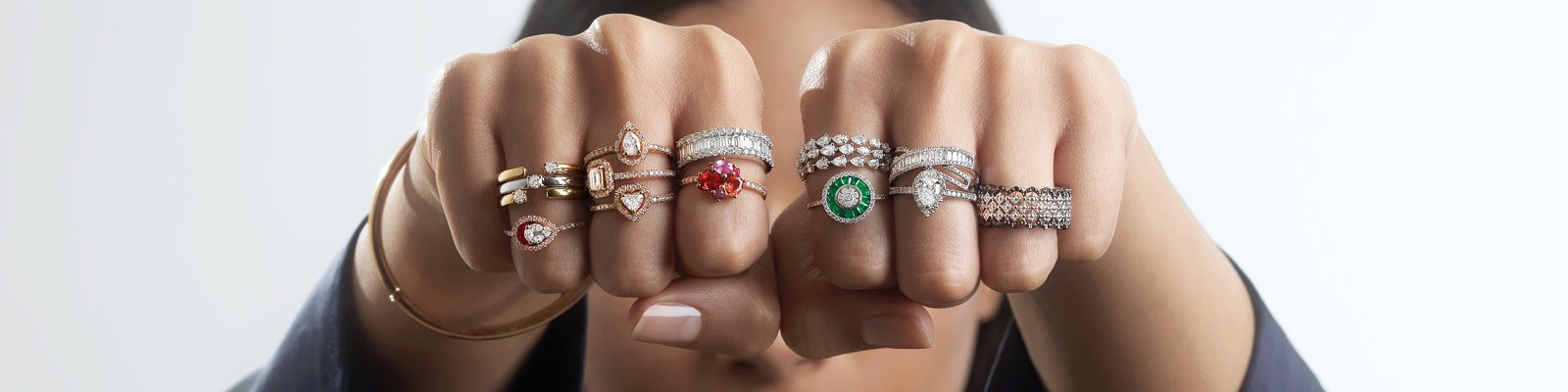
Marthan Lorand - Bijoux is a jewelry boutique located on the 4th floor at 8 Place de la Madeleine in Paris. A prestigious location, close to the Église de la Madeleine, near Place de la Concorde and just a few hundred meters from the Opéra Garnier. Marthan Lorand - Bijoux at your service.
Every day, we strive to provide our customers with the best possible welcome and help them find exactly what they're looking for, as well as something that suits them perfectly. All our creations are crafted by French master jewelers. This allows us to offer delivery times that are often shorter than those of other jewelers. Our after-sales service includes checking the setting of your jewelry and a free in-store cleaning once a year. All our diamonds are certified by the world's leading laboratories (GIA and HRD).
Soon-to-be-weds, you can choose from the most beautiful engagement rings and solitaires in Paris, with complete confidence. Our offer is very comprehensive: the most daring rings sit alongside the great classics of jewelry. From baptism medals to creations adorned with cultured pearls (Tahiti, Japan), from contemporary gold necklaces and bracelets to luxury watches for women and men. Marthan Lorand is here to fulfill all your desires.
For nearly 40 years, our Parisian address has been a true showcase where the finest pieces from the capital's greatest jewelers and the most renowned watchmaking brands come together.
What you’ll find at Marthan Lorand – Bijoux
First, the jewelry
Wedding bands
Engagement rings
Rings
Earrings
Bracelets
Chains
Necklaces
Pendants
Also, watches from the following brands
Poiray
Tag Heuer
Baume & Mercier
Tissot
Herbelin
And finally, everything for a wedding
Engagement rings
Wedding bands
Expert appraisal
Before visiting a jeweler, a quick lesson on gemstones from Marthan Lorand – Bijoux
The diamond
It is one of the oldest and most famous stones created by the Earth. More than 3 billion years ago, carbon rocks began to crystallize more than 250 kilometers below the surface. High pressure and temperature are essential for carbon to crystallize into a diamond. These conditions make it the hardest stone in the world, with a rating of 10 on the Mohs scale (a hardness scale for stones graded from 0 to 10).
How diamonds are graded
Carat. The carat is the international unit of measurement in the world of gemstones. It corresponds to the stone’s weight, so 1 carat = 0.20 grams. The weight of a stone depends on its density. For example, a 1-carat diamond should ideally measure 6.4 mm in diameter. However, not all 1-carat diamonds are the same size.
Color. The color depends on the amount of nitrogen in the original rough stone.
Color is evaluated using letters, ranging from “D” for the finest color to “Z.” The more nitrogen a diamond contains, the more its color shifts toward yellow, reducing its value.
Clarity. Clarity is assessed based on natural inclusions within the stone, caused by crystallization. Most inclusions are colorless and invisible to the naked eye, having no effect on the stone’s color. The fewer the inclusions, the higher the grade.
Cut. Cut is evaluated not only by shape but also by the precision of the faceting. Symmetry among the facets enhances the diamond’s brilliance, ensuring perfect light reflection.
Sapphire and Ruby
Both belong to the same family, known as “corundum.” They differ in their chemical composition, which produces distinct colors while sharing the same properties, including hardness (9 on the Mohs scale). After diamonds, they are the hardest gemstones. Historically, the most prized rubies were a color described as “pigeon’s blood”—a deep red with a hint of blue—originating from Mogok in Myanmar. Today, due to the country’s geopolitical situation, such rubies have become extremely rare. Nowadays, the finest-quality rubies on the market come from Montepuez in Mozambique. French jewelers have particularly appreciated this intense color with a touch of pink.
Vers 1880, sapphires gained attention for their velvety, royal blue hue, which did not go unnoticed by master jewelers. It was during this period that the most exquisite sapphires appeared: the Kashmir sapphires. Their deep blue captivated connoisseurs of exceptional stones, but unfortunately, their production dried up by 1980. Today, Sri Lankan sapphires (blue or colored) are the most sought-after, especially by leading jewelers.
The emerald
This gem boasts a green so distinctive, so mesmerizing… Like aquamarine and morganite, the emerald belongs to the beryl family. The emerald features numerous inclusions known as “gardens.” These are inevitable during crystallization. Despite a hardness of 7.5 on the Mohs scale, the emerald is considered the most “fragile” of all precious stones. Since the 16th century, the finest emeralds have come from Colombia (renowned for producing the purest emeralds). In recent years, emeralds from Zambia and Brazil have grown increasingly popular. This stone is a true marvel of nature in its formation.
What to know when choosing a stone
Diamonds are sold with a certificate issued by an international laboratory. The most reputable are HRD (Antwerp) and especially GIA (New York), the global authority in the field.
This nonprofit organization certifies a diamond’s value according to the International Grading System based on the 4Cs (Carat, Color, Clarity, Cut). At Marthan Lorand, all diamonds starting from 0.30 carats come with an international laboratory certificate. Other stones may undergo “colored gemstone treatments.” These involve modifying and/or introducing colored foreign substances to artificially enhance the stone’s appearance, color, or weight. Such treatments weaken the gem and are not permanent (they are reversible, and the stone’s appearance changes over time). At Marthan Lorand, you will find no treated stones.