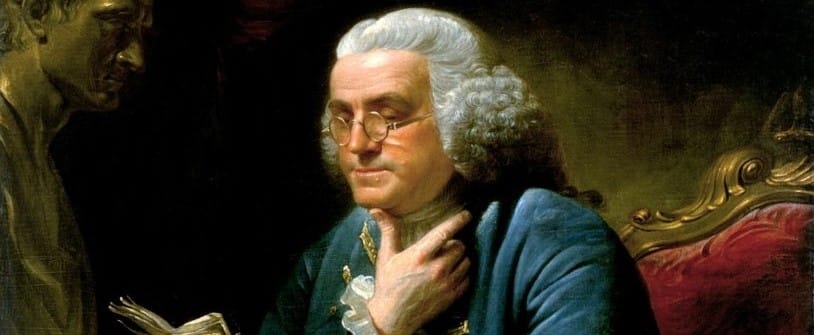
Benjamin Franklin in Paris as the United States’ diplomatic envoy during the American Revolution. His life in Paris from 1776 to 1785 was marked by his political influence, his scientific contributions, and his success in French high society.
Benjamin Franklin: a man good at everything
He began his professional life as a printer at the age of 12. Over time, however, he became a publisher, writer, naturalist, humanist, inventor, abolitionist and American politician. A genius jack-of-all-trades.
His many discoveries include the existence of two types of electricity (positive and negative), the “power of spikes” and the invention of the lightning rod. He traced the Gulf Stream along the American coast, invented bifocals, adapted a urinary catheter, developed a closed-burning stove and built a glass harmonica.
A Freemason, often involved in associations for the betterment of society and his fellow citizens, he retired from business in 1848 at the age of 42 to enter politics and devote himself to associative life, while maintaining an intense research activity and, initially, his official duties in the service of the British Crown until 1775.

Benjamin Franklin: an experienced politician
After retiring from business in 1848, he turned his attention to associations and politics:
- 1749: with his friends and the Penn family, he founded the first Academy of Philadelphia College, today the University of Pennsylvania.
- 1751: Elected member of the Pennsylvania Assembly.
- 1752 (February): he founded and opened the Pennsylvania Hospital in Philadelphia.
- On August 10, 1753, he is elected Deputy Postmaster General of North America. This gave him access to all 13 colonies. His reform of the system introduced weekly postal links between Phildadelphia and Boston, halving delivery times.
- 1754-1755: he attempted to unify the colonies to defend themselves more effectively against the French, as a prelude to the Seven Years’ War between Great Britain and France.
- 1756: He reformed Philadelphia’s police force, introducing new regulations designed to better protect citizens while preserving their privacy. He introduced street lighting in Philadelphia. He was fifty years old at the time.
- 1757: the Philadelphia assembly sends him to London to settle problems between landowners (the Penn family) and the government.
- On February 12, 1759, he was awarded an honorary doctorate by the University of St Andrews for his work in science. He received a similar honor from Oxford University in 1762. Thus, although he had no university education, he is now often referred to as “Doctor Franklin”.
- 1760: The Pennsylvania Assembly wins its long-running case against the Penn proprietors in London. Benjamin Franklin is commissioned to oversee the equitable distribution of Pennsylvania taxes and the establishment of fair taxes.
Taking a break to travel Europe
- 1761: trips to Belgium and Holland.
- 1762: after a stopover in Madeira, he returned to Pennsylvania on November 1.
Back to Philadelphia
- 1763: between June and November 1763, he organized a grand tour of post office inspection in New Jersey, New York and New England.
- On October 1, 1764, he lost his seat in the Pennsylvania assembly; his opponents accused him of being in favor of the royal government, because he coveted the governorship.
- He is appointed Colonial Agent by the British government in London (the de facto ambassador not only of Pennsylvania, but also of Massachusetts, New Jersey and Georgia). He returned to England on December 9, landing on the Isle of Wight.
- 1765: He calls for repeal of the Stamp Act. This law instituted that in the Thirteen American Colonies, all documents, licenses, commercial contracts, newspapers, wills, books and playing cards had to bear a revenue stamp. Its purpose was to cover the cost of the military presence required to protect the colonies. Little applied and finally repealed on March 18, 1766, it marked a step towards the American Revolution.
- 1767: during a trip to Paris between August and October, he is presented to Louis XV.
- 1769: elected President of the American Philosophical Society. New trip to France.
- 1775: he resigned as representative of the British colonies. This marked the end of his cooperation with the British.
The War of Independence (or War of the American Revolution)
- 1775: open warfare against the British from April. Since 1763, relations between England and its American colonies had steadily deteriorated against a backdrop of tax reforms.
- 1775 to 1783: War of Independence (or American Revolutionary War).
- 1776: Benjamin Franklin presides over the Philadelphia Constitutional Convention. He is a member of the Commission of Five, along with Thomas Jefferson, charged by the Second Continental Congress with drafting the text of the Declaration of Independence. He was one of the signatories, alongside representatives of the Thirteen Colonies.
- 1776 (July 4 – National holiday): Declaration of Independence. The definitive document, written on parchment (not hemp paper as often mentioned)[, is approved and signed on July 4 by 56 delegates gathered at Independence Hall in Philadelphia.
- 1776: Benjamin Franklin in Paris. He returns to France in October as unofficial ambassador (representative) of the United States in France.
- June 13, 1777: The Marquis de La Fayette, won over to the American cause, joins the American army.
- October 17, 1777: English defeat at Saratoga. France joins the conflict
- February 6, 1778: American representatives sign the Treaty of Alliance and the Treaty of Friendship and Commerce with France. It was in the Hotel de Coislin, Place de la Concorde, in Paris. A plaque on the building at the corner of Place de la Concorde and Rue Royale reads:
“In this hotel, on February 6th, 1778, Conrad A. Gérard, in the name of Louis XVI, King of France, Benjamin Franklin, Silas Deane, Arthur Lee in the name of the United States, signed the Treaties of Peace, Commerce and Alliance by which France before any other nation recognized the independence of the United States.”

- October 19, 1781: Cornwallis surrenders at Yorktown, marking the end of military operations on American soil.
- September 3, 1783: Treaty of Paris recognizing American independence
- 1789: George Washington becomes the first President of the United States, a post he holds until 1797.

Benjamin Franklin: first a convinced British colonist – until 1775
Benjamin Franklin was not converted to the idea of the United States of America until 1775. For American historian Gordon Wood, before becoming “the First American”, Franklin was first and foremost the last colonist. For most of his life, he considered himself British and part of an Empire. He didn’t reinvent himself as a militant American until 1775.
In fact, before 1775, he was right in line with the British of the time. Today, we’d call it racism. Franklin didn’t consider Germans to be “white” (With the exception of the Saxons, considered the ancestors of the British). Swedes, Russians, Italians, French or Spanish were in the same bag. “The number of perfectly white people in this world is very small”, he lamented in an essay in 1751. Until 1775, Franklin never gave up his dream of an America populated only by Britons. He only reinvented himself as a militant American in 1775, after much hesitation.
In the end, he sided with the supporters of independence, unlike his son William, governor of New Jersey since 1762. He could not disavow the free American conscience. However, he condemned the Boston tea party as a “violent act of injustice”. Despite his delicate personal and family situation, he joined the independence movement.
In 1776, he presided over the Philadelphia Constitutional Convention. He was a member of the Commission of Five, along with Thomas Jefferson, charged by the Second Continental Congress with drafting the text of the Declaration of Independence. He was one of the signatories, alongside representatives of the Thirteen Colonies.
Background to the arrival of Benjamin Franklin in Paris
In October 1776, Franklin left for Paris to serve as the unofficial U.S. ambassador to France, accompanied by friend and diplomat Silas Deane and younger diplomat Arthur Lee. He was 70 years old at the time.
In December 1776, at the arrival of Benjamin Franklin in Paris the American colonies were in the midst of the war for independence against England. His mission was to convince France to lend its military and financial support to the United States.
Although Franklin was already internationally renowned for his scientific work and inventions, he was also known for his simplicity and modest style of dress, which won him the admiration of the French. He kept his glasses, the fur cap of the American philosopher, and his simple walking stick. Without a sword or a powdered wig, the simply dressed Republican ambassador was a sensation. The scientist, who speaks French with accent and slowness, if not difficulty, patiently embarks on a most successful diplomatic career.

The scientist is always present in him. He crossed the Atlantic on the vessel Reprisal in spite of British naval vessels. By plunging a thermometer into the water, he tries to find clues to a mighty warm maritime river that, according to the belief of the old navigators, leads to the coasts of Europe.
Diplomatic role and political success
- Benjamin Franklin in Paris, negotiating French support
With his colleagues Arthur Lee and Silas Deane, Franklin succeeded in securing the help of France, which saw an opportunity to weaken its British rival.
On February 6, 1778, in the Hôtel particulier de Coislin on Place de la Concorde in Paris, the first Treaty of Alliance and the Treaty of Friendship and Commerce were signed between France, represented by Conrad Alexandre Gérard, and the United States, represented by Benjamin Franklin, Silas Deane and Arthur Lee. After 1778, both Deane and Lee returned to their country and let Benjamin Franklin the only representative in France.
Through these treaties, France recognized the independence of the United States, and agreed to military support and eternal peace between the two states. This date marks France’s official entry into the war against the United Kingdom and on the side of the United States.
- Financial and military support
Thanks to his charm and diplomatic skills, Franklin obtained financing, weapons and the dispatch of French troops from Louis XVI, including the decisive help of the Marquis de La Fayette and, above all, Rochambeau.
These resources were crucial to the American victory at the Battle of Yorktown in 1781.
- Treaty of Paris (1783)
Franklin also played a key role in negotiating the treaty that put an end to the Revolutionary War.
In 1783, he signed the Treaty of Paris at the Hôtel d’York, 56 rue Jacob, 75006 – Paris. With this treaty, England recognized the independence of the United States, effective May 12, 1784.
This diplomatic success made Franklin one of the most respected Americans of his time.
The Treaty of Versailles of 1783, also known as the Peace of Versailles or the Peace of Paris, is a treaty signed in Versailles on September 3, 1783, at the same time as the treaty signed the same day in Paris (Treaty of Paris) between Great Britain and the United States.
The Treaty of Versailles is “composed” of three definitive bilateral treaties of peace and friendship signed by Great Britain with, respectively, a treaty with France to end the Anglo-French War, a second treaty with Spain to end the Anglo-Spanish War, and finally, in 1784, a third treaty with the United Provinces to end the Fourth Anglo-Dutch War.
Social life and recognition in Parisian circles a few years before the French revolution
Benjamin Franklin in Paris was immensely popular in this pre-revolutionary society. His simplicity of life and his wit were much appreciated by French philosophers and intellectuals, who saw in him a model of the spirit of the Enlightenment.
When he arrived in France, he chose to live in a large residence in Passy, serviced by a large number of servants, and enjoyed a sweet friendship with a few beauties, such as Mesdames Helvétius and Brillon.
His life was thus divided between French banter and scientific reports, between walks in the Bois de la Muette and studies in his study with his secretaries. He invited his neighbors as well as the kingdom’s most prominent personalities to dinner. From 1777 to 1785, he moved to the Hôtel de Valentinois in Passy
- Icon of the Enlightenment
Franklin was welcomed in literary and philosophical salons, frequenting the likes of Voltaire, Turgot and Dr. Guillotin ( It was before he became known as the inventor of the guillotine) . His taste for science and his enlightened mind made him an emblematic figure of the Enlightenment.
- Parisian society
Franklin became a fashionable figure in Parisian salons, where his fur cap and modest attire contrasted sharply with the powdered wigs and sumptuous clothes of the day.
His charisma and intelligence captivated aristocrats, and he often frequented influential salons such as those of Madame Helvétius and Madame Brillon.
- Symbol of the American Republic
Franklin represented a model of humility and republican idealism that fascinated the French. He became almost an icon for the French nobility, who were interested in the ideas of freedom and democracy he embodied.
Scientific contributions and inventions
Benjamin Franklin in Paris continued his scientific work. Although famous for his experiments in electricity, he was also interested in meteorology, medicine and aerostation.
- Scientific observations
He studied the Gulf Stream (as a result of measurements he had made during his crossing), and his research influenced maritime navigation.
He was also fascinated by the invention of the hot-air balloon, encouraged by the Montgolfier brothers, who made the first flight in 1783.
- Scientific relations
Franklin becomes a member of the French Académie des Sciences and maintains ties with European scientists, sharing his observations and hypotheses on various scientific subjects.
Benjamin Frankln’s return to the United States
In 1785, Franklin left France to return to the United States, where he continued to serve as an influential political and intellectual figure. His mission to France was a success, winning decisive support for the American cause.
His stay in Paris left a lasting impact. He not only strengthened diplomatic ties between France and the United States, but also introduced republican ideas that would influence the French Revolution a few years later.
Another consequence of Benjamin Franklin’s successful mission: the French Revolution
France directly spent just under 2 million pounds on its military expedition for les Etats Unis, twelve times less than its indirect financing, via the 12 million pounds it lent the Americans and the other 12 million it gave them for the war.
After the war, France advanced the United States six million pounds to rebuild the country. Historians Jean Tulard and Philippe Levillain believe that the cost of France’s support for American independence “precipitated the fall of Louis XVI”.

In the first decade following the American War of Succession, American exports per capita fell by almost half, making it more difficult to repay the loans made during the war.
This in turn weakened France’s position as a creditor. Pierre Goubert wrote that in France, the Estates General met in 1789 “because total bankruptcy seemed inevitable; it was brought about both by the enormous expenses of the American war and the refusal of the entire aristocracy (but also of the bankers) to contribute seriously to the financial support of the French State”.
American debt repayment during the French Revolution
This enormous American debt has been progressively repaid and/or adapted over several years
- The ist repayment of this debt did not begin until November 1790 – after the start of the French Revolution – and continued until December 1792, for an initial amount of 29,717,689 francs. On which more than 23 million in interest was charged.
- In January 1793, 29,157,000 francs remained to be paid.
- On January 25, 1795, the French Comité révolutionnaire de Salut public appointed James Swann & Co, a merchant and commissioner of the French government, to oversee the collection and liquidation of the said debt. The exact account was settled at 14,336,619 francs.
- On March 3, 1795, the U.S. Congress converted its sovereign debt into a domestic loan open until December 1796, enabling the federal government to continue repaying France.
- The balance of 10,586,776 francs was paid in American securities at 5.5% interest, while the remaining 969,696 francs was negotiated at 4.5% by James Swann in the best interests of France. This debt was thus definitively extinguished.
The city of Paris honors Benjamin Franklin
Rue Benjamin Franklin is located in the 16th arrondissement of Paris. It’s a long, complicated street, with a steep incline plunging towards the Seine, ending at Place du Costa Rica. It begins on Avenue Paul Doumer, 50 m from Place du Trocadéro. Rue Franklin, then Benjamin Franklin, was named in honor of the politician, diplomat and one of the founding fathers of the United States, but also as a former resident of Passy.

In 1777, he was welcomed into the Hôtel de Valentinois, a beautiful property overlooking the Seine and owned by a French supporter of the American cause, Jacques-Donatien Le Ray de Chaumont, grand-maitre des eaux et forêt. The Hôtel de Valentinois, which was partially destroyed at the beginning of the 20th century, is now located on rue Raynouard, a few hundred meters from rue Benjamin Franklin. The remains of the hotel bear a plaque commemorating the installation of the first lightning conductor in Paris designed by the American scientist.
The great man’s death in Philadelphia in 1790 led to three days of national mourning in France, decreed by the Constituent Assembly installed in 1789. In 1791, rue Neuve was renamed rue Franklin in honor of the man who had honored France with his presence.
At the end of the street stands a magnificent bronze statue. Its base bears votive inscriptions and two bronze bas-reliefs. The sculpture is a copy of the one created by John J. Boyle and installed in Philadelphia. It was donated by an American banker, John H. Haryes, in 1906. The pedestal features two bas-reliefs by Frédéric Brou: one illustrates Benjamin Franklin’s reception at the French court when he was presented to King Louis XVI in Versailles in 1778, the other shows the signing of the Treaty of Paris in 1783.
On the front of the pedestal, a quotation from Mirabeau on June 14, 1790, celebrating the memory of Benjamin Franklin: “This genius who freed America and poured torrents of light on Europe, the wise man that two worlds are calling for…”.
In 1983, at the foot of the statue, a plaque was laid in memory of the bicentenary of the Treaties of Paris and Versailles, which established the independence of the United States of America. It was donated to the City of Paris by the “Daughters of the American Revolution” and bears this quotation from Benjamin Franklin: “the finest of works: the making of peace.