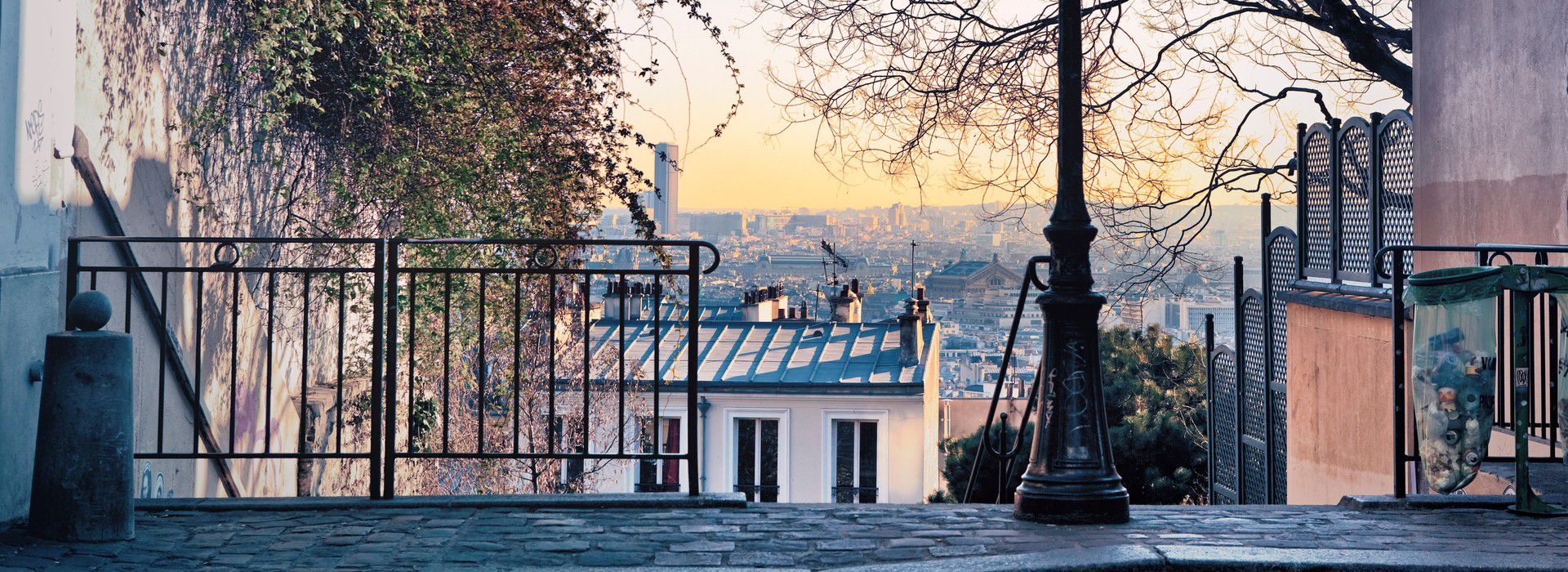
The walk from the Musée de Montmartre to Pigalle via the Moulin-Rouge takes you down from the Butte Montmartre (route 1, or up it if you choose the reversed route 2) while exploring the western slope of the Butte Montmartre, stunning at sunset with its views of the Eiffel Tower. The Butte Montmartre lies about 2 km north of the Louvre Museum.
This walk begins “just in front of the Musée de Montmartre,” at the top of the hill, and ends at the bottom of the Butte, in Pigalle Square, near the Moulin-Rouge. It covers about 2.5 km and lasts roughly 2 hours.
Read also: How to climb the Butte Montmartre without getting tired: stairs, funicular, little trains and bus
The Montmartre to Pigalle Walk features 23 points of interest. It’s intentional: you’ll discover more about Montmartre than on a standard tour. This western slope of the Butte, less frequented by tourists and thus less familiar, also holds unique treasures found nowhere else on the Butte. The route passes near the Montmartre Cemetery, renowned for the famous figures resting there. Finally, you arrive in the iconic Pigalle district, close to the Moulin Rouge cabaret. Along this walk, there are 43 spots to relax, including 8 dedicated to “beauty and fashion,” 9 to “bakeries, pastry shops, chocolatiers, and ice cream parlors,” 21 to “cafés, bistros, restaurants, and bars,” plus a few others.
Points of interest along the walk
1. Musée de Montmartre - Jardins Renoir
12 rue Cortot75018 Paris
https://museedemontmartre.fr/
Access
- Metro - Line 2 (Anvers station then Montmartre funicular) - Line 12 (Lamarck-Caulaincourt and Abbesses stations)
- RER - Lines B and D (Gare du Nord-Magenta Station)
- Bus - 80 and 40 (Stop Saules-Cortot or Montcenis-Cortot)
- Funicular of Montmartre
Short description
The Montmartre Museum - Renoir Gardens is a French art museum located in Paris, in the 18th arrondissement. It is installed in a group of buildings that includes the Hotel Demarne and the House of Bel Air and surrounded by the "Renoir Gardens".
Inaugurated in 1960, it has been refurbished since 2011 and gives rise to several annual temporary exhibitions.
The Museum was created in one of the oldest buildings of the Butte, built in the 17th century: the Maison du Bel Air.
This House of Bel Air was also the place of creation and work of many artists as Suzanne Valadon, Maurice Utrillo, André Utter (painter, husband of Suzanne Valadon), Emile Bernard, the fauvists Othon Friesz and Raoul Dufy, Demetrios Galanis, Francisque Poulbot, etc. Auguste Renoir rented a studio there in 1876 and during his stay he painted major canvases such as The Ball at the Moulin de la Galette, The Swing and Garden on Rue Cortot in Montmartre.
The permanent collections take you back to the history of the Butte Montmartre, the effervescence of its workshops, from the Bateau-Lavoir to the Cortot workshop, and the atmosphere of its famous cabarets, from the Lapin Agile to the Moulin Rouge. One room is dedicated to the French Cancan, another to shadow theater, the dreamlike décor that made the reputation of the Chat Noir cabaret. The artists settled there from 1870. The cafés and cabarets multiplied in the 1880s. One finds there the artistic bohemia of Montmartre specific
The Museum houses a unique collection of paintings, posters and drawings by Toulouse-Lautrec, Modigliani, Kupka, Steinlen, Valadon, Utrillo, Pierre Dumont, Charles Genty. There are also illustrations, photographs and testimonials signed by artists.
The Montmartre Museum has reconstructed the studio where Suzanne Valadon, her son Maurice Utrillo and her partner André Utter lived.
2. La Maison rose
2 rue de l'Abreuvoir (A l’angle de la rue des Saules)75018 Paris
| Coordinates | Latitude | Longitude |
| Sexagesimal (°, ', ") | 48° 53' 17" N | 2° 20′ 19″ E |
| Degré décimal (GPS) | 48.88798 | 2.33961 |
Access
- Montmartre, 2 rue de l'Abreuvoir (A l’angle de la rue des Saules)
- Metro - Line 2 (Anvers station then Montmartre funicular) - Line 12 (Lamarck-Caulaincourt and Abbesses stations)
- RER - Lines B and D (Gare du Nord-Magenta Station)
- Bus - 80 and 40 (Stop Saules-Cortot or Montcenis-Cortot)
- Funicular of Montmartre
Short description
The Pink House is the little story of the Catalan Ramon Pichot, at n° 2 rue de l'Abreuvoir (at the corner of rue des Saules), on the Butte Montmartre. It is known because of the painting of Utrillo which represents it. Ramon Pichot bought this small house around 1905. He was also a painter and a friend of Dali, also a Catalan, and the Spanish artist Pablo Picasso. He often received them in this house which served as his studio.
The story goes that Utrillo made the Pink House famous by painting it on one of his pictures. However, it was Élisée Maclet, a modest painter, but recognized at the time, as famous (or more so) than Utrillo who was his friend. He painted La Maison Rose and Montmartre well before him.
The Pink House is now a creative and welcoming neighborhood restaurant, La Maison Rose offers a short menu based on seasonal products. It is inspired by the French kitchen and the Italian cucina povera (modest Italian cuisine).
3. Clos de Montmartre
(Vignes de Montmartre)Rue des Saules
75018 Paris
| Coordinates | Latitude | Longitude |
| Sexagesimal (°, ', ") | 48° 53′ 18″ N | 2° 20′ 24″ E |
| Degré décimal (GPS) | 48.88839 | 2.33989 |
Access
- Metro - Line 12 (Lamarck-Caulaincourt station)
- Bus : n° 80 and 40
- Parking : Parking garage at 350 meters rue Custine.
- Cab : Lamarck station or on request.
Short description
The vineyard of Montmartre, whose official name is the Clos-Montmartre, is a vineyard planted on the hillock Montmartre, in the 18th arrondissement of Paris.. The vineyard grows on the northern slope of the Montmartre hillock, along the rue Saint-Vincent and the rue des Saules.
Owner of the vineyard: City of Paris,
Manager: Comité des Fêtes du 18e arrondissement
Maintenance of the vineyard: Technical services of the City of Paris
Annual production: about 1000 numbered bottles
In the 12th century, vines were planted by the ladies of the abbey of Montmartre founded by Adelaide of Savoy. But the impoverishment of the abbey led the nuns to sell the vineyard plots. In the 16th century, the inhabitants of Montmartre, which was then located outside of Paris (until 1860), were mainly ploughmen and winegrowers. The vines were cultivated from the top of the hill to the surrounding plains.
But since Montmartre was annexed to Paris in 1860, the houses grew at the expense of the remaining vineyard. In 1930, it was planned to build buildings there. This was without counting on the mobilization of the inhabitants of the district who were opposed to these constructions.
The disappearance of the vines in Montmartre is complete in 1928. They were replanted five years later with 2,000 Gamay and Pinot Noir vines.
The first harvest festival in 1934, takes place on the second weekend of October. It was sponsored by Mistinguett and Fernandel, and took place in the presence of the President of the Republic Albert Lebrun. But there were no grapes yet, the vineyard was only 2 years old. So grapes were bought at Les Halles and bunches were hung with wire so that the sponsors could cut them.
4. Au Lapin Agile
22 rue des Saules75018 Paris
https://au-lapin-agile.com/
Access
Au Lapin Agile
22 rue des Saules
75018 Paris
https://au-lapin-agile.com/
- Metro - Line 12 (Lamarck-Caulaincourt station)
- Bus : n° 80 and 40
- Parking : Parking garage at 350 meters rue Custine.
- Cab : Lamarck station or on request.
Short description
The Cabaret Lapin-Agile (Agile rabbit) has an international reputation. It is well known to most tourists who come to Montmartre. However, it is an ordinary little house, but it is also an "old fashioned" cabaret and has a whole history.
The little house with the sign of the "Lapin agile" is the former cabaret of the "Assassins". In 1880, the owner entrusted the caricaturist André Gill, who was familiar with the place, with the creation of a sign: the cabaret then became known under the name "Au Lapin à Gill", soon phonetically transformed into "Lapin Agile".
Le cabaret Lapin-Agile aujourd'hui: toujours pas comme les autres.
5. Cimetière Saint Vincent
6 rue Lucien-Gaulard75018 Paris
Access
- Metro: line 12 - Station Lamarck - Caulaincourt
- Bus: line 40, 80
Short description
The Saint-Vincent Cemetery at 6 rue Lucien-Gaulard (18th arrondissement), opened on January 5, 1831. It is one of the 3 cemeteries of the Butte Montmartre with the Cemetery of Calvaire (closed), next to the church of Saint-Pierre de Montmartre, and the cemetery of the North, commonly called "cemetery of Montmartre". The latter is halfway up the Butte, on the west side.
The Saint-Vincent Cemetery is a small cemetary (900 graves) built on the slope which gives a nice perspective on the Dome of the Sacred Heart. The charm of its flowered alleys will seize you as soon as you enter.
You will discover among others some personalities buried in this cemetery. Among the most famous are Marcel Aymé, Marcel Carné or Maurice Utrillo.
6. Square Joël Le-Tac
6 Place Constantin Pecqueur75018 Paris
Access
- The square is located in the middle of the place Constantin-Pecqueur.
- The site is accessible by 3, place Constantin-Pecqueur.
- Metro: It is served by line 12 - Station Lamarck - Caulaincourt.
- Bus: n° 80, 40
- Vélib Station at 74 m
Short description
The Joël Le-Tac Square and the mini park (green space) that surrounds it, are places made to rest on the route of your walk. It is planted with viburnum, aucuba, boxwood, yew, prunus pissardii, flowering apple trees and plane trees; there is also a potable water point. But there is something else to see in the middle of this mini-park and greenery:
- Fountain of the woods - and drinkable water
- Monument to Théophile Steinlen
- The Square Joël Le-Tac
- Claude Nougaro Square
- Monument to Eugène Carrière
7. House of Tzara
15 avenue Junot75018 Paris
Architecte : Adolf Loos (1926)
Access
- Montmartre Hill-
- Metro - Line 2 (Anvers station then Montmartre funicular) - Line 12 (Lamarck-Caulaincourt and Abbesses stations)
- RER - Lines B and D (Gare du Nord-Magenta Station)
- Bus - 80 and 40 (Stop Saules-Cortot or Montcenis-Cortot)
- Funicular of Montmartre
Short description
In 1926, the dada poet Tristan Tzara had the Austrian architect Adolf Loos build a house that sums up his architectural approach: the essence of modern architecture is not in the beauty of the elements that make up a building, but in the beauty of pure forms, the relationships that the volumes have with each other. This can be seen in the contrast between the lightness of the white second floor, hollowed out of a rectangular box, and the first floor in rubble.
Just to the left, at n° 13, it is the hotel of the cartoonist Poulbot acquired once the success came.
8. Square Suzanne Buisson
7 bis, rue Girardon ou Rue Simon Demeure75018 Paris
Access
- Metro - Lamarck-Caulaincourt (Line 12) and Abbesses (Line 2)
- Bus - 30, 40, 54 , 80
Short description
The Suzanne-Buisson Square is a green space in the 18th arrondissement of Paris. on the Montmartre Hill. It is named after the politician and resistance fighter Suzanne Buisson (1883-1944), who was deported and died in Auschwitz.
She joined Libération-Sud, a clandestine resistance movement in the Lyon region. In 1943, she became a liaison between the occupied and free zones for the clandestine Socialist Party and for relations with the French Communist Party.
She was arrested by the Germans on April 1, 1944 in Lyon.
9. Château des Brouillards
Allée des Brouillards75018 Paris
Access
Château des Brouillards
Allée des Brouillards
75018 Paris
- This street is located on the northern slope of the Montmartre hill; it starts at place Dalida and ends at 4, place Casadesus.
- It is served by line 12 at the Lamarck - Caulaincourt station and by the RATP bus line 40 at the Abreuvoir - Girardon stop.
Short description
The Allée des Brouillards, its castle and the Casadesus family of musicians. An indissociable whole in this area of Montmartre Hill.
Place Casadesus is an extension of the Allée des Brouillards since 1995. The Casadesus family bought the Château des Brouillards at the end of 1920.
The Château des Brouillards was built before 1789. Its different owners have restored it several times, artists have occupied it more or less legally. It was only in 1920 that Victor Perrot (1865-1963) turned a ruin into the present manor.
10. Bust of Singer Dalida
Dalida Square75018 Paris
| Coordinates | Latitude | Longitude |
| Sexagesimal (°, ', ") | 48° 53′ 18″ N | 2° 20′ 17″ E |
| Degré décimal (GPS) | 48.88854 | 2.33806 |
Access
- Metro - Line 2 (Anvers station then Montmartre funicular) - Line 12 (Lamarck-Caulaincourt and Abbesses stations)
- RER - Lines B and D (Gare du Nord-Magenta Station)
- Bus - 80 and 40 (Stop Saules-Cortot or Montcenis-Cortot)
- Funicular of Montmartre
Short description
The Dalida bust and Square are a tribute to the singer who lived a few meters from there (11B Rue d'Orchampt, 75018 Paris) between 1962 and 1987. She became a prominent figure in Montmartre, and her memory lives on in the collective memory of the inhabitants who recall her memory with emotion. Dalida loved the area of the Montmartre hillock. Another tribute to Dalida is the 1996 vintage of the Clos Montmartre wine: it bears her name.
Dalida is buried a few hundred meters away, in the Cemetery of Montmartre.
11. Rue de l'Abreuvoir
75018 ParisAccess
Rue de l'Abreuvoir
75018 Paris
- Montmartre Hill
- Metro - Line 2 (Anvers station then Montmartre funicular) - Line 12 (Lamarck-Caulaincourt and Abbesses stations)
- RER - Lines B and D (Gare du Nord-Magenta Station)
- Bus - 80 and 40 (Stop Saules-Cortot or Montcenis-Cortot)
- Funicular of Montmartre
Short description
The Abreuvoir street is located on the Butte Montmartre in Paris, in the Grandes-arrières district of the 18th arrondissement. It has a discreet country charm. It is probably the most photographed street in Montmartre, for several reasons, from the Maison Rose located at number 2 to the perspective on the Sacré Coeur from the Allée des Brouillards and the Place Dalida.
12. Le Moulin de la Galette
(Restaurant)83 rue Lepic
75018 Paris (Montmartre)
Le Moulin de la Galette ("Le Blute-fin")
75-77 rue Lepic
75018 Paris
These 2 streets are neighbors
| Coordinates | Latitude | Longitude |
| Sexagesimal (°, ', ") | 48° 53′ 14″ N | 2° 20′ 13″ E |
| Degré décimal (GPS) | 48.88733 | 2.33705 |
Access
Le Moulin de la Galette (Restaurant)
83 rue Lepic
75018 Paris (Montmartre)
Le Moulin de la Galette ("Le Blute-fin")
75-77 rue Lepic
75018 Paris
These 2 streets are neighbors on Montmartre Hill
- Metro - Lamarck-Caulaincourt (Line 12) and Abbesses (Line 2)
- Bus - 30, 40, 54 , 80
Short description
The Moulin-de-la-Galette is in fact a duo of mills. The history of the Moulin-de-la-Galette is that of 2 mills: the mill called "Le Blute-fin" and the other "Le_Radet", both belonging to the Debray family, millers and ... manufacturers of galettes sold in their famous and very popular ball of the Butte Montmartre along the 19th century!
The "Blute-fin" mill is today the only remaining windmill on the Butte Montmartre, in the 18th arrondissement of Paris, and still in working order.
To know more, a lot more on the Moulin-de-la-Galette in English or in French.
13. Maison de Dalida à Montmartre
11 bis rue d'Orchamps75018 Paris
Access
- Metro - Lamarck-Caulaincourt (Line 12) and Abbesses (Line 2)
- Bus - 30, 40, 54 , 80
Short description
Dalida's house is located at 11 bis rue d'Orchamps, on the Butte Montmartre, in Paris. Peaceful, this street reminds of the countryside and freedom. What Dalida was trying to find in the middle of Paris. In a television interview in 1975, she said "I have always loved Montmartre, I found it so peaceful and quiet that I immediately bought this house when I saw it," she said, before specifying that the neighborhood evokes for her the countryside in the heart of Paris.
The house is already an attraction during the singer's lifetime. Some fans spent hours watching for her exits. "I can't stand it anymore. I'm sick, I want to go to the doctor and I have to put on makeup, I have to poison myself because I know they'll be there. I can't take it anymore. I want to be still." But elle n'était pas toujours excédée par ce manque de liberté. Elle savait aussi être aimable avec eux et même les inviter chez elle.
She also loved her neighborhood. Dalida had her habits at the Moulin de la Galette, 50 m from her home, where she always sat by the window at table number three.
14. Bateau-Lavoir
13 de la place Émile-Goudeau75018 Paris
Access
- Subway: The place Émile-Goudeau is accessible by the metro line 12 at the Abbesses station
- Bus: The RATP bus line 40 is the only one to circulate on the Montmartre hill. Stop Durantin-Burq or Abbesses also
Short description
This wooden building, probably named as such out of derision, opened on the first floor onto the square and led three floors down to rue Garreau. At the beginning of the 20th century, it was a poorly heated refuge that served as improvised workshops for a "band of oddballs" who occupied it, often of foreign origin and penniless. It was obviously the crucible of Modern Art.
[caption id="attachment_2248" align="alignright" width="290"]
 Les Demoiselles d'Avignon de Pablo Picasso[/caption]
After the Impressionists who had settled there a few years earlier, its occupants were to challenge the standards of classical painting. Apollinaire, Max Jacob, Mac Orlan, Modigliani, Van Dongen, Juan Gris... When he arrived at the Bateau Lavoir, Pablo Picasso revolutionized painting with his famous cubist picture, painted in 1907: Les Demoiselles d'Avignon.
Classified by André Malraux in 1969, the Bateau-Lavoir was destroyed by fire in 1970. Rebuilt in concrete in 1978, it was reorganized into 25 studios for young artists who work and create during the day, without being housed there.
15. Le mur des je t'aime
Square Jehan Rictus75018 Paris (Montmartre)
Access
- Subway - Abbesses
- Bus - 30, 54
Short description
The "I love you wall" is a work imagined by Frédéric Baron and Claire Kito. It has become an unavoidable landmark for lovers from all over the world who meet in Paris, the capital of romance.
The wall, built on a surface of 40 m², in the Square Jehan Rictus, in Montmartre in Paris, is composed of 612 tiles in enamelled lava. On these tiles are calligraphed 311 "I love you" in 250 common languages, but also in rare or forgotten dialects like Navajo, Inuit, Bambara or Esperanto.
16. Place des Abbesses
Place des Abbesses
75018 Paris
Access
- Metro - Abbesses
- Bus - 30, 54
- Funicular of Montmartre.
Short description
The Abbesses Square (Place des Abbesses) is located at the foot of the Montmartre hill, in the 18th arrondissement of Paris, in the Clignancourt district. This charming square is also a landmark of the Parisian metro: it is the deepest station in Paris and its entrance is topped by one of the rare Art nouveau Guimard aedicule (canopy) still "in activity". Others can be seen in museum in several towns in the world.

La station Abbesses (la plus profonde de Paris), sur la ligne 12 comporte une seule entrée.
17. Église Saint-Jean de Montmartre
19 et 21 Rue des Abbesses rue des Abbesses75018 Paris
Tel: 01 46 06 43 96
Architecture : Art Nouveau
Architecte: Anatole de Baudot
Access
- Metro : Abbesses
- Ce site est desservi par la station de métro Abbesses
Short description
The Saint-Jean-de-Montmartre church , also called église Saint-Jean l'Évangéliste is a Catholic parish church. It is at the foot of the Butte Montmartre, located at 19, rue des Abbesses, in the 18th arrondissement of Paris.
His name St. John the Evangelist (Saint-Jean l'Évangéliste) comes from John, a first century Jew who became a Christian, a disciple of Jesus and also the brother of James the Greater. Christian tradition attributes the writing of the Gospel of John to the apostle John. The apostle John is credited with many miracles, especially that of the poison. John, summoned to drink a cup of poison, is not at all bothered by it, while the two tasters are struck down in a few seconds. They were then resurrected by the saint.
The Saint-Jean-de-Montmartre church was classified as a historical heritage site by order of September 9, 2014.
18. Théâtre des Abbesses
31 rue des Abbesses75018 Paris
Architectes Charles Vandenhove, Jacques Sequaris et Prudent de Wispelaere, 1992
Access
- Metro : line 12 (Station Abbesses) - line 2 and line 12 : (Station Pigalle)
- Bus : 30, 54, 67 (Montmartrobus stop) and 50, 80, 95
- Velib : Station n°18004 - Place des Abbesses
- Parking Montmartre Garage - underground parking, 5 rue Dancourt Paris 18
Short description
The architect Charles Vandenhove wanted to respect the "neo-classical architecture" of the district, by "making current" the pediments, the capitals, the columns, the curved zinc roofs, by using stone and clear concrete colored in the mass.
Very close to Pigalle, this Theater of contemporary dance, world music, classical music is the 2nd theater of the City. Its programming is directly linked to that of the Théâtre de la Ville: the successful shows of young choreographers, companies, authors or directors can allow them to be programmed the following year on the stage of the Théâtre de la Ville, place du Châtelet, for a revival or a new creation. On average, the Théâtre des Abbesses puts on about a hundred performances a year.
19. Cimetière de Montmartre
20 avenue Rachel75018 Paris
Tel. +33 (0) 1 53 42 36 30
cimetiere.montmartre@paris.fr
https://www.paris.fr/
Access
- Metro - Place de Clichy Station - Lines 2 and 13
- Bus - 30, 31, 54, 56, 80, 85, 95
- Velib station at 180 m
Short description
The Montmartre cemetery, officially the cemetery of the North, opened in 1825. It is the third largest necropolis in Paris, after Père Lachaise and Montparnasse. Its surface area is 11 hectares.
Nestled on the side of the Butte Montmartre, it offers a 20 m difference in level and a remarkable view of the capital. 21,500 graves are gathered there in the shade of almost 800 trees - 38 different species, mainly maples, to which are added a few chestnut trees, lime trees and thuyas.
They are numerous over the almost 200 years that this cemetery exists. Some, famous in their time are now forgotten. You will find a no-exhaustive list of them in the detailed description. Here is a short list with the adresses of the tombs (by street) :
- tombe of Edgar Degas - Av. de Montebello,
- tombe of Michel Berger et France Gall - Av. de la Croix,
- tomb of Stendhal - 8 Rue Camille Tahan,
- tombe André-Marie Ampère - 8 Rue Camille Tahan,
- tombe de Louise Weber, dite La Goulue - 20 Av. Rachel, 75018 Paris
- Cénotaphe d'Émile Zola - 14 Av. Dubuisson,
- tombe de Berlioz - Av. Cordier, (Ave Hector Berlioz),
- tombe of François Truffaut - 22 Rue Joseph de Maistre,
- tombe d'Alexandre Dumas fils - Av. de Montebello,
20. Cimetière de Montmartre
Tombe de Dalida (18e division)20 Avenue Rachel
75018 Paris
Access
- Metro: Abbesses or Lamarck Caulaincourt stations (Line 12)
- Bus: n°40, n° 80
Short description
Dalida's grave is one of the most visited in the cemetery of Montmartre, 35 years after her death. It is indeed on May 3, 1987 that she gave herself death in her house of the Bute Montmartre, 11 bis rue d'Orchampt, located at 250 m in direction of the Place du Tertre. Her name of singer is Dalida and that of her civil status Iolanda Christina Gigliotti.
21. Moulin Rouge
82 Boulevard de Clichy75018 Paris
Access
- Metro: line 2 (Blanche station)
- Bus: 30 / 54 / 68 / 74
- Parking: Clichy-Montmartre - 12 Rue Forest, 75018 Paris - Rédélé Parking - 11 Rue Forest, 75018 Paris
Short description
Moulin-Rouge Show is a Parisian cabaret founded in 1889 by Joseph Oller and Charles Zidler, who already owned the cabaret Olympia. The Moulin Rouge celebrated its 100th anniversary in 1989.
Located on the boulevard de Clichy, some 250 m from the Place Pigalle in the 18th arrondissement of Paris, at the foot of the Montmartre hill, its style and name have been imitated and borrowed by other cabarets around the world. Its dance symbol is the French Cancan.
22. Villa-des-Platanes
58 boulevard de Clichy75018 Paris
Cité-du-Midi
48 boulevard de Clichy
75018 Paris
Access
- The distance between the Villa-des-Platanes and the Cité-du-Midi is about 50 m.
- Metro : Blanche station (line 2) and Pigalle station (lines 2 and 12)
- Bus 40, 54, N02
Short description
Villa-des-Platanes and Cité-du-Midi : two spaces not to be missed on the way from Place Blanche to Place Pigalle, two green and original cul-de-sacs for the neighborhood that overlook Boulevard de Clichy:
- at 58, La Villa-des-Platanes, an upscale 19th century building complex and green space
- and 50 m further on, at 48, La Cité-du-Midi, a green corner with a country charm
These two totally different and opposed spaces meet in their originality in this otherwise famous tourist district of Pigalle.
23. Place Pigalle (Square)
Pigalle QuarterPlace du Quartier Saint Georges
75009 Paris
Access
- Metro: lines 2 and 12 - Pigalle or Anvers station (Equal distance from La Cigale)
- By bus : get off at Rochechouart - Martyrs - Lines 30, 54, 67
- Vélib' : terminal in front of la Cigale. There is a bicycle path all along the boulevard Rochechouart
Short description
The Pigalle Quarter is the name of a district of Paris, located around the Pigalle square, it includes the streets located on both sides of the boulevards of Clichy and Marguerite-de-Rochechouart, and extends on the 9th and 18th districts. The square is named after the sculptor Jean-Baptiste Pigalle (1714-1785).
The district is renowned for being a tourist mecca (it is located at the foot of the Montmartre hill). Even if the time when mobsters, policemen and clients met in Pigalle seems long gone, there are still some sex shops and specialized bars. However, the nightclubs, the famous cabarets, the multicolored and neon signs that give the image of a hot district are for many today a decor for tourists.
Further information on the walk from “Museum of Montmartre to Pigalle via Moulin-Rouge“
The west side of the Butte Montmartre is just as interesting to visit as the rest of the Montmartre – Pigalle district but a lot less touristic.
A much less visited part of Montmartre
Because there’s no Place du Tertre, no Sacré-Coeur, though it’s close by. And yet this is the part of Montmartre where today’s Montmartre residents live, a little sheltered from the tourist crowds. There are many vistas to see, reminiscent of the Montmartre of yesteryear.
The Walk Museum of Montmartre to Pigalle via Moulin-Rouge with 23 Points of interest and 19 Relaxation Breaks
Each Point of Interest includes detailed historical, anecdotal or simply practical comments (opening hours, reservations, etc.). Like a human guide at your beck and call. With photos, diagrams and itineraries to follow.
We’ve added 19 “Recreational Breaks” to the 23 “Points of Interest” on our walks and the information you’ll find for each. These “Recreational Breaks” are distributed along the route (coffee break, restaurant break, shopping break, patisseries, ice creams and chocolat shops, jewelries, parfumeries). This allows you to rest, taste or buy at recommended points rated (up to 5) by the tourists who have preceded you. Avoid scores below 4.0 to avoid tourist price gouging.
A panoramic view of West Paris
On your descent to Pigalle from the Butte Montmartre, you’ll enjoy a superb view of the west of Paris, with the Eiffel Tower and possibly the Arc de Triomphe in the distance.
One of the largest cemeteries in Paris
In addition to the Saint Vincent cemetery on the top of the Butte Montmartre, mainly reserved for Montmartre families, there’s also the Cimetière de Montmartre (officially “le cimetière du Nord”), one of the capital’s best-known cemeteries after Père Lachaise. It has become the resting place of many of today’s and yesterday’s celebrities. This cemetery is also the site of one of the largest Paris cemeteries. It is located on your way down to Pigalle.
Short list of personalities buried in Montmartre cemetery
This vast cemetery is organized by street for easy orientation:
- Grave of Edgar Degas – Av. de Montebello,
- Grave of Michel Berger et France Gall – Av. de la Croix,
- Grave of Stendhal – 8 Rue Camille Tahan,
- Grave of André-Marie Ampère – 8 Rue Camille Tahan,
- Grave of Louise Weber, dite La Goulue – 20 Av. Rachel, 75018 Paris
- Cénotaphe of Émile Zola – 14 Av. Dubuisson,
- Grave of Berlioz – Av. Cordier, (Ave Hector Berlioz),
- Grave of François Truffaut – 22 Rue Joseph de Maistre,
- Grave of Alexandre Dumas fils – Av. de Montebello,
Getting ready to visit Montmartre
We remind your that to better appreciate and understand your walk, you should know the Little History of the Butte Montmartre by clicking on Montmartre and its hill – History, religion, festivities
Two other walks available to help you get to know Montmartre better
We’ve put together 3 walks to really get to grips with Montmartre. All these walks follow on from each other. For the courageous, it’s possible :
1/ to Walk Pigalle to Sacré-Coeur by south of Montmartre Hill (in the rising sun),
2/ then visit the top of the Butte with Montmartre hill self-guided stroll on the top of Paris
3/ and finally descend in following the walk via the west (setting sun) with our Walk Museum of Montmartre to Pigalle via Moulin-Rouge and to return to the Pigalle starting point. This is the walk of your present screen.
The next walks you could follow …
It’s worth knowing that several equally interesting walks are available. Less than 500 m south of Pigalle begins the promenade that links the department stores of Boulevard Haussmann to Place de la Concorde (Walk Opera-Garnier to Grand-Magasin Lafayette and Concorde-Square).
Starting at Place de la Concorde, a walk takes you along the Champs-Elysées, up to Arc-de-Triomphe (Walk Arc-de-Triomphe to Place-de-la-Concorde via the Champs-Elysées Avenue – Itinerary 2). Plus a shopping session on the Champs-Elysées (Shopping on the Champs-Elysées : list of 100 shops to visit).
From the Arc-de-Triomphe, the Walk from Palais-de-Chaillot to Arc-de-Triomphe via George-V Avenue -itinerary 2 takes you to the Palais de Chaillot-Trocadéro.
From the Palais de Chaillot, there, to reach the Tour-Eiffel, just follow Walk from Eiffel-Tower to Palais-de-Chaillot via Place d’Iena – Itinerary 1.
Back from the same Place de la Concorde, another walk takes you to the door of the Louvre Museum (Walk from Louvre to Concord-Square via Tuileries and Place-Vendôme – Itinerary 2).
From there, if you’re still in shape, you can follow the itinerary of the promenade that will take you to the Ile-de-la-Cité, in the heart of historic and royal Paris (Stroll in the Ile-de-la-Cité of Paris, 800 year history – Itinerary 2).
Finally, crossing the Seine, you can continue to the Bastille, through the Marais District (Walk from Pompidou-museum to the Bastille via the Marais – Itinerary 1).
Quite a program, but you don’t have to do it all in one day. In fact, we’ve made it easy for you to pick up where you left off your walk.