Column of la Bastille and July revolution of 1830 – A memorial and a tomb
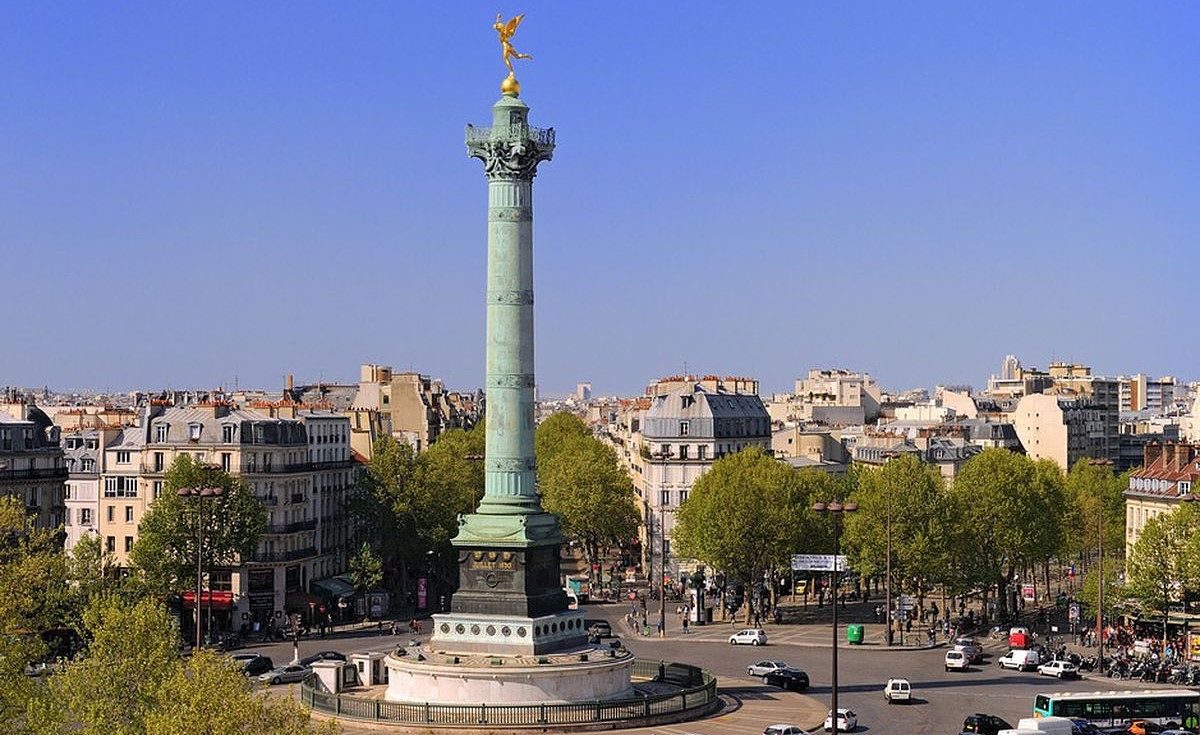
Column of la Bastille and the Révolution of July 1830
Column of la Bastille comes after the second revolution of 1830, the first being the "Révolution of 1789".
Charles X (brother of Louis XVI and Louis XVIII) tried to re-establish an authoritarian regime, by curbing the fervor of the liberal deputies with his "Saint-Cloud ordinances" of July 25, 1830. In response, Parisians rose up during battles that lasted three days known as "the Three Glorious Days" ("lles Trois Glorieuses" - July 27, 28, and 29, 1830). Charles X and the royal family then fled Paris. After an incredible journey through Normandy, the King and his family, escorted by some 1,500 followers, embarked on August 16, 1830 at the military port of Cherbourg on the "Great Britain", commanded by Captain Dumont d'Urville. It was the beginning of the July Monarchy.
The liberal deputies, mostly monarchists, took the popular revolution in hand. They finally opt for a more liberal constitutional monarchy with the help of a change of dynasty. The House of Orleans, the younger branch of the House of Bourbon (Charles X) succeeded the older branch. The Duke of Orleans is proclaimed "King of the French" and no longer "King of France", under the name of Louis-Philippe 1er.
Construction of the July Column (1835-1840)
The July column was classified as a historical monument in 1995 only.
But before that, in 1793, the Fountain of Regeneration was installed on the site of the demolished Bastille prison to commemorate the capture of the Tuileries Palace on August 10, 1792. In 1794, the guillotine was also installed there and claimed 75 victims in only 3 days (the local residents do not like this and the guillotine was transferred to "Place du Trône-Renversé", today's Place de la Nation).
Later, Napoleon 1st wanted to install there a huge bronze elephant with a fountain fed by the Saint Martin canal which passes just underneath. He had the first stone of the base laid in 1808. The project was abandoned for lack of money and the plaster model at scale 1 gradually fell into ruin.
One year after the July revolution (1830), King Louis-Philippe laid the first stone of the new project on July 27, 1831. The construction lasted from 1835 to 1840.
The foundations of the column and underground parts
The Saint-Martin canal flows under the July column. The foundations that support the monument were built straddling the waterway.
On either side of the canal, two crypts unfold in a semicircle. This is where the remains of the seven hundred victims of the revolutions of July 1830 and February 1848 were placed.
The base that supports the column is the oldest part of the monument: it dates from the First Empire and was designed to support the elephant fountain wanted by Napoleon 1er. This masonry was preserved when the column was built in the 1830s.
The base is made up of a circular red marble base, on which a second square base decorated with 24 medallions and a third base decorated with lion's heads rests.
A mosaic and paving decorate the two terraces. Their elegant geometric patterns are not visible from the ground but from the nearby Opera terrace.
The "column de Juillet" or column of "Place de la Bastille"
It is made of bronze. It weighs 179,500 kilograms. The metal part consists of a cubic pedestal that supports a 23-meter high shaft, crowned by a composite capital. It takes 240 steps to reach the top. Its height is 51 m.
The bronze pedestal is decorated with a relief showing a lion and four roosters. A poem by Victor Hugo, written for the Column, completes this ensemble.
The shaft of the column contains three registers of inscriptions: here are the names of the 504 victims of the Three Glorious Ones of July 1830, engraved in bronze and gilded with gold leaf.
The interior of the column is hollow: a narrow staircase of 240 steps leads to the top. Entirely cast in bronze and in a very good state of preservation, this staircase is a true technical feat.
Winged genius from the top
This golden statue on the top which seems small is almost four meters high! It is the work of the sculptor Auguste Dumont. To admire its aesthetic qualities, it is necessary to go to the Louvre Museum. A replica reduced by half is exposed there.
The winged genie symbolizes Liberty, brandishing a torch and a broken chain. Usually Freedom, in republican symbolism, is represented by feminine features. For example the famous painting by Delacroix, "La Liberté guidant le peuple". But here, the ordainer is a new monarchy and wanted to break with the republican spirit.
The inauguration of the Bastille Column in 1840
The law of July 26, 1839, consecrated the column as a funerary monument for the victims of the 1830 revolution. Its inauguration coincided also with the celebration of the 10th anniversary of the "Revolution of the Three glorious days".
On July 28, 1840, the French government, therefore, celebrated with great pomp the transfer of the bodies of the 504 revolutionaries of 1830. They had been buried for 10 years near the Louvre, in the "Jardin de l'Infante".
But next to them were also buried mummies brought back from Egypt during Napoleon's expedition, which the Louvre had difficulty preserving. In the haste of the transfer of 1840, the mummies (or one mummy?) were also moved under the July column at the same time as the revolutionaries of 1830 - and are still there.
The 3rd Revolution of 1848 and the revolts of June 22 to 26, 1848
King Louis-Philippe 1er was in turn driven from the throne in February 1848 and fled. This revolution officially left 500 to 600 victims. 196 of them from the 1848 revolution were added in one of the 2 vaults under the Bastille column.
The paradox is that the remains of the victims of the revolution of 1848 that overthrew Louis-Philippe in 1848 were added to the deaths of the Révolution of 1830 ("Les 3 glorieuses"). Those who fought to overthrow Louis-Philipe were celebrated for giving him the power of the throne!
Under the column, there are two crypts:
On one side, the tomb of the 503 or 504 citizens "who armed themselves and fought for the defense of public liberties" in 1830, as indicated on the slab.
On the other, the 196 to 200 bodies "fallen for the re-establishment of a democratic and social republic, on February 22, 23 and 24, 1848".
The column on Place de la Bastille is not only a beautiful monument: it is also a cemetery!
These two tombs were rebuilt after the great flood of the Seine in 1910, which flooded the crypt.
Note to avoid misunderstanding
What is known as "The Revolution of 1848" (which took place in February) was against King Louis-Philippe. But what little is talked about is the other riot of June 22-26, 1848, in Paris alone. Following the threat of closure of the national workshops intended to cope with unemployment, led to the raising of barricades. The repression (by the National Assembly of the new 2nd Republic, against the revolted workers) was carried out in blood under the orders of General Cavaignac. The government forces lose about 1,600 men, including a thousand soldiers and national guards. The number of insurgents killed during the fighting was estimated at between 3,000 and 5,000, to which must be added about 1,500 shot without trial. There were about 25,000 arrests and 11,000 convictions in prison or deportation to Algeria.
These 4 days of riots were therefore much more deadly than the February Revolution of the same year, known as the "3rd Revolution" or Revolution of 1848. None of these victims of this riot were buried under the July column.