Storming of the Bastille, as if you were there in 1789
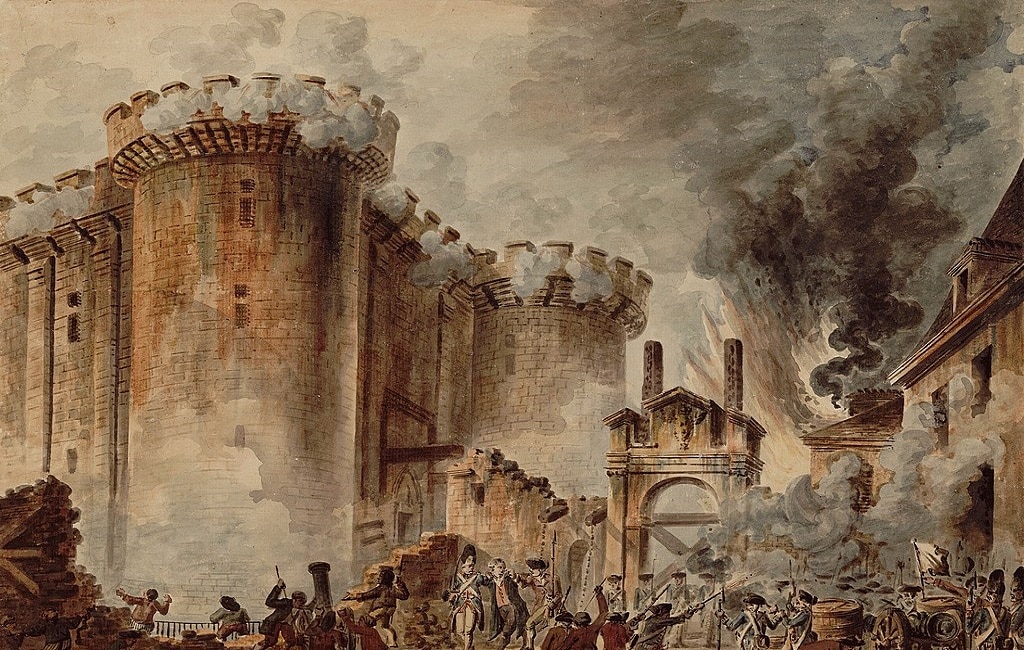
The storming of the Bastille marked the culmination of the crisis gripping France following the major economic downturn from 1783 to 1789.
France and its people in the late Ancien Régime
By the end of the Ancien Régime, the state was impoverished and the Treasury empty. Financial difficulties had been worsened by the American War. Tax inequalities outraged the non-privileged. Peasants complained of poor harvests, falling wheat and wine prices.
Despite the crisis, the Controller-General of Finances, Calonne, refused to cut spending and relied on loans.
Worried by the scale of the deficit, the minister nevertheless sought to curb abuses. In August 1786, he proposed to the king a new tax, the *subvention territoriale*, levied on all landowners—noble or commoner—the abolition of internal customs duties, free movement of grain, reductions in the *taille* and *gabelle*, and the creation of provincial consultative assemblies. The assembly of notables consulted—mostly privileged elites—accepted some reforms but refused to examine the tax proposal until they knew the full extent of the deficit. The king dismissed them on 25 May.
It was probably at this moment that the seeds of the Revolution were sown.
The Leaders' Failure to Understand the Course of Events
The new minister, Loménie de Brienne, adopted his predecessor’s ideas and presented the projects to the Paris Parliament. The latter, in turn, demanded to review the state of the finances and, above all, declared that only the Estates-General could approve a new tax. Faced with the parliamentarians’ stubbornness, the king exiled them to Troyes, but widespread discontent forced him to recall them (September 1787).
As the financial crisis continued to worsen, Brienne sought to launch a major loan, which the king forced through despite opposition from the Parliament. The Keeper of the Seals, Lamoignon, attempted to strip parliamentarians of their right to register decrees they had granted themselves. The king adjourned Parliament (8 May 1788). Violent riots then erupted across the country. Soon after, facing the threat of bankruptcy, Brienne announced on 8 August 1788 the convening of the Estates-General for 1 May 1789. Louis XVI and his ministers hoped the Estates-General would calm tensions (the last such assembly had been held in 1614). A few days later, Minister Brienne was replaced by Necker (25 August).
The convening of the Estates-General for 1 May 1789
1,200 delegates gathered in Versailles on May 5. The Estates-General consisted of three “orders”: the nobility, the clergy, and the Third Estate (what we would now call three “electoral colleges”). Naturally, each had different objectives.
Quickly, the discussions failed to meet the expectations of the Third Estate (the people) and ended in a half-hearted failure. On June 17, the deputies declared themselves the National Assembly. Then, on June 20, at the initiative of the Third Estate during the Tennis Court Oath, the assembly proclaimed itself the Constituent Assembly to draft a constitution and end absolute monarchy. It began exercising this role on July 9 and was finally recognized as such by the king in October. In just a few days, the gears of events had been set in motion… and would never stop turning.
France was ripe for a profound break with the past regime
The storming of the Bastille thus forms part of the wave of popular and political mobilisation sweeping through the towns of the Kingdom of France during the summer of 1789. It coincides with the political revolution initiated by the deputies of the Estates-General, still assembled in Versailles. Since 20 June—the date of the Tennis Court Oath—they have been asserting themselves as the National Constituent Assembly in opposition to the king. Of course, Versailles is only 15 km from Paris, and “contacts” with the city’s representatives are frequent.
The unrest in Paris in the days leading up to the storming of the Bastille
Popular agitation in Paris reached fever pitch after the dismissal in 1787 of Jacques Necker, the Genevan financier and statesman who served as Minister of Finance. Recalled by Louis XVI in August 1788 with the title of Minister of State—thanks to unwavering public support—he was also the father of Madame de Staël, the Genevan and French novelist, letter-writer and philosopher.
The second dismissal of Necker, on 11 July 1789, was announced on 12 July by the journalist Camille Desmoulins.
Moreover, the presence of mercenary troops (in the service of the monarchy) around Paris worried the population. Parisians feared that these foreign troops, massed around the capital since June, might be used against the Estates-General or to carry out a hypothetical massacre of the “patriots.”
The echoes and publicity surrounding the Assembly’s debates contributed as much to the popular mobilization as “the anger and fears accumulated in the different strata of Parisian society.” Fear of an “aristocratic plot,” fear of famine fueled by rumors of a “famine pact” meant to starve the population. By July 14, the price of bread had reached its highest level since the beginning of the reign of Louis XIV. The issue of grain then became a central concern of the insurrection. The rioters confirmed these worries: most were artisans and shop clerks, two-thirds of whom were literate.
The insurrection brews across all of Paris
For nearly ten days, from July 9 to 17, clashes erupt at the toll barriers (customs posts) of Paris. Around forty of the fifty-four offices along the Ferme générale wall are set ablaze. The aim of these riots is clear: to abolish Paris’s entry duties and free up trade.
Though unrelated to the storming of the Bastille, the “taking of the barriers,” which brings together Parisian commoners and “brigands,” already reflects an insurrectional climate. Yet this is still far from the king’s deposition and execution at the place de Grève (place de la Concorde today).
The defense of Paris and the Bastille in 1789
The Bastille, where Baron de Besenval had stored the arsenal’s gunpowder, was notorious for its strategic weakness. Its governor was disavowed by his superiors. Besenval himself claims to have tried to find him a replacement in early July. In 1789, Besenval is the military commander of Île-de-France, the surrounding provinces, and the Paris garrison. In May, he firmly restores order in the faubourg Saint-Antoine, close to the Bastille. Despite his requests, the government refuses to reinforce the Paris garrison.
He then makes a poor judgment call. On July 12, outraged by the government’s inaction, he decides to withdraw the troops from Paris. This unexpected move allows the population to raid the Hôtel des Invalides (to seize weapons) and march on the Bastille (to retrieve gunpowder and bullets).
In 1789, the Bastille was defended by a garrison of 32 Swiss soldiers detached from the Salis-Samade regiment and 82 war veterans.
The events of July 14, 1789, around the Bastille
The storming of the Bastille served two practical purposes. The insurgents, who had already secured weapons from the Hôtel des Invalides, needed gunpowder and ammunition—rumors claimed the Bastille prison held a stockpile. Beyond this immediate need, the Bastille represented a symbol of monarchic repression that had to be toppled.
The morning of Sunday, July 12, 1789
Two days before the storming of the Bastille, Parisians learn of the dismissal of Necker. The news spreads throughout Paris. At noon, in the Palais-Royal, a little-known lawyer and journalist, Camille Desmoulins, climbs onto a chair at the Café de Foy and harangues the crowd of strollers, urging them to “take up arms against the king’s government.”
July 14, 10 a.m.
The rioters seize the rifles stored at the Hôtel des Invalides. Facing the refusal of its governor, a mixed crowd—nearly 80,000 people, including about a thousand fighters—demands to take them by force. The “invalid” soldiers defending the site do not appear inclined to open fire on the Parisians.
A few hundred meters away, several regiments of cavalry, infantry, and artillery are camped on the Champ-de-Mars esplanade, under the command of Pierre-Victor de Besenval. He is unsure of his soldiers. He decides to abandon his position and march his troops toward Saint-Cloud and Sèvres. The crowd seizes the 30,000 to 40,000 black-powder rifles stored there, along with twenty field guns and a mortar. The Parisians are now armed. All they lack is gunpowder and bullets. Rumor has it that there is some at the “Château de la Bastille.”
A first delegation from the Paris Electors’ Assembly goes to the Bastille
Pressed by the rioters’ mob—especially those from the nearby working-class faubourg of Saint-Antoine, where the Réveillon affair had been a key pre-revolutionary episode—the electors send a delegation to the Bastille’s governor, Bernard-René Jordan de Launay. The delegation is received cordially, even invited to lunch, but departs without having achieved its goal.
At 11:30 a.m., a second delegation, initiated by Thuriot, arrives at the Bastille fort
The governor pledges not to open fire first. The mob of rioters, armed with rifles taken from the Invalides, gathers outside the Bastille. They bring with them five cannons seized the day before from the Invalides and the Garde-Meuble (including two silver-damascened parade cannons, gifts from the King of Siam to Louis XIV a century earlier!). An explosion, mistaken by the rioters for a cannonade ordered by the governor, triggers the first assaults. Rioters break into the fortress by climbing onto the roof of the guardhouse and attack the chains of the drawbridge with axes.
At 1:30 PM, the soldiers open fire
The eighty-two invalid defenders of the Bastille and thirty-two Swiss soldiers from the Salis-Samade regiment open fire on the rioters, who continue their assault on the fortress, killing about a hundred. For three and a half hours, the Bastille is then subjected to a sustained siege.
At 2:00 PM, meanwhile, a third delegation arrives at the Bastille
In this delegation was Abbé Claude Fauchet, followed at 3 p.m. by a fourth. This latest delegation, formally organized by the permanent committee of the Hôtel de Ville, equipped with a drum and a flag to display its official character, presented itself to the Marquis de Launay but obtained nothing. Worse still, the parliamentarians were met with a volley of musket fire that struck the crowd. The soldiers of the Bastille garrison and the besiegers exchanged gunfire.
At 3:30 p.m., a detachment of sixty-one Gardes Françaises arrived on the scene
It was composed largely of grenadiers from Reffuveilles and fusiliers from the company of Lubersac. It was led by Sergeant-Major Wargnieret and Sergeant Antoine Labarthe, accompanied by a few others, and arrived amid heavy gunfire in front of the Bastille.
These seasoned soldiers arrive in the Cour de l’Orme, dragging by hand five cannon and a mortar. They are positioned and aimed at the fort’s embrasures, driving off the gunners and sharpshooters. The other two pieces are trained on the gate that connected the inner courtyard to the Arsenal garden, and soon the gate gives way under their fire. Immediately, the crowd surges forward to enter the Bastille; but the French Guards, maintaining their composure amid the chaos, form a barrier beyond the bridge and, by this act of prudence, save the lives of thousands who would have plunged into the moat.
De Launay, isolated with his garrison
Seeing that, despite their heavy losses, the attackers will not relent, he negotiates the opening of the gates in exchange for the besiegers’ promise that no executions will follow the surrender. The rioters—among whom there are about a hundred dead and seventy-three wounded—storm the fortress, seize the powder and bullets, then free the seven prisoners held within.
The Bastille’s garrison, now prisoners, are marched to the Hôtel de Ville to stand trial.
On the way, De Launay is beaten to death
Slaughtered with saber blows, beheaded by the kitchen assistant Desnot, his head was then impaled on a pike. The heads of de Launay and Jacques de Flesselles, prévôt des marchands of Paris, were paraded on pikes through the streets of the capital to the Palais-Royal. Several invalids also died along the way. De Flesselles was assassinated on charges of treason.
The aftermath of the storming of the Bastille
In addition to the prisoners, the fortress housed the archives of the Paris police lieutenant.
Following the storming of the Bastille, they were systematically looted. The Gardes-Françaises scattered some of them in the fortress’s moat. By July 15, municipal authorities attempted to recover them. In 1798, those that had been saved were preserved in the Bibliothèque de l’Arsenal and cataloged from the 19th century onward (60,000 files comprising 600,000 sheets, mainly lettres de cachet, interrogations, pleas to the king, and prisoner correspondence).
The prisoners on the day of the storming of the Bastille
There were seven of them. The four counterfeiters Jean Lacorrège, Jean Béchade, Jean-Antoine Pujade and Bernard Larroche vanished into the crowd for good. Auguste-Claude Tavernier (convicted of attempted assassination on Louis XV and imprisoned since 4 August 1759—thirty years earlier) and Count Jacques-François Xavier de Whyte de Malleville, committed to an asylum at his family’s request, were re-incarcerated the following day. The Count de Solages, jailed since 1784 at his father’s behest for “monstrous acts,” returned to his region near Albi, where he died around 1825.
The Demolition of the Bastille
It began on 15 July under the direction of private contractor Pierre-François Palloy. He set up a sideline business, turning the Bastille’s chains into patriotic medals and selling rings set with stones from the old fortress.
Palloy also had scale models of the building made and sent to every departmental capital. He even repurposed the wrought iron and woodwork from the fortress into religious and devotional objects.
Yet the bulk of the salvaged stones were used to build the Pont de la Concorde.
The Marquis de Lafayette sent one of the keys to the Bastille to George Washington, one of the key figures of the American Revolution and the first President of the United States. It is now on display at Mount Vernon, his residence turned into a museum.
Another of the keys was sent to Gournay-en-Bray, the birthplace of the first revolutionary to enter the Bastille, Stanislas-Marie Maillard. This latter key has since disappeared.
The clock and bells of the fortress were preserved at the Romilly foundry in Eure until its recent closure. The carillon, however, is currently housed at the European Museum of Bell Art in L'Isle-Jourdain (Gers).
Fashion “à la Bastille”
The fall of the Bastille did not prevent its myth from resurfacing during the Revolution in the form of a fashion “à la Bastille” (bonnets, shoes, fans).