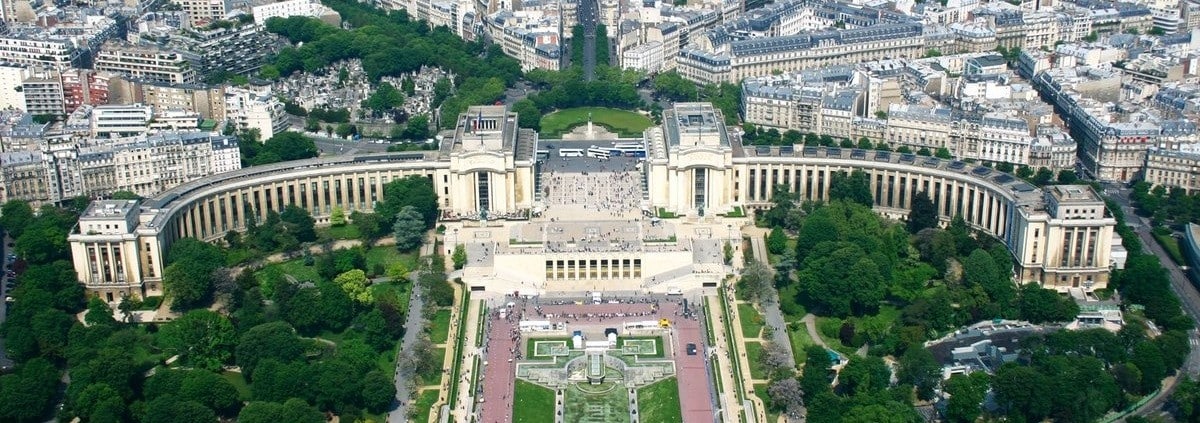
The walk from the Eiffel Tower to the Palais de Chaillot takes place in the western part of the capital. It starts at a world-famous address: the Eiffel Tower (GPS 48.85881, 2.29459) and ends at the Trocadéro Esplanade – Palais de Chaillot, which can be seen from the Eiffel Tower, just 500 meters away as the crow flies.
But this walk designed by VisitingParisByYourself (VPBY) is so much more than just a straight line! If you follow the itinerary we suggest below, this roughly 1,500 m route will offer you a wealth of detailed information at 15 points of interest—that’s one point of interest every 100 m. And to fully appreciate it, it’s only possible on foot: no buses, no metro, no bike, scooter, or car! Among them: 6 world-class museums, unique photo opportunities from Trocadéro (a treat for amateur and professional photographers from around the world), as well as historical insights and a memorial site with the tribute to Princess Diana, marking the spot of her tragic accident.
There are also “relaxation stops” along the way—whenever possible, of course: coffee break, restaurant stop, garden pause, art gallery, pastry shop, wine bar, and more.
All the information you need to make the most of this walk is available on the map or by clicking on it; further details and an FAQ can be found below the map.
🗺️ Interactive walk map
Points of interest along the walk
1. Eiffel Tower
Champs de Mars, Avenue Gustave Eiffel and 5 Avenue Anatole FranceParis, 75007
Access
- Métro :
- Lines 6 and 9: Station Trocadéro to 500 m (15 mn)
- Line 6 : Bir-Hakeim station is also 500 m away (11 mn). The subway line 6 is overhead and runs in the open air. It crosses the Seine just before arriving at Bir Hakeim station. You will also be able to see the Eiffet Tower when you get there. Always an exciting moment !)
- Line 8 : Ecole Militaire Station (15 mn)
- RER : line C - Station "Tour Eiffel-Champ de Mars"
- Bus : 82, 42, 87, 69
- Batobus : Service de navettes sur la Seine. Escale Tour Eiffel (http://www.batobus.com/)
- Parking : à proximité (Prévoir réservation)
You can also click here to get the access map.
Short description
The Eiffel Tower was built by Gustave Eiffel on the occasion of the Universal Exhibition of 1889. The year 1889 was also the celebration of the first centenary of the French Revolution.
The construction of the Eiffel Tower in 2 years, 2 months, and 5 days, by 250 workers, was a truly technical and architectural performance. This exceptional heritage still attests to Gustave Eiffel's visionary genius.
The monument is the symbol of France and showcase of Paris. Today it receives nearly 7 million visitors per year (of which about 75% are foreigners). Nearly 300 million visitors, regardless of age or origin, have come from all over the world to discover it since it opened in 1889.
The Eiffel Tower in figures:
Current height: 324 meters (with antennas).
Initial height: 312 meters
1st floor at 57 meters, 4415 m2 of floor space
2nd floor at 115 meters and 1430 m2 of floor space
3rd floor at 276 meters and 250 m2 of floor space
Elevators: 5 elevators from the ground to the 2nd floor, 2 batteries of 2 duo-lifts (special elevators) from the 2nd floor to the top.
Weight of the steel structure: 7,300 tons
Total weight: 10,100 tons
Number of rivets used: 2 500 000
Number of iron pieces: 18 038
Pillars: The 4 pillars form a square of 125 meters on each side.
2. Musée du Quai Branly - Jacques Chirac
37 quai Branly - 75007Access
MUSEUM ENTRANCES
- Debilly entrance - 37, quai Branly - opposite the Debilly footbridge
- University entrance - 218, rue de l'Université
- Bassins entrance - 206, rue de l'Université
Please note: in application of the Vigipirate Plan, level "attack alert", access to the Quai Branly - Jacques Chirac Museum is only possible via the Debilly entrance (37, quai Branly) and the University entrance (218, rue de l'Université). We thank you in advance for your understanding.
Access reserved for people with motor disabilities - 222, rue de l'Université
METRO STATIONS
- Line 9 : Alma-Marceau or Iéna
- Line 8 : Ecole Militaire
- Line 6 : Bir Hakeim
RER STATIONS - LINE C: Pont de l'Alma or Champ de Mars Tour Eiffel
BUS
- Line 42 : Tour Eiffel or Bosquet-Rapp stops
- Lines 63, 80 and 92 : Bosquet-Rapp stop
- Line 69 : Champ de Mars stop
- Line 72 : Musée d'Art Moderne - Palais de Tokyo or Alma Marceau stop
- Line 82 : Warsaw or Champ de Mars stop
- Line 87 : Rapp - La Bourdonnais stop
VELIB': Station 7023 : Bourdonnais - Tour Eiffel
BATOBUS: stop Tour Eiffel
PARKING: parking Quai Branly - 25, quai Branly
PARKING RESERVED FOR PEOPLE WITH REDUCED MOBILITY: corner of rue de l'Université and avenue de la Bourdonnais
- 211 rue de l'Université
- 22 rue Montessuy
- 15 avenue Franco-Russe
- 5 avenue Franco-Russe
- corner avenue Franco-Russe and avenue Rapp
- 179 rue de l'Université
- 8 rue Edmond Valentin
- 31 avenue Rapp
Short description
The Quai Branly museum - Jacques Chirac, is located on the banks of the Seine, near the Eiffel Tower. It is dedicated to showing the importance of the Arts and Civilizations of Africa, Asia, Oceania, and the Americas, at the crossroads of multiple cultural, religious, and historical influences.
3. Musée des égouts de Paris
Esplanade Habib Bourguiba 75007 ParisPont de l'Alma - Face au 93 quai d'Orsay
75007 Paris
Tel. +33 (0) 1 53 68 27 81
Téléphone : 01 53 68 27 84
Access
- Metro: Alma-Marceau station, line 9; La Tour-Maubourg station, line 8
- RER : Pont de l'Alma station, line C
- Bus : n° 92, 42, 63, 80, Stop Bosquet-Rapp
- Velib: Station 7022 (3 avenue Bosquet), Station 8045 (opposite 3 avenue Montaigne), Station 8046 (2 rue Marceau)
Short description
The history of the sewers of Paris and that of the city are intimately linked. At the end of the 18th century, the sewer was an open-air cesspool, and the capital was invaded by diseases. In the course of the 19th century and technical advances, the sewers gradually became a network snaking skilfully under the city in a unitary and gravity network. Paris began to breathe and to develop.
Since 1975, a museum tells the story of the sewers of Paris and its various tools and machines. It is installed in the Alma factory, at the start of the sewer siphon under the Seine, in the heart of a site in operation. It is open again since October 23, 2021 after a complete renovation.
4. Place Diana
Paris 75016Access
- Metro: line 9 - Alma-Marceau station
- RER: line C - Pont de l'Alma station
- Bus: 42, 63, 72, 80, 92
Short description
Princess-Diana Square in Paris, one place, one eternal flame for two commemorations: that of Liberty symbolized by the copy of the flame at the top of the Statue of Liberty in New York and that of the place of the accident that cost the Princess her life.
5. Passerelle Debilly (Footbridge)
Quai Branly - Avenue New York75007 Paris
Access
Metro - line 9 - Iéna and Alma-Marceau stations
RER - line C - Pont de l'Alma station
Bus - 42, 63, 72
Short description
The Debilly footbridge connects the Avenue de New York to the David Ben Gourion esplanade, in front of the Quay Branly- Jacques-Chirac Museum. It links the 16th to the 7th arrondissement. It is located 300 m from the Eiffel Tower.
The Passerelle Debilly allows a view in the distance, on the Sacré Coeur, and nearby on the Trocadero and its garden, the Port Debilly and the Seine at night, and finally the Eiffel Tower at sunset, lit from the West.
6. Place d'Iéna
75116 ParisAccess
- Metro: line 9 (Station Iéna)
- Bus: Lines 32, 63
Short description
Iéna Square is located in the 16th arrondissement, in the Chaillot district, at the intersection of avenues d'Iéna and President Wilson and at the end of avenue Pierre-Ier-de-Serbie and rue Boissière and rue de Longchamp.
Iena Square is named after the Napoleonic victory of Iena (Jena) on October 14, 1806. But the square was created in 1858 and took its current name in 1878.
In the center of the Iena Square stands the equestrian statue of George Washington in bronze by the American sculptor Daniel Chester French. It was donated by a committee of American women from high society and was inaugurated on July 3, 1900.
7. Musée national des Arts asiatiques - Guimet/MNAAG
6 place d'Iéna75116 Paris
Tel: 01 56 52 54 33
Musée Hôtel d’Heidelbach : - The Buddhist Pantheon (Japanese garden annex)
19 avenue d'Iéna
75116 Paris
Access
Métro - Line 9 ( Station Iéna and Trocadéro ) ou line 6 - (Station Boissière and Trocadéro )
RER - Line A - Station Charles de Gaulle-Etoile (800 m)
Bus - 22, 30, 32, 63, 82
Parkings : Avenue Kléber, avenue George V (place de l’Alma)
Handicap : Offer adapted to people with disabilities
Short description
Asian Arts Museum Guimet, or MNAAG for short, has been renovated in a masterly and contemporary manner. It is the largest European museum entirely dedicated to this region of the world.
The collections are divided in the museum by geographical area and according to a stylistic evolution aiming at the knowledge of the history of Asian arts.
Emile Guimet's original collection, supplemented by numerous donations over the years, has meant that the museum's collections, which are relatively exhaustive in terms of the geographical distribution of East Asia, are limited to archaeological or ancient art objects and exclude contemporary art and ethnological objects.
However, a form of diversification can be noted with the creation of a department of textiles thanks to the legacy of Krishna Riboud.
A place, although not very important, is also sometimes given to contemporary art in the margin of temporary exhibitions.
8. Restaurant des Arts - Hôtel des Arts et Métiers
9bis Avenue d’Iéna75016 PARIS
Tél : 33 (0)1 40 69 27 69
Access
- Metro: Line 9 (Iéna Station)
- RER: Line A (Charles de Gaulle - Etoile station)
- Bus: Line 32, 63
- Parking: 65 Avenue Kleber, 75116
Short description
The Lounges of the gastronomic Restaurant of Arts et Métiers "les Arts" in the "Maison des Arts et Métiers" mansion.
This restaurant is a club reserved for Arts et Métiers Engineers (meeting rooms, library, management of the engineers' association) but also now open to the public (meals but also exceptional events, rental of the hotel for weddings, meetings, etc.).
In a majestic setting, you can enjoy an excellent meal at a affordable price. Reservations are recommended (Tel 01 40 69 27 53).
Open from Monday to Friday for lunch (from 12:00 to 14:00) and dinner (from 19:30 to 22:00).
9. Conseil économique, social et environnemental
9 Place d’Iéna75016 PARIS
Architectes : Auguste Perret et ses frères Gustave et Claude
Access
- Métro : Station Iéna (line 9)
- RER : Stations Pont de l'Alma and Champs-de-Mars/ Tour Eiffel- ( Line C)
- Bus : lines 32, 63 et 82
- Parking : 65 Avenue Kleber
Short description
The building of 1937, was first the "Museum of Public Works". The building is original by the rotundity of the façade where the columns flare towards the top.
Now the building houses the National representation of professional organizations: the CESE
This assembly allows the representation at the national level of the professional organizations and the communication between the various actors of the economy.
10. Cité de l'architecture et du patrimoine
Palais de Chaillot1 place du Trocadéro et du 11 novembre
75116 Paris
Restaurant "Girafe" : with a view on the Eiffel Tower - Tel : +33 (0) 1 40 61 70 61 - contact@girafeparis.com
Access
Métro - Lines 6 end 9 - Station : Trocadéro
RER - Line C - Station Champ de Mars - Tour Eiffel
Bus - Lines 22, 30, 32, 63, 82, OpenTour
Handicap : Offer adapted to people with disabilities
Short description
The City of architecture Museum shows the French architectural heritage. It is located in the Palais de Chaillot, entrance on the Trocadero square, in the 16th district of Paris. From this esplanade, the view is also extraordinary on the Eiffel Tower and the Champ de Mars.
11. Coordinates
Musée national de la Marine
Palais de Chaillot - 17 place du Trocadéro et du 11 Novembre
75116 Paris
Access
- Metro - Lines 6 and 9 - Trocadero Station
- RER - line C - Station Champ de Mars - Tour Eiffel
- Bus - 22, 30, 32, 63, 72, 82
- Batobus : Eiffel Tower
Proposed access facilities
- Free admission for disabled persons upon presentation of proof of disability
- Free for the accompanying person
Information on accessibility
Museum under renovation (2017-2022)
https://www.parisinfo.com/visiter-a-paris/visiter-paris-avec-un-handicap
Short description
The Musée de la Marine in Paris holds 30,000 objects and works of art, including most of Joseph Vernet's series of Views of the Ports of France, figureheads, and 2,822 models of ships from all periods, including sailing warships from the seventeenth and nineteenth centuries.
There are also two important pieces:
- the decorated stern of the extraordinary galley "La Réale" of Louis XIV launched in 1694.
- the imperial canoe of Napoléon 1st built in 1810, which is no longer on display at the Musée de la Marine in Paris. Indeed, in 2018, it returns to Brest to be exhibited in the workshops of the Plateau des Capucins.
12. Musée de l’Homme - Muséum national d'histoire naturelle
Palais de Chaillot17 place du Trocadéro et du 11 Novembre
75116 Paris
Access
- Métro - Lines 6 and 9 - Station Trocadéro ( (Sortie Ave Paul Doumer – Musée de l’Homme)
- RER : Line C - Station Champ-de-Mars Tour Eiffel
- Bus - Lines 22, 30, 32, 63, 72, 82
- Batobus : escale Tour Eiffel
- Parking :65 Avenue Kleber
Disabled: Offer adapted to people with disabilities
Short description
The new Museum of Man inaugurated on October 15, 2015, remains faithful to the initial project of Paul Rivet, its founder, since, in the same building, the Passy wing of the Palais de Chaillot, it combines, like the Cité de l'architecture located in the other wing, research, and teaching center and a museum, comprising:
- a permanent interactive discovery tour (permanent exhibition) and temporary exhibitions (one per year on a given theme) ;
- two scientific departments of the Museum: "Prehistory and Men", "Nature and Society";
teaching activities; - a research library, partly transferred to the Musée du Quai Branly, which remains a place of research in the field of human sciences. It offers the public direct access to "science in the making" through direct contact with the community of scientists and researchers.
13. Esplanade du Trocadéro
ou Parvis des droits de l’hommePlace du Trocadéro
75016 Paris
Access
- Metro: lines 6 and 9 - Trocadero Station
- RER: line C - Station Champs-de-Mars/Tour Eiffel
- Bus: n° 22, 30, 32, 63, 72
Short description
The Trocadero esplanade separates the two wings of the Palais de Chaillot. It can be accessed either from the "back" and the Place du Trocadéro (officially renamed Place du Trocadéro-et-du-11-Novembre in 1978) or from the Jardin du Trocadéro, on the Eiffel Tower side. The extraordinary view of the Eiffel Tower makes it a popular place for photographers, both tourists and professionals.
14. Palais de Chaillot
1 place du Trocadéro-et-du-11-Novembre , avenue du Président-Wilson , avenue Albert-de-Mun et rue Benjamin-FranklinParis 75116
Access
- Métro - lines 6 and 9 - Station Trocadéro
- RER - Line C - Station Champ de Mars - Tour Eiffel
- Bus - Lines 22, 30, 32, 63, 52, 72, 82
Short description
The Palais-de-Chaillot and Trocadero Gardens are located on Chaillot hill in the 16th district of Paris. It was built for the 1937 Exposition Universelle in place of the Palais du Trocadero which had been built for the 1878 World's Fair. Only the name "Trocadéro" has remained for the gardens that surround the Palais de Chaillot today.
15. Fontaine du Trocadéro
Place de VarsovieParis 75016
Access
- Metro: Trocadero Station - Lines 6 and 9
- RER: Line C (Boulainvilliers/Muette Station and Champs de Mars/Tor Eiffel Station)
- Bus: 22, 32, 63,72
Short description
The Fountain of Trocadero or Warsaw Fountain is located in the Trocadero Garden, below the Palais de Chaillot, in the 16th arrondissement of Paris.
The Trocadero Fountain forms an island bounded to the southwest by Avenue Albert-Ier-de-Monaco, to the west by Avenue Hussein-Ier-de-Jordan and to the northeast by Avenue Gustave-V-de-Suède.
Twenty oblique water cannons still have a range of 50 meters, 56 sheaves with a range of 7 meters (instead of 4 m) and 12 water columns of 7 meters jets. The flow rate of the whole is 5,700 liters of water per second.
Further information on Eiffel-Tower to Palais de Chaillot walk via Place d’Iéna
Walk from Eiffel-Tower to Palais-de-Chaillot: a short walk particularly rich in Points of interest
First, the Eiffel Tower, often considered the emblem of France, but in fact much more than that (See our post “Eiffel tower, technical and commercial achievement, symbol of France“).
Six museums on the walk itinerary
What’s more, this walk is particularly “endowed” with museums: no fewer than 6, which will appear in the order below during the walk. Each of them has its own entry in our database. To access them, click on the corresponding link.
- Quai Branly museum – Jacques Chirac museum of Arts Premiers
- Sewers of Paris and its museum: the sewers in action
- Guimet Asian-Arts Museum, world-renowned and its Buddhist Pantheon
- City-of-architecture Museum, 15 centuries of models, paintings and moldings
- Navy Museum with a new look – Collections since Louis XV
- Museum of Man and research center on past and future
Do you have to visit them all? Why not, but it would take more than a day, as they are so rich in curiosities and documentation.
A remembrance and a pilgrimage
What’s more, this walk passes close to the place where Princess Diana accidentally lost her life. It has become a place of pilgrimage. A poignant tribute 25 years later, to be read by clicking on “A tragic night’: Princess Diana’s fatal Paris crash, 25 years on”.
A spotlight for photographers
Finally, the view from the Trocadero esplanade of the Eiffel Tower, Paris, the Trocadero Gardens and its fountain is majestic enough to be a meeting point for amateur and professional photographers from all over the world.
So there’s a lot more to this walk than just walking from the Eiffel Tower to the Palais-de-Chaillot!
Relaxation breaks in addition to the Points of Interest on the Walk from Eiffel-Tower to Palais-de-Chaillot
The icing on the cake are the “Relaxation Breaks” along the way – whenever possible, of course. It could be a coffee break, a restaurant break, a garden break, an art gallery break, a patisserie, a wine bar, etc… We’ve added this “encore” itinerary that follows the route of our “basic” walks. So you can shop, dine and drink, and not just anywhere: all the recommended shops have been rated from 0 to 5.0 by dozens of Tourists who have preceded you on the same walk. What’s more, we’ve eliminated from our lists all those with scores below 4.0. So you should avoid prohibitive prices, poor service and touristy scams. And, of course, you can rate the shops you’ve visited yourself, thanks to a quick and easy evaluation form you can leave us on the site.
The next walks you could follow …
It’s worth knowing that another equally interesting walk, less than 2 km long, starts at the Palais de Chaillot, where this walk ends, on the Esplanade de Chaillot. This new promenade leads to the Arc de Triomphe, passing through places of remembrance and the luxury and haute couture addresses of the “Golden Triangle“. This other walk is called Walk Palais de Chaillot to Arc-de-Triomphe via George V avenue.
You can continue your tour of Paris along the Champs-Elysées to Place de la Concorde (Walk Arc-de-Triomphe to Place-de-la-Concorde via the Champs-Elysées Avenue). From there, you have two options: a stroll to the Louvre (Walk from Louvre to Concord-Square via Tuileries and Place-Vendôme), followed by a walk to Notre Dame and Ile de la Cité (Stroll in the Ile-de-la-Cité of Paris, 800 year history). Or, alternatively, “go back up” along the promenade Opera-Garnier to Grand-Magasin Lafayette and Concorde-Square to the Madeleine, the Opéra Garnier and the department stores (Galerie Lafayette and Printemps).