Saint-Eustache Church, a museum of sacred art to visit
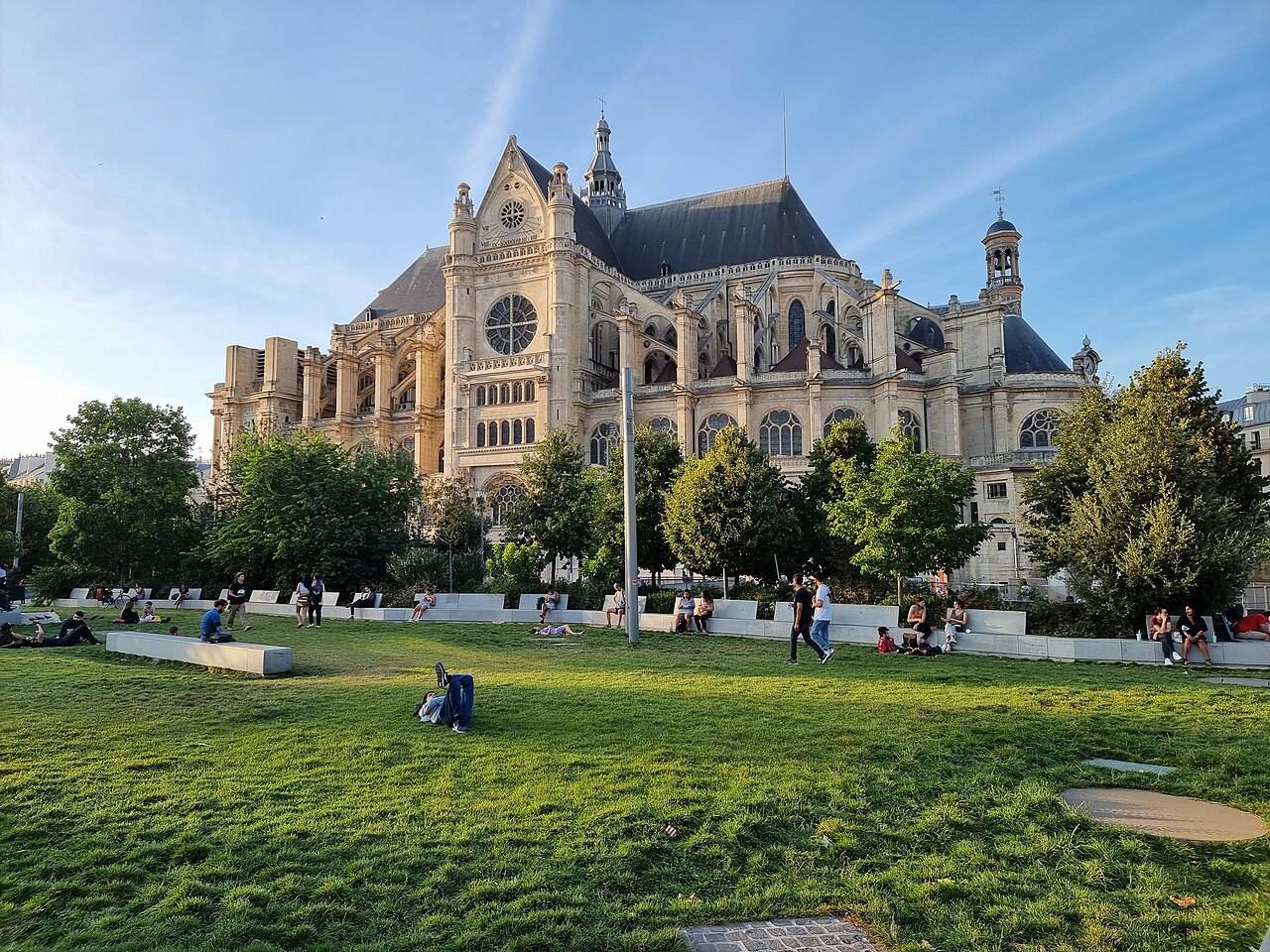
Dive into the heart of Paris and discover Saint-Eustache Church, an architectural gem where history, art, and spirituality intertwine. Nestled in the heart of the Halles, this iconic church is far more than a place of worship: it is a true open-air museum, bearing witness to nearly five centuries of Parisian history. Prepare for a fascinating journey between Flamboyant Gothic and Renaissance styles, where every stone tells a story.
Whether you're an art lover, a history buff, or simply in search of beauty, Saint-Eustache will captivate you. Follow the guide to explore this unique monument, where the shadows of Molière, Richelieu and even Mozart converge!
A strategic location in the heart of Paris
Saint-Eustache Church proudly stands in the 1st arrondissement of Paris, just a stone’s throw from the Les Halles district and the Forum des Halles. Its address, 2 Impasse Saint-Eustache, places it right in the heart of the capital, between the Louvre, the Centre Pompidou, and the Bourse de Commerce. An ideal location for a combined visit with other must-see Parisian landmarks.
Once surrounded by the famous Halles de Paris (the "belly of Paris" immortalized by Zola), the church has always been a place of passage and gathering. Today, it overlooks the Nelson-Mandela Garden, a peaceful oasis in the heart of the city. Its forecourt, enlivened by café terraces and market stalls, exudes a quintessentially Parisian atmosphere.
The Origins of Saint-Eustache Church: From Humble Beginnings to a Royal Church
The history of Saint-Eustache dates back to the 13th century, when Paris was expanding and the Les Halles district became a major economic hub. Originally, a small chapel dedicated to Saint Agnes was built around 1213 to serve the merchants and residents of the area. However, it quickly became too small to accommodate the growing number of worshippers.
In 1223, a first church was built under the name of Saint-Eustache, in honor of the patron saint of hunters, as well as merchants and… trumpeters! A unique feature that explains why the church is still associated with the musical arts today. This first structure, built in early Gothic style, was expanded several times to meet the needs of a rapidly growing parish.
The construction of the current church: a titanic undertaking (1532–1632)
In the early 16th century, the medieval church was deemed too dilapidated and too small. The parishioners, including wealthy merchants and bourgeois, decided to finance the construction of a grander new building. Work began in 1532 under the direction of architect Lemercier, before being taken over by Pierre Le Mercier and Charles David.
The construction spanned nearly a century, reflecting the architectural evolutions of the time. While the initial plans drew inspiration from Flamboyant Gothic, the church gradually incorporated elements of the Renaissance, particularly in its sculpted decorations. This blending of styles makes Saint-Eustache a unique monument, straddling different eras.
The church was finally consecrated in 1637, though some elements, such as the west façade, were not completed until the 18th century. A long and costly project, but one that gave rise to one of Paris’s most beautiful religious buildings.
The restorations: saving the Church of Saint-Eustache from the ravages of time
Like many Parisian monuments, Saint-Eustache has experienced periods of deterioration and neglect. In the 18th century, the church was in a sorry state: its façade was unfinished, its stained glass damaged, and its sculptures eroding. The French Revolution only made things worse: the church was looted, its statues beheaded, and it was even converted into the Temple of Agriculture in 1793!
Fortunately, the 19th century marked a turning point. Under the guidance of Victor Baltard (the architect of Les Halles), a major restoration was undertaken. The stained glass was replaced, the sculptures restored, and the west façade was finally completed in 1788 in a neoclassical style, far removed from the original plans. A controversial decision, but one that gave the church its current appearance.
In the 20th century, new restoration campaigns were launched to preserve the monument. The most recent, carried out between 2010 and 2016, involved cleaning the stone, restoring the frescoes, and modernizing the lighting. Today, Saint-Eustache shines brightly, ready to welcome visitors for centuries to come.
Famous Figures Linked to Saint-Eustache Church: A Pantheon of Celebrities
Saint-Eustache is not just an architectural masterpiece: it is also a place steeped in history, where some of France’s greatest figures have crossed paths. Among them, Molière, who was baptized here in 1622. A commemorative plaque marks this connection, making the church a must-visit for theater enthusiasts.
Another notable figure is Richelieu, who served as parish priest before becoming a cardinal. His influence was such that the church became a hub of power, frequented by nobility and clergy. Later, Madame de Pompadour, favorite of Louis XV, had grand masses celebrated here in her honor.
Music also holds a special place at Saint-Eustache. Jean-Philippe Rameau, the Baroque composer, served as its organist, just as Liszt and Berlioz gave concerts there. More recently, Mozart is said to have performed during his stay in Paris in 1778. Today, the church is still renowned for its exceptional acoustics and its organ concerts.
Breathtaking exterior architecture of the Church of Saint-Eustache
From the very first glance, Saint-Eustache impresses with its imposing dimensions: 105 metres long, 43 metres wide, and a vault height of 33 metres. A size that makes it one of the largest churches in Paris, second only to Notre-Dame.
The west façade, completed late, is a blend of Neoclassical and Baroque styles. Its columned portico, inspired by the Panthéon, contrasts with the Gothic towers that frame it. A marriage of styles that may surprise, yet gives the church its unique character.
The sides of the building, on the other hand, are pure Flamboyant Gothic, with their buttresses adorned with pinnacles, their gargoyles, and their rose windows. The chevet, particularly elegant, is pierced by large stained-glass windows that flood the interior with light. A perfect harmony between strength and delicacy.
Inside Saint-Eustache Church: a museum of sacred art
Step through the doors of Saint-Eustache and let yourself be overwhelmed by the magic of its interior. From the entrance, the eye is drawn to the celestial vault, supported by massive pillars adorned with sculptures. The church houses an exceptional collection of artworks, some dating back to the Renaissance.
Among the must-sees, do not miss the high altar, a masterpiece of the 18th century by Pierre Lepautre. Its altarpiece, in marble and gilded bronze, depicts the Resurrection of Christ and is considered one of the finest in Paris.
The side chapels, numbering 24, are each treasures to discover. Each is dedicated to a saint or a particular devotion and houses paintings, statues, or ex-votos. The chapel of the Virgin, for example, is adorned with a statue of the Madonna attributed to Jean-Baptiste Pigalle, one of the greatest sculptors of the 18th century.
Paintings and Sculptures: A Journey Through the Centuries
Saint-Eustache is a true open-air art gallery. Its walls and vaults are adorned with frescoes and paintings by some of the greatest artists of the 17th, 18th, and 19th centuries. Among the most remarkable are "The Martyrdom of Saint Eustace" by Simon Vouet, a monumental canvas that dominates the south transept.
The sculptures are no less impressive. In addition to the statues of saints adorning the pillars, the church houses major works such as "Christ in the Garden of Olives" by Thomas Regnaudin, and "The Virgin and Child" by Antoine Coysevox. These pieces, of exceptional craftsmanship, bear witness to the skill of French artists.
The woodwork of the choir, created in the 17th century, is also worth admiring. Rich in detail, it features biblical scenes and floral motifs in a style typical of the Renaissance.
The stained glass: an explosion of colors
The stained glass windows of Saint-Eustache are a spectacle in their own right. While the original windows were destroyed during the Revolution, those that replaced them in the 19th and 20th centuries are true masterpieces. Crafted by master glassmakers such as Émile Hirsch or Jacques Grüber, they bathe the church in vibrant hues.
Among the most beautiful are the stained glass windows of the choir, depicting scenes from the life of Christ, and those in the Chapel of the Virgin, dedicated to the life of Mary. The rose windows, meanwhile, are true laceworks of glass, blending geometric patterns with sacred figures.
Do not miss the modern stained glass in the Saint-Joseph Chapel, created in 1990 by Jean Bazaine. An abstract and luminous work, it contrasts with the traditional stained glass and adds a contemporary touch to the building.
The organ: a giant of 8,000 pipes
It is impossible to talk about Saint-Eustache without mentioning its monumental organ. With its 8,000 pipes, it is one of the largest in France, and its history is as rich as its sound. The first organ, installed in the 17th century, was replaced in the 19th century by an instrument signed by Aristide Cavaillé-Coll, the greatest organ maker of the time.
The current organ, restored in 1989, is a monster of power and precision. It is regularly used for concerts, attracting organists from around the world. If you have the chance to attend a mass or recital, you will be carried away by the powerful sound of this instrument, capable of making the church’s vaults vibrate.
The chapels and other hidden treasures
Saint-Eustache is brimming with hidden treasures, starting with its 24 chapels. Each one has its own history and style, reflecting the devotions of parishioners over the centuries. Among the most remarkable:
The Chapel of the Souls in Purgatory: adorned with a Baroque altarpiece and paintings depicting suffering souls.
The Chapel of Saint Louis: dedicated to King Louis IX, it houses a statue of the saint in prayer.
The Chapel of Saint Vincent de Paul: where the saint, then a young priest, is said to have celebrated his first mass.
Another curiosity: the vault of the baptismal fonts, where Molière was baptized, as well as Marshal Richelieu. A dive into French history, just a few meters underground.
Why visit Saint-Eustache? What makes it unique
Saint-Eustache is far more than just a church: it is a monument like no other, where history, art, and spirituality intertwine. Here’s what makes it a must-see:
A unique architectural blend: Flamboyant Gothic, Renaissance, and Neoclassical styles coexist harmoniously.
Exceptional artistic heritage: paintings, sculptures, stained glass and woodwork compete in beauty.
A connection to France’s greatest figures: Molière, Richelieu, Mozart… Names that have shaped the church’s history.
A legendary organ: one of the largest and most beautiful in France, with breathtaking acoustics.
Prime central location: just steps from the Louvre, Les Halles and the Centre Pompidou, it’s the perfect complement to other must-see sites.
Whether you are a believer or not, Saint-Eustache is a place that moves and captivates. Its unique atmosphere, blending reverence and wonder, makes it a must-visit during your stay in Paris.
Practical information for your visit
To make the most of your visit, here are some practical tips:
Opening hours: The church is open daily from 9:30 AM to 7:00 PM (hours may vary depending on services and events).
Access: Metro Les Halles (line 4) or Châtelet (lines 1, 4, 7, 11, 14). RER Châtelet - Les Halles.
Admission: Entry is free, but donations are welcome to help maintain the monument.
Guided Tours: Themed tours are available (by reservation via the official website).
Concerts: The church regularly hosts organ and sacred music concerts. Check the schedule on-site or online.
Don’t forget to look up and take your time: every detail of Saint-Eustache deserves admiration. And if you’re lucky enough to visit the church on a Sunday, attend the Gregorian mass: an unforgettable experience!
In conclusion: the Church of Saint-Eustache, a jewel not to be missed
The Church of Saint-Eustache is one of those Parisian places that leave a lasting impression. With its grand architecture, artistic treasures, and a history full of twists and turns, it offers a unique and immersive visit. Whether you’re an art or history enthusiast or simply in search of beauty, you’ll leave in awe of this monument where the sacred and the profane blend with elegance.
So, during your next stay in Paris, don’t hesitate any longer: step through the doors of Saint-Eustache and let yourself be carried away by the magic of this timeless place. And who knows? Perhaps, during your visit, you’ll catch a glimpse of the shadow of Molière or the enchanting notes of the organ…
Nearby attractions
Louvre Museum
Louvre Pyramid
Centre Pompidou
National Domain of the Palais-Royal
Place Vendôme
Tuileries Garden
Grévin Museum
Palais Garnier
Pont Neuf
Île de la Cité
Sainte-Chapelle
Conciergerie
Square du Vert-Galant
Jacques de Molay Templar Memorial
Musée d'Orsay
Vedettes du Pont-Neuf Cruises
Paris-Canal Cruises
Batobus Louvre Stop, Orsay Stop
Bonus: 5 essential tips to help you plan and enjoy your stay in Paris
Have you noticed that our website provides tools to help you easily organize your trip to Paris so that your stay is a stress-free success?
1. Phrasebook Translator for those who don’t speak French fluently
Do you struggle to find the right word or phrase in French? Click here on PHRASEBOOK – or at the top right of your screen. It’s a glossary of 100 useful words and/or expressions for a tourist visiting Paris. You’ll feel at ease in restaurants, hotels, shopping, the metro, greetings, asking for directions, and more. Eight languages are available. And here’s the best part? You can also listen to each word and expression in French.
2. VPBY’s Stay Generator
There are many interesting and educational things to see in Paris. We strongly recommend that you organize your stay well. To help you, we offer you FREE use of our Trip Generator.
In just 5 minutes and 5 clicks, you’ll get your half-day-by-half-day itinerary. Plus, all reservations—if you want, with no obligation—for the sites you wish to visit. You can also book your transport (plane, train, or car) and your accommodation. We can even suggest valuable gift ideas for you, your friends, and your family.
How does it work?
Click on "Paris Trip Organizer"—completely free—which will save you the hassle of trying to see as much as possible in as little time as possible. Then you’ll need to make your choices:
1/ Select your "general interests" by clicking on the list (Museums, Churches, Monuments, Parks, etc.);
2/ The VPBY Stay Generator then suggests all relevant listings;
3/ You select by clicking on the names of the museums, monuments, parks, or activities you wish to include;
4/ The organizer returns a day-by-day itinerary for your stay;
5/ with geographically optimized daily visits—if you so choose—to avoid tiring and tedious travel.
It takes just 5 clicks and 3 minutes. And it’s completely free. To use it, click on "Paris Stay Organizer"
Note: Want to see what users of the VPBY Stay Generator think of their experience? Click on "They planned their trip with VPBY"
3. List of Reservations to Make
To avoid wasting time waiting in line, we recommend making your reservations online a few days in advance. All official reservations are available and can be made on our website:
Reservations to enter museums, monuments, shows, and Seine River cruises
Reservations for your arrival in France: flights, trains, and cars
Reservations for your accommodation: hotels, apartments, guesthouses – in Paris or the immediate vicinity
You’ll find links to all these reservations directly in the articles about the attractions that interest you or in the self-guided itineraries of our walks. By clicking on "Reservations" in the header bar, you’ll have access to all the reservations you’ll need during your stay. For example:
4. Collectible Paris Photo Souvenirs
These are high-definition collectible photos available in digital format or as long-lasting prints (75 to 100 years). Their size ranges from postcard to large format (1 meter or more on a side). A lifelong keepsake to decorate your home. Quality souvenirs (unlike plastic Eiffel Towers or snow globes). At very affordable prices. Click on:
5. Take home a personalized photo reportage of your stay in Paris
Professional photographers will capture your moments in Paris at your chosen locations or ones we recommend. A "family" reportage, wedding, or other events. From 1 hour to a full day. The best value for money. Click on:


