Place-Dauphine, romantic island on the Seine
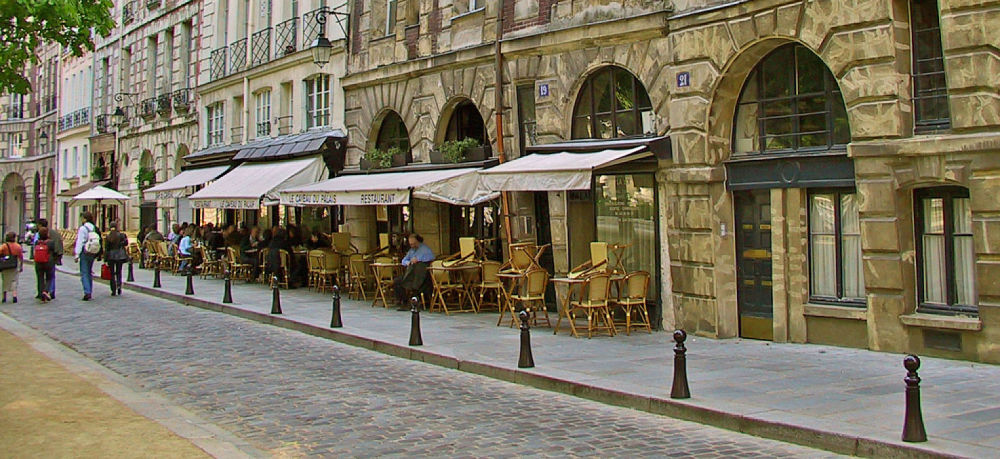
Place Dauphine is located in the 1st arrondissement of Paris. Originally triangular in shape, it is surrounded by buildings on each of its sides, forming an enclosed space. It is situated on the Île de la Cité, to the west of the former Palais de la Cité, at the current location of the Palais de Justice.
According to IGN calculations published in 2016, the geographical center of Paris is located on this square, at the coordinates 48° 51′ 24″ N, 2° 20′ 32″ E.
Place Dauphine: a space to claim
Place Dauphine, 102 meters long and 67 meters wide, occupies a triangular space to the west of the Île de la Cité. The triangle’s apex points west, leading to the middle of the Pont Neuf, at the Place du Pont-Neuf, via the short Rue Henri-Robert. This street was once considered part of the square. Alongside the Palais de Justice, Place Dauphine forms the section of the Île de la Cité belonging to the 1st arrondissement of Paris.
The eastern side of the square is separated from the Palais de Justice by Rue de Harlay. On the other two sides, a row of buildings separates it from the Quai de l’Horloge to the north and the Quai des Orfèvres to the south. The row of buildings along Rue de Harlay was demolished in the 19th century.
The area between the two rows of buildings to the north and south, as well as Rue de Harlay, covers 2,665 m². It is known as Square de la Place Dauphine.
Origin of Place Dauphine: three islands to form one
Formerly, there were two islands at the site of this square. The larger was called Île au Bureau. Its name comes from Hugues Bureau, who, on 6 February 1462, purchased the land for 12 deniers of rent and an annual payment of 10 sols. The neighbouring island, narrower but longer, bore the name “Île à la Gourdaine,” after the mill known as “de la Gourdaine.”
The construction of the Pont Neuf, from 1578 to 1607, led to the merging of three alluvial islets rising above the water with the Île de la Cité: the Île du Passeur-aux-Vaches (or “Île aux Bœufs”), the Île à la Gourdaine (also called “Île du Patriarche”), and the Île aux Juifs. In 1607, after work began on the Place Royale (now Place des Vosges) and the inauguration of the Pont Neuf, King Henry IV decided to develop the western tip of the Île de la Cité, between the Palais de la Cité and the Pont Neuf. He ordered the creation of a square on the site of the former islets and the “verger du roi” (the king’s orchard).
On March 10, 1607, Henri IV granted his loyal and former servant Achille Iᵉʳ de Harlay, First President of the Parliament of Paris, the lands forming the western tip of the island. This was a reward for his loyal services rendered during the League.
He was authorized to create a triangular square. He was tasked with constructing the new buildings in the spirit of the Place Royale (then under construction, now Place des Vosges) and according to the plan imposed by the king and the Grand Voier Sully: a "promenoir" surrounded by houses "of the same order" (of the same style), featuring two floors, whose overhangs would be adorned with stone tables contrasting against the brick, and whose ground-floor arcades would house shops.
After paying a modest sum, de Harlay began the works (as well as those of the adjacent buildings) in May 1607.
Why “Place Dauphine”?
The square was named by King Henri IV himself, in honor of the dauphin born in 1601, the future Louis XIII. As agreed, Achille de Harlay had thirty-two identical houses built in white stone, linked together, with slate roofs, on two levels, including a first floor with solid arcades (comprising a ground floor with a gallery, two square floors, and an attic), around a closed triangular square. He allocated the private lots but imposed common construction rules, which made it a fine example of planned urbanism.
“The buyers agreed to build on the lots bordering ‘a place of exchange or bourse’—our current Place Dauphine.”
A place of exchange and commerce
Close to the Louvre, Place Dauphine became a hub of exchange and commerce, attracting goldsmiths, optical instrument makers, and engravers. It is mentioned under the name “Place Dauphine” in a manuscript from 1636.
As the houses were income-generating properties, and in the absence of royal restrictions, successive owners altered the square, no longer respecting the original uniformity.
Evolution of Place Dauphine over time
Of the original thirty-two uniform houses, only the two corner pavilions on the Pont Neuf remain intact. The Pont Neuf connects the two banks of the Seine, anchored on the Île de la Cité. The other buildings were either transformed, demolished, rebuilt, or raised from the 18th century onward. In front of these two original pavilions stands a bronze statue of King Henry IV (unveiled on August 25, 1818, the first having been melted down during the Revolution), as well as the Square du Vert-Galant. → See sheet
The Revolution and subsequent history
During the French Revolution and the First Empire, the square was renamed: between 1792 and 1814, it bore the name "Place de Thionville," in memory of the heroic resistance of the inhabitants and garrison of Thionville against Prussian forces in 1792.
From 1803 to 1874, the Desaix Fountain, honoring General Desaix, who died at the Battle of Marengo in 1800, occupied the square.
In 1874, at the initiative of Viollet-le-Duc, the even-numbered side of Rue de Harlay (base of the square’s triangle) was demolished to clear the rear façade of the Palais de Justice, built in 1854. Trees were planted in the newly freed space, marking the location of the former row of buildings. With one side of its triangle removed, Place Dauphine lost its original character as an almost enclosed space.
Place Dauphine today
It is located at the "prow" of the boat-shaped Île de la Cité. Place Dauphine is one of Paris’s most romantic squares.
Admittedly, the square has not regained its original architectural unity. But the architects took advantage of the recent construction of an underground car park and its central esplanade to correct the slope of the terrain. Large trees have helped to partially and harmoniously recreate its enclosed appearance. The tranquillity of the square remains unchanged: the buildings on the sides, angled in a triangle on the two remaining sides, act as a screen against surrounding noise.
Today, Place Dauphine is home to many art galleries and small cafés and restaurants, ensuring a steady flow of visitors without the crowds. Hidden behind charming little buildings, "intimate" and "secret" are the first words that come to mind for visitors.
To reach Place Dauphine, you need to go to Place du Pont-Neuf (at the level of the Pont Neuf) and take the small rue Henri-Robert.
Place Dauphine and the artists
Place Dauphine is mentioned in literature by Gérard de Nerval in *The Enchanted Hand*, then by Anatole France in *The Gods Are Thirsty*. It also appears briefly in Curzio Malaparte’s iconic *Kaputt*.
André Breton, fascinated by its triangular shape evoking a female pubis, surrealistically deemed it « the sex of Paris ».
Place Dauphine is also a famous filming location for movies and TV series (for example, *Love Lasts Three Years* in 2011).
In music, Jacques Dutronc references Place Dauphine in Jacques Lanzmann’s song *Il est cinq heures, Paris s’éveille*, from the 1968 album.
Yves Simon, who lived there, also mentions it in his song *We Loved Each Other So Much* (album *Macadam*).
The singers and actors Yves Montand and Simone Signoret immortalized it by staying at No. 15 Place Dauphine.
Notable buildings and historic sites
N°7: Vert-Galant building, designed by Henri Sauvage in 1932. At the time of its construction, this luxury building was equipped with a garbage incinerator, two elevators, and three maid’s rooms per apartment.
N°15:
Simone Signoret and Yves Montand lived here.
Yves Simon also resided here.
N°23: Galerie des Orfèvres, an art gallery.
N°26: site of the pyre where Jacques de Molay died on March 11 or 18, 1314. He was the 23rd and last Grand Master of the Knights Templar. Arrested in Paris on October 3, 1307, on orders of King Philip IV, accused of heresy and obscene practices, he received no support from Pope Clement V or other Christian rulers, despite their hesitation. After an unjust trial, Jacques de Molay was executed in March 1314 on a pyre erected on the Île aux Juifs in Paris. The best-known and oldest legend about Jacques de Molay is the curse he supposedly cast against Philip IV and his descendants, the royal Capetian line, as well as those who condemned him: “Pope Clement!… Knight William!… King Philip!… Within a year, I summon you to appear before the tribunal of God to receive your just judgment! Cursed! Cursed! Cursed! Cursed to the thirteenth generation of your bloodlines!” All of these men died within the year that followed.
A memorial to Jacques de Molay stands behind the statue of Henry IV on the Pont Neuf.
No. 28: André Antoine (1858–1943), French actor and founder of the Théâtre-Libre, lived here from 1912 to 1934; a commemorative plaque honors him. At the same address, the Gaubert stationery shop, founded in 1830, remains in business.
Buildings on Place Dauphine listed or registered as historic monuments
The ground of Place Dauphine itself has been registered as a historic monument since 1950.
Many buildings lining the square are also registered or classified. On the odd-numbered side (south), these are numbers 13, 15, 17, 19, 21, 23, 25, 27, 29 and 31, and on the even-numbered side (north) numbers 12, 14, 16, 24, 26 and 28.