Mascotte Montmartre – Brasserie, seafood specialties
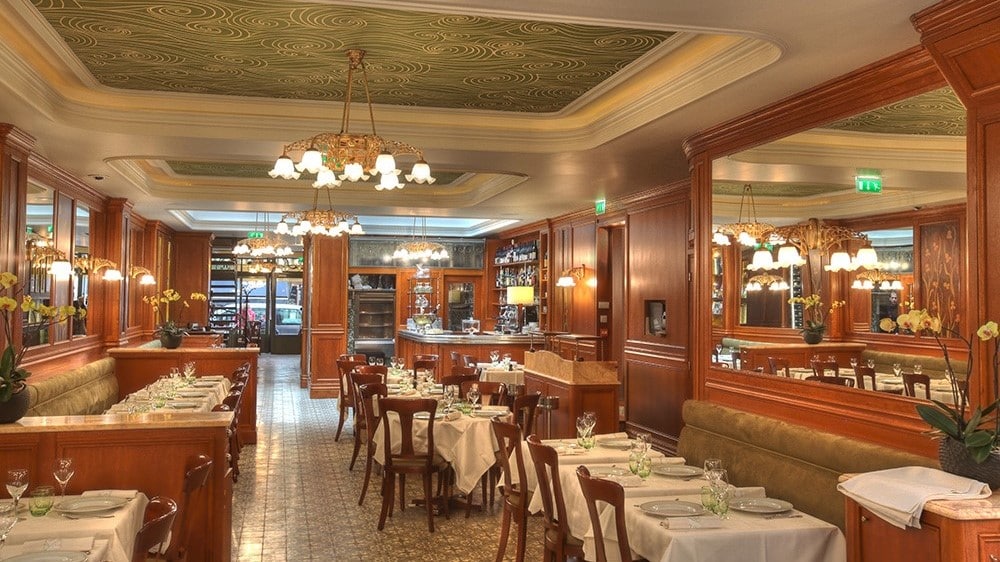
Mascotte Montmartre is a very special place, both a bar and a brasserie. It is the last authentic bistro on Rue des Abbesses, right in the heart of Montmartre, on the southern slope. Founded in 1889.
Everything began in 1889, the same year as the Eiffel Tower and the Moulin Rouge.
That year, in the heart of Rue des Abbesses, Le Pompea opened its doors as a modest two-storey hotel, with a large counter on the first floor. It was a typical Parisian pub in the purest popular tradition, where everyone could gather.
In the 1930s, the owner, a certain Père Teissier, added three more storeys to the building to create a second hotel, the Antinea, intended to house his sons. At the time, it was known as a “préfecture hotel,” in other words a “furnished flat” or “lodging house,” which, incidentally, was home in 1953 to the love story between Édith Piaf and her pianist.
In the 1950s, a billiards room for the Montmartre clientele
The establishment was run by Laurent and Mézia. At the time, the back room housed four billiard tables, and the place was frequented by a Montmartre clientele of artisans, shopkeepers, and artists, all drawn by the quality of the wines served at reasonable prices, as well as by the small stand of periwinkles run by the Marchal couple, founders of the Escargot de la Butte, the gastropod farm located on rue Joseph de Maistre. Today, it is a coworking space, a place for work, sharing, and collaboration (Minca Coworking).
The Arrival of the Aveyronnais
The first Aveyronnais family, the Comtes, took over the business before Irène and Maurice Campion bought it in 1965.
At the time, the bar was already on the left, and apart from the periwinkles and takeaway seafood dishes that made the establishment famous, only sandwiches were served. But Irène was an excellent cook and dreamed of offering her customers real hot meals. Her husband didn’t believe in it, but she took the plunge and started cooking in a tiny room at the back of the counter, first omelettes, then a few traditional dishes. The whole neighborhood rushed to taste the boss’s famous fried potatoes and her cherry clafoutis!
The True Beginnings of La Mascotte Montmartre in 1975
Following the success of Irène’s cooking, the Campion family decided in 1975 to expand the space by enlarging the bar—now on the right—and turning the dining room into a single area by removing two billiard tables. This marked the golden age of La Mascotte, which became the beating heart of Rue des Abbesses, a gathering place for regulars from the neighborhood and Parisians who loved simple, flavorful, and welcoming spots. The bar, which then stretched nearly the full length of the room toward the back, played a big part in this, and many Montmartrois still remember the endless evenings spent at the counter… It was in the family apartment, just above the bar and amid all this “crowd,” that Thierry, Maurice and Irène’s son, grew up. When Maurice passed away prematurely in 1988, Thierry was too young to take over the business, and his mother, too affected, couldn’t carry on alone. The establishment was then placed under management.
The Campions’ return to La Mascotte Montmartre
Four years later, Thierry and his wife Ghislaine decided to take back La Mascotte. The young man’s path (he was 29 at the time) was not insignificant: after earning an agricultural baccalaureate, he graduated from a business school and worked as a sales representative for Pernod-Ricard, then Perrier.
His family background and professional journey make him a legitimate candidate for this adventure, even though he admits regretting not attending a hospitality school. Yet, La Mascotte flows through his veins, and he is living proof that hard work, passion, and determination make all the difference!
La Mascotte Montmartre today
The pool tables have gradually disappeared, and La Mascotte has evolved from a neighborhood bistro into a renowned restaurant without losing its deeply Montmartre soul. True to his Aveyron origins, Thierry has kept a taste for the good things in life and tradition. He works directly with producers and winemakers and boasts having won the Coupe du Meilleur Pot awarded by the Académie Rabelais in 1999.
In the relaxed atmosphere of the slopes of the Butte Montmartre, the mood is far from gloomy, and true Parisians never fail to visit La Mascotte for a drink at the large zinc counter that lines the entrance. Which Montmartrois has never sipped a glass of white wine on a Sunday noon, accompanied by some seafood at the bar?
La Mascotte, the iconic retro-style bar-brasserie of Montmartre
But people also come to Thierry Campion for a pleasant meal in the large dining room, once decorated by his parents in the Art Deco style, with mirrors and marquetry. Thierry Campion also remains loyal to his favorite winemakers from Beaujolais and the Southwest.
The Specialties of La Mascotte Montmartre
Among La Mascotte’s other specialties are seafood (the counter is closed only in July and August due to the heat) and the unmissable farmhouse pork products from Cantal. Very French, straddling between rustic and home-style, the menu suggestions are numerous, appetizing, and sometimes original. And here, quality is never compromised, with fish arriving directly from Brittany.
We also appreciated the original simplicity of the andouille tartare from Père Duval, seasoned with mustard seeds, as well as a beef shin cooked in pot-au-feu, pan-seared “backwards” with pearl onions and carrots.
To whet the appetite: Seafood platters, Sole meunière, Live lobster on the plancha, Beef tartare, Mussels à la normande, Fish & Chips Mascotte-style, and Berthillon house ice creams and sorbets.
Around €70 excluding drinks à la carte. €49 menu. €32 lunch menu, including drinks, Monday to Friday. €22 children’s menu.
L’Écaille or the Extension of La Mascotte
After acquiring the adjacent premises to the restaurant in 2011, L’Écaille was created. Following major renovation work in 2012, the space was expanded and modernized to offer seafood and other regional products, thereby freeing up the terrace. The counter was restored to its original position, on the left upon entering, and the decor was designed in an Art Nouveau style, blending period woodwork and traditional tiles. An upstairs room was also fitted out, which regularly serves as a meeting place for many local associations.