Fountains of the Place de la Concorde, inseparable companions of the Obelisk
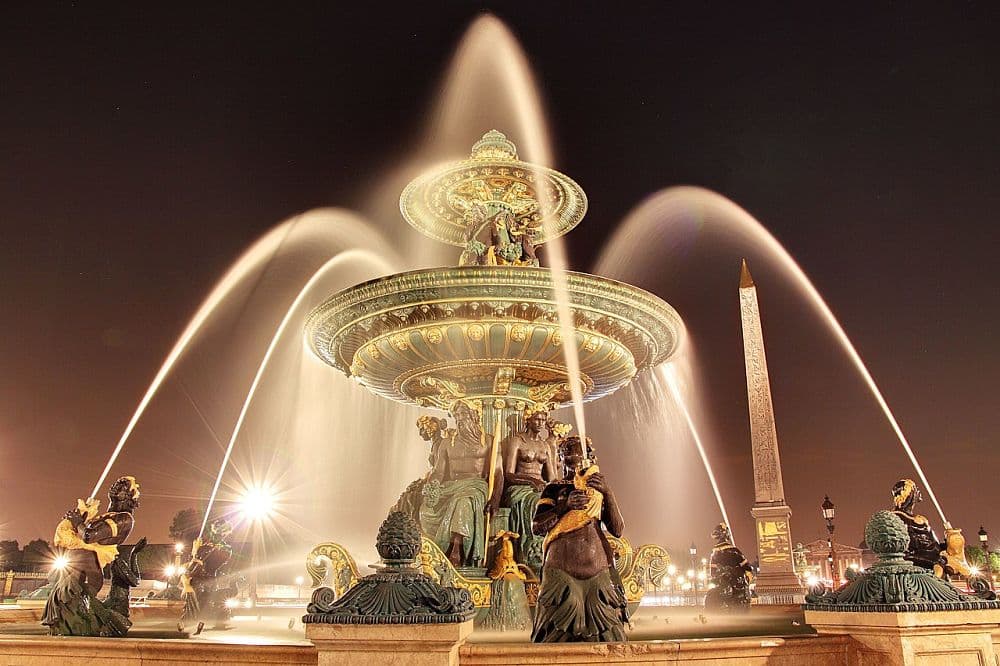
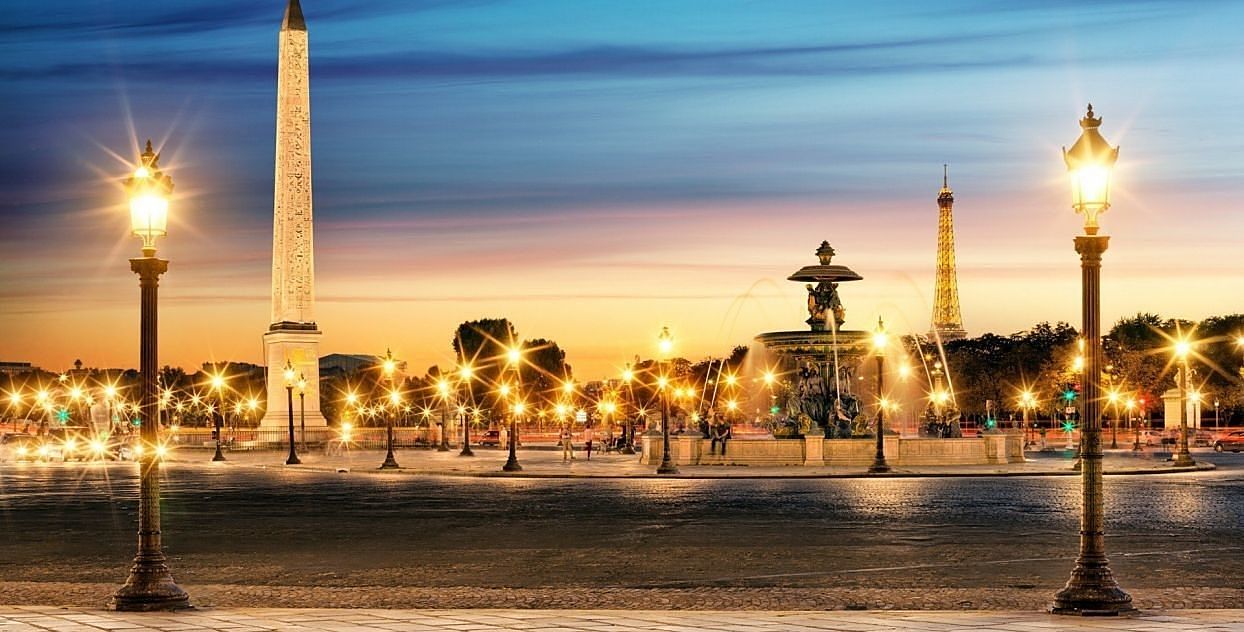
The Fountains of the Place de la Concorde are the two basins located on Place de la Concorde, in the 8th arrondissement of Paris. Flanking the Luxor Obelisk, they are named the Fountain of the Seas to the south (Seine side) and the Fountain of the Rivers to the north (Rue Royale side). The obelisk was inaugurated in 1836, and the fountains in 1840.
The renovation of Place de la Concorde
It was Louis-Philippe I who decided to erect the Luxor Obelisk on Place de la Concorde, “where it would serve as a reminder of no political event.” The operation, a true technical feat, was carried out on October 25, 1836, under the direction of naval engineer Apollinaire Lebas, in front of more than 200,000 spectators.
Between 1836 and 1846, the square was transformed by the architect Jacques-Ignace Hittorff, who preserved the concept envisioned by Gabriel.
The addition of the two monumental fountains of the Concorde
He had two monumental fountains installed—the Fountain of the Seas and the Fountain of the Rivers—on either side of the obelisk, and surrounded the square with candelabras and rostral columns.
The square thus became a celebration of French naval engineering, in reference to the presence of the Ministry of the Navy in one of the two hotels built by Gabriel. The two fountains were inaugurated on May 1, 1840, by Prefect Rambuteau.
The technical expertise behind the fountains of the Concorde
In 1837, Jacques-Ignace Hittorff, tasked with the major transformation of the Place de la Concorde, commissioned the fountains from the Muel foundry in Tusey, in the Meuse region.
They were initially intended to be made by the Parisian foundry Calla, but it was the Vaucouleurs foundry that won the contract. The most symbolic parts in cast iron were gilded.
A. Guettier, an engineer from the École des Arts et Métiers (1), then head of the Muel workshops, meticulously recorded in his archives the techniques used, the casting methods, the stages of core production and pouring, as well as the nature of the sands and irons employed. This invaluable document, which has come down to us, still serves as a reference for the most recent restorations. The entire fountain weighs around 50 tonnes. A fine piece of work.
(1) The École des Arts et Métiers is a prestigious engineering school that still exists today under the name École nationale supérieure des Arts et Métiers (ENSAM). Founded in 1780, fourteen years before the École polytechnique, by the Duke of La Rochefoucauld-Liancourt, it was originally intended to educate the wards of his cavalry regiment, which later became the 11th Dragoons. Curiously, about 100 m further down, at 9 rue Royale, the Duke of La Rochefoucauld died on 27 March 1828. His funeral was marked by events both painful and extraordinary.
The fountains of the Place de la Concorde, a tribute to water and to Paris
The two 3-meter-high basins celebrate river navigation (northern fountain, facing Rue Royale) and maritime navigation (southern fountain, facing the Seine). They also evoke the emblem of the City of Paris, which features a ship (a boat) sailing with the wind, floating on the water (the Seine). Above it is a fasce (the chief of the shield) adorned with golden fleurs-de-lys. The motto is « Fluctuat nec mergitur » (tossed by the waves but does not sink).
The river fountain features seated figures symbolizing the rivers Rhine and the Rhône, along with products from the regions they flow through (grapes, wheat, fruits, flowers), as well as allegorical statues of river navigation, agriculture, and industry.
The maritime fountain showcases six colossal figures representing the Ocean, the Mediterranean, fish, corals, pearls, and seashells. Swans mingle with three genii symbolizing Maritime Navigation, Commerce, and Astronomy.
For the artistic creation of the statues adorning these fountains, the architect Hittorff commissioned several artists: Jean-François-Théodore Gechter, Honoré-Jean-Aristide Husson, François Lanno, Nicolas Brion, Auguste-Hyacinthe Debay, Antoine Desboeufs, Jean-Jacques Feuchère, Antonin-Marie Moine, Jean-Jacques Elshoecht (known as Carle Elshoecht), and Louis-Parfait Merlieux.
Other contemporary decorations of the Place de la Concorde
The rostral columns (grand triumphal columns commemorating naval victories or victorious maritime campaigns), standing 9.60 meters tall, feature ship prows adapted for gas lighting. The same foundry choice was made for the rostral columns, also cast in iron and produced in the same Lorraine foundry.
Additionally, eight female statues preside over small pavilions called Gabriel’s sentry boxes. They represent eight French cities: Brest and Rouen by Jean-Pierre Cortot (1897–1833), Lille and Strasbourg by James Pradier (1790–1852), Lyon and Marseille by Louis Petitot (1760–1840), and Bordeaux and Nantes by Louis-Denis Caillouette (1790–1868).
The Strasbourg fountain was draped in black starting in 1871, when Alsace-Lorraine was annexed by Germany.
Restorations of the fountains of the Place de la Concorde
Originally, the idea of cast-iron fountains was boldly modern, and despite the challenges, their creation was successfully completed.
However, their maintenance proved more problematic. Victims of rust from the very first winter, the fountains on Place de la Concorde underwent numerous restoration campaigns and frequent repainting.
The first copper cladding was applied in 1841, followed by a second in 1861.
Damaged during the events of the Commune in 1871, major renovations were undertaken on the Fontaine des Mers, and to a lesser extent on the Fontaine des Fleuves. Over time, repairs using metal plates and copper sheets were gradually degraded by the natural oxidation of the cast iron, accelerating the uncontrolled aging of the fountains.
The major restoration project of 1999–2000 and beyond
To restore the fountains of Place de la Concorde to their former brilliance, a large-scale restoration project was recently undertaken. Approved in 1998, it followed the architectural and technical design of Étienne Poncelet, chief architect of the Monuments historiques.
The work took place from February 1999 to March 2000. Entrusted to Oudry workshops, the restoration involved all the sculpted elements, cast iron basins, and statues covered with hammered copper sheets, with the exception of the basin statues, which had been cast in bronze as early as 1932. The technical virtuosity and creativity of the work led to the filing of new patents. The Fountain of the Seas, the most damaged, received special attention.
For each fountain, a new stainless steel structure was designed. The cast iron elements were restored as much as possible or reconstructed by molding before undergoing a series of treatments. The restored water effects were enhanced by modernized lighting.
In 2017, a new project ensured the lasting beauty of the fountains of Place de la Concorde.
More recently, in 2022, restoration work involved applying a tint and a protective wax coating to the ornaments (gilding and bronze), as well as waterproofing the basins before they were put back into service.
The Paris 2024 Olympic Games and Place de la Concorde
Basketball 3×3, breaking, BMX freestyle, and skateboarding events will take place on Place de la Concorde. It will also host the Opening Ceremony of the Paralympic Games.
Indeed, the opening ceremony for the Paralympic Games is scheduled for the evening of 28 August 2024.
That evening, to celebrate the arrival of the 4,400 Paralympic athletes from 184 delegations, up to 35,000 people will be able to take their seats in the temporary stands set up on either side of the site, while a further 30,000 can enjoy free seating on the lower part of the Champs-Élysées.
Films shot in or near the fountains of the Place de la Concorde
The Place de la Concorde appears in many films.
In particular, the fountains are featured in the following works:
1951: An American in Paris, directed by Vincente Minnelli (part of the final dance scenes was filmed in a replica of one of the two fountains, as the movie was shot in a studio)
1961: L'Amant de cinq jours by Philippe de Broca
1971: Les Palmiers du Metropolitan by Jean-Claude Youri, starring Linda Thorson and Maurice
2011: Le Flâneur [archive], a Parisian time-lapse by Luke Shepard, includes a sequence featuring the maritime fountain.
2012: LOL USA, directed by Lisa Azuelos
2013: People Kissing; scene of the kiss shared by Lou de Laâge and Max Boublil.
Music video filmed near the fountains of the Concorde
1981: the music video for the song Pour le plaisir, performed by Herbert Léonard with lyrics by Julien Lepers, was filmed at Place de la Concorde. The obelisk and details of one of the two fountains can be seen.
To visit nearby
On Place de la Concorde
Just a few hundred metres away
Book tickets for Palais Garnier (and just 200 m away, the famous department stores Galeries Lafayette and Le Printemps)
At the other end of the Champs-Élysées (2 km)
Crossing the Seine (500 m)
Self-guided walks starting from Place de la Concorde
Walk from the Louvre to Concorde via Tuileries and Place Vendôme
Walk from Opéra Garnier to Galeries Lafayette and Place de la Concorde (under construction)
Walk from the Arc de Triomphe to Concorde via the Champs-Élysées (under construction)
Walk on the Île de la Cité in Paris, 800 years of history (under construction)
Seine River cruise
Book Batobus tickets (Water taxi - 9 stops including Concorde stop - Daily pass)