Toussaint in France, a day to remember our dead
What Is Toussaint in France and Why Is It So Important ?
Every year on November 1st, France observes Toussaint (All Saint’s day), a deeply meaningful holiday dedicated to honoring the dead. Unlike Halloween—its costume-driven, commercial counterpart—Toussaint is a day of quiet reflection, family gatherings, and traditions focused around cemeteries, flowers, and remembrance. This is not only a significant date for religious reasons but also a public holiday, so banks, schools, and many businesses close, allowing families across France to reunite and pay their respects together.
Toussaint is the French term for All Saints’ Day, but it has grown to include honoring departed loved ones, whether you’re religious or simply following cultural tradition. In France, the boundary between Toussaint and All Souls’ Day (November 2nd) is blurred: although All Souls’ Day is dedicated specifically to praying for the dead, most families visit cemeteries and remember their loved ones on November 1st because it is a public holiday.
The Difference Between Toussaint in France, All Saints’ Day, and Halloween
It’s common for visitors to confuse Toussaint, All Saints’ Day, and Halloween—so here’s how they differ:
- Toussaint (November 1st): The French name for All Saints’ Day—a Catholic holiday honoring all saints. It’s also become the day for families to visit cemeteries and remember their departed loved ones.
- All Souls’ Day (November 2nd): Specifically for praying for the dead. In practice, most of the rituals happen on Toussaint due to it being the official day off.
- Halloween (October 31st): A much newer American import, focused on costumes and trick-or-treating. Its popularity in France is rising, especially in big cities, but it still has little cultural significance compared to Toussaint.
For travelers, this means you won’t find widespread Halloween festivities in Paris—expect to see cemeteries glowing with flowers and candles instead.
How the French Celebrate Toussaint in France: Traditions and Customs
Toussaint is all about honoring loved ones through simple, heartfelt rituals:
1. Visiting Cemeteries: The Heart of Toussaint
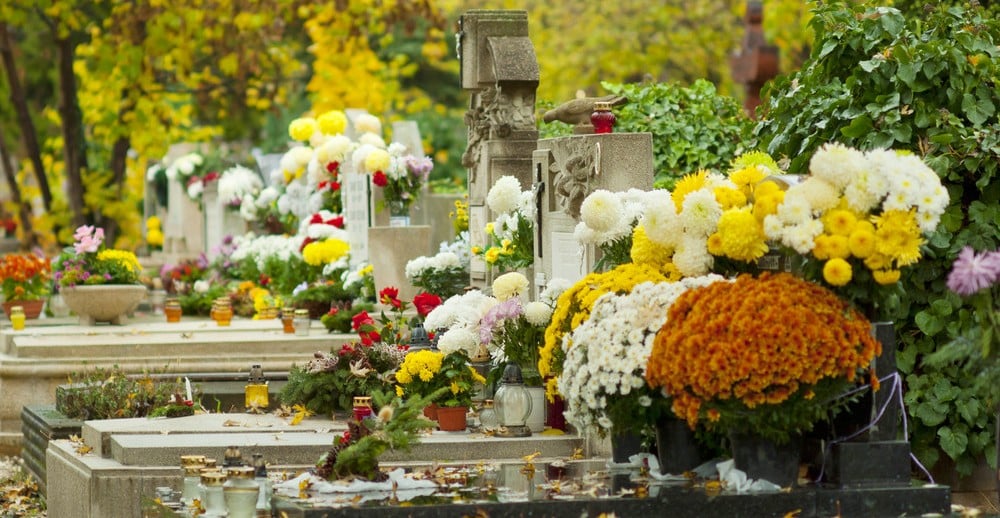
Families gather to clean and decorate graves. French cemeteries bloom with color, mainly from chrysanthemums—the flower traditionally associated with mourning and remembrance in France. Chrysanthemums symbolize longevity, comfort, and respect, and their appearance in cemeteries is overwhelming, with every grave carefully adorned. Candles are often lit at sunset, creating a sea of flickering lights. In Paris, places like Père Lachaise take on a special, almost magical atmosphere.
2. Family Gatherings and Special Meals
After their cemetery visit, families often share a hearty, comforting meal. There’s no fixed menu, but classics might include pot-au-feu, gratin dauphinois, or tarte Tatin. In southern regions, you might discover pastries shaped like bones (ossements des morts) or spiced pain des morts.
3. Religious Services (For Some)
Although Toussaint has Catholic origins, not all French people attend church. Those who do may visit for a special All Saints’ Day mass at churches like Saint-Sulpice or, when open, Notre-Dame.
4. Reflection and Storytelling
Toussaint is a time for sharing stories of family ancestors—recounting how they lived, what they endured, and keeping memories alive for younger generations.
Toussaint in Paris: Where to Experience the Holiday Like a Local
If you’re in Paris during Toussaint, you’ll notice a quieter city, as many Parisians travel to the countryside. Yet, the capital offers unique ways to experience the holiday.
1. Père Lachaise Cemetery: The World’s Most Famous Necropolis
Père Lachaise is a must-visit at Toussaint. You’ll find families quietly tending to graves, a gorgeous display of chrysanthemums, and candle-lit paths among Gothic tombs. This is the resting place of Jim Morrison, Oscar Wilde, Edith Piaf, and more.

2. Montmartre Cemetery: A Peaceful Escape
Less crowded than Père Lachaise, Montmartre Cemetery is the final home of artists like Degas and Dalida. The setting, beneath Sacré-Cœur and dotted with ivy, makes for an intimate place of remembrance.
More information on Montmartre Cemetery, place and celebrities of the art world
3. Montparnasse Cemetery: For Literary Pilgrims
Montparnasse is where the greats of French literature rest. You can visit the graves of Sartre, de Beauvoir, Beckett, and Baudelaire, each marked with poems and tributes.
More on Montparnasse Cemetery
4. Flower Markets: Toussaint’s Chrysanthemum Explosion
Local markets like the Marché aux Fleurs on Île de la Cité transform before Toussaint, filled with chrysanthemums in every shade. Even small neighborhood florists compete with eye-catching arrangements.
5. Special Events in Paris
Cultural organizations offer themed cemetery tours, classical concerts in venues like Sainte-Chapelle, and exhibitions at museums such as the Musée Carnavalet to commemorate the occasion.
- More on Sainte-Chapelle, masterpiece touched by grace, once threatened to disappear
- Book Sainte-Chapelle and Conciergerie
What to Say (and Not Say) During Toussaint
If you meet locals, these respectful phrases can help:
- “Bonne Toussaint” – the standard greeting.
- “Je pense à vos défunts” – “I’m thinking of your departed loved ones.”
- “Repose en paix” – “Rest in peace.”
Avoid saying “Joyeuse Toussaint” (it sounds irreverent), joking about death, or making Halloween comparisons—the French take this holiday seriously.
Toussaint in France vs. Mexico Día de los Muertos: A Quick Comparison
| Aspect | Toussaint (France) | Día de los Muertos (Mexico) |
|---|---|---|
| Tone | Solemn, reflective | Festive, colorful |
| Main Symbol | Chrysanthemums | Marigolds |
| Food | Hearty family meals | Sugar skulls, sweet bread |
| Activities | Cemetery visits, flower arranging | Parades, altars, storytelling |
| Religious Link | Catholic (All Saints’ Day) | Syncretic: Catholic + Pre-Hispanic |
Can Tourists Participate in Toussaint in France?

Visitors are welcome to respectfully take part in Toussaint traditions. Here’s how:
- Visit a cemetery like Père Lachaise or Montmartre.
- Buy chrysanthemums at a market and place them on a grave.
- Join a guided cemetery walk or attend a classical music concert in a historic church.
- Sample autumnal French dishes in a local bistro.
And what to avoid:
- Don’t take selfies in cemeteries or touch decorations.
- Costumes are only for Halloween events, which are rare.
- Respect the quiet, reflective tone—it’s not a day for noisy celebration.
The History of Toussaint: From Pagan Roots to Modern France
Toussaint’s origins blend pagan, Christian, and French influences. Its roots stretch to the Celtic festival of Samhain, marking the harvest’s end and the start of winter—traditionally seen as a time when the veil between the living and the dead was thinnest.
The Christianization of this moment came in the 7th century with All Saints’ Day, first observed on May 13th before Pope Gregory III shifted it to November 1st, likely to absorb the pagan rites. France’s own twist has made Toussaint a day for all the dead, not just saints, with grave visits and flower offerings becoming the norm from the 19th century, helped by the martyrdoms of World War I, which cemented the chrysanthemum as the symbol of remembrance in France.
Where to Stay in Paris During Toussaint
Your choice of neighborhood shapes the experience:
- Le Marais: Central, historic, close to Père Lachaise, and ideal for first-timers looking for culture and convenience.
- Montmartre: Artistic, romantic, and near Montmartre Cemetery—perfect for couples and history lovers.
- Saint-Germain-des-Prés: Elegant, literary, proximate to Montparnasse Cemetery, great for readers and those seeking a quieter vibe.
- Latin Quarter: Youthful, affordable, and close to the Panthéon, suiting backpackers and budget travelers.
Toussaint Travel Tips for Visitors
Make the most of your trip with these practical pointers:
- Check for closures—some museums and restaurants may close. Book dining early and confirm opening times for attractions.
- Dress warmly—Paris can be chilly and damp, usually 5°C to 12°C in early November. Waterproof shoes recommended.
- Be respectful in cemeteries—keep voices low, no eating or drinking, and observe posted hours.
- Pick up a few French phrases, like “Où puis-je acheter des chrysanthèmes ?” (Where can I buy chrysanthemums?) or “Merci pour votre accueil” (Thank you for your welcome).
- If you have extra time, consider visiting nearby cemeteries like Passy or the American Cemetery in Normandy.
Why Toussaint in France Is More Than Just a Holiday—It’s a Cultural Experience
At heart, Toussaint is about memory, respect, and the connection between the living and the dead. It’s a chance for the French to celebrate life by honoring those who’ve gone before. For visitors, it’s a window into French culture’s deep ties to family, beauty, and history; Paris itself slows down, reflects, and embraces its traditions. If you’re in France in November, a walk through a flower-filled cemetery, a taste of seasonal food, or a quiet moment of reflection will leave you with lasting insight into this unique holiday.

All Saints’ Day is also a benchmark for the weather in early November
These traditional sayings, which are sometimes debatable, only reflect reality in the temperate countries of the northern hemisphere:
- “From Saint Michael’s Day to All Saints’ Day, plow hard” or “on All Saints’ Day, sow your grain,” “on All Saints’ Day, sleeves on your arms, gloves on your hands,” “on All Saints’ Day, wheat sown, fruit enclosed (or fruit tightened).”
- “On All Saints’ Day, the summer of Saint Martin begins” or, conversely, “on All Saints’ Day, the cold returns and winter sets in.”
- “If it snows on All Saints’ Day, winter will be cold,” but “if it is sunny on All Saints’ Day, winter will come early,” “if it is warm on All Saints’ Day, it will always snow the next day,” “as All Saints’ Day is, so will Christmas be,” “frost on All Saints’ Day, Christmas will be unhealthy,“ ”as many hours of sunshine on All Saints’ Day as there will be weeks of blowing on your hands,“ ”depending on the weather on All Saints’ Day, winter will or will not be unhealthy.”
- “From All Saints’ Day to the end of Advent, there is never too much rain or wind” or “between All Saints’ Day and Christmas, it cannot rain or wind too much,” “All Saints’ Day wind, terror of sailors,” “the wind blows three-quarters of the year as it blows on the eve of All Saints’ Day.”
- “When All Saints’ Day comes, leave your plow” or “on the day of the dead, do not turn the soil, unless you want to dig up the bones of your fathers.”
Final Thoughts: How to Bring a Piece of Toussaint Home
If you’re inspired by Toussaint, here are simple ways to adopt its traditions:
- Light a candle or share a meal in memory of loved ones.
- Visit a local cemetery and leave flowers—even an unmarked grave.
- Plant chrysanthemums in your garden, honoring resilience and memory.
- Ask older relatives about their lives; write down stories to share with future generations.
Toussaint teaches us that remembering is an act of love—and that remembrance carries life forward, even on the quietest, most reflective of days.