Bruno Coquatrix's Olympia Concert Hall, 60 years of success
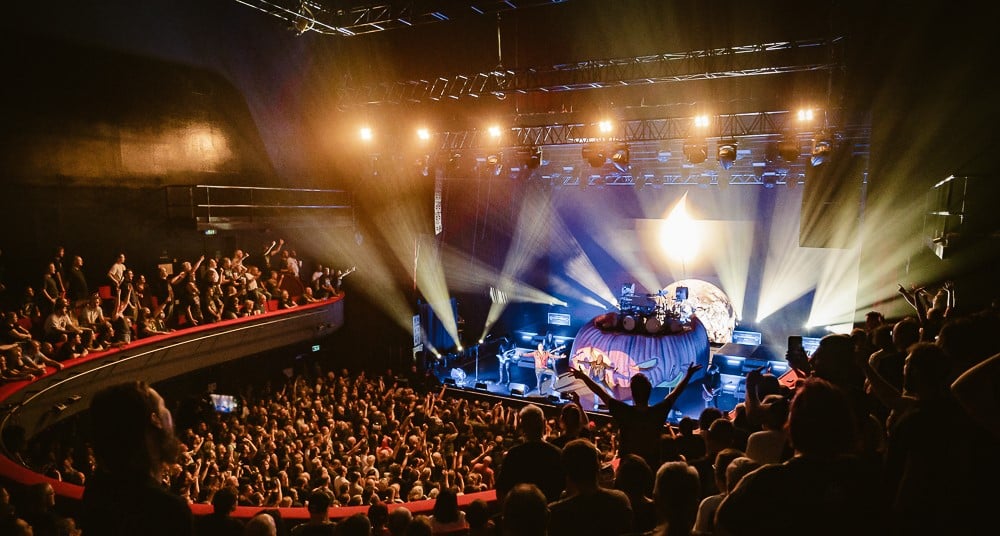
The Olympia concert hall, a legendary venue, was founded in 1888 by Joseph Oller, the creator of the Pari Mutuel and the Moulin Rouge. He installed his wooden merry-go-round in the courtyard of a building overlooking 28, boulevard des Capucines, near the Opéra Garnier. A few years later, the police prefect, fearing the wooden merry-go-round might catch fire, ordered the attraction to close. The owner then built a 2,000-seat hall: the Olympia. The first Olympia concert hall.
It opened on April 12, 1893, with La Goulue (a cancan dancer), Loïe Fuller (an American dancer), and Fregoli (a quick-change artist) as its first stars. Fairground attractions (acrobats, contortionists, etc.) took center stage. From 1911 to 1914, Jacques Charles staged music-hall revues there, and Mistinguett and Yvonne Printemps performed. In 1916, Raphaël Beretta and Léon Volterra took over its management.
**World War I: Olympia in silence**
During World War I, the original Olympia remained closed until 1928. Paul Franck managed it from 1918 to 1928, offering attractions and increasingly featuring songs. But in 1929, due to the economic crisis, it became a cinema under the name Théâtre Jacques-Haïck. In 1954, it was rebuilt as a music-hall with modern sound systems, and Bruno Coquatrix was appointed director.
The second Olympia in 1954 with Bruno Coquatrix
During the Second World War, the German army, then the American army, occupied the hall. The cinema reigned until 1954. Jacques Haïk (creator of the Le Grand Rex cinema) completely rebuilt the old music hall of Joseph Oller into a magnificent performance venue. In 1954, Sato (member of the "Jacques Haïk Group," owner of the Olympia) fully financed a modern sound system and hired Bruno Coquatrix as director. The new Olympia opened its doors on February 5, 1954. It was an immense success. Lucienne Delyle took the stage, accompanied by Aimé Barelli’s orchestra. Gilbert Bécaud made his debut there, followed by Barbara, Georges Brassens, Brel, Ferré, Piaf… and international artists like the Beatles and the Rolling Stones. Dalida made her debut there in 1956. Gilbert Bécaud premiered *Et maintenant* there in 1961. But that same year, the Olympia nearly went bankrupt, saved only by Edith Piaf’s performances, then gravely ill (*Non, je ne regrette rien*, *Mon Dieu*, *Les Flonflons du bal*), who stayed for three months. After Jacques Tati’s *Jour de fête* (a reprise of scenes from his first film, with acrobatics and live sketches), Johnny Hallyday took over. The Olympia and the New Wave
The craze for Johnny Hallyday was such that new seats had to be ordered, broken by spectators during performances.
Then Jacques Brel performed *Les Bourgeois*, *Madeleine*, *Les Paumés du petit matin* and *Ne me quitte pas*. In late 1961, the venue hosted Sylvie Vartan’s first shows, after which she moved on to larger halls, before returning in 1996, 1999, 2009 and 2010…
Rock and twist shows were staged between 1961 and 1963. In 1979, following Bruno Coquatrix’s death, management passed to his nephew Jean-Michel Boris (who remained in post until 2001). The end of the Coquatrix era and the start of Jean-Michel Boris’s tenure
In 1989, Sheila bade farewell to singing, and nine years later, in 1998, she returned to the stage. In 1998, Annie Cordy celebrated 50 years in show business and 70 years on stage. The record for the longest continuous run was set by Michel Sardou in 1995, when he stayed on for six months, giving 113 performances from 10 January to 26 March, then from 11 April to 30 April, before concluding his tour on 10 June. Besides music and song, the Olympia hosts a wide variety of shows, including circuses, ballets, films and operettas. A dance and performance school occupies the attic of the building. Later, Béatrix Hoang (dancer and choreographer) taught jazz there, and Patrick Ehrhard (choreographer, teacher and dancer) took charge of contemporary dance classes. Alice Dona and Bernard Lavilliers also run their own performance schools. Many dancers have been trained there.
The battle to save the Olympia
In 1992, Société Générale, the owner of the block, announced a major real estate project, involving a restructuring of the rear of the building to create a public square. Public and professional mobilization led to the former billiards hall being listed as a historic monument by decree on 23 May 1991. The result: the bank opted for a more modest plan—the hall was rebuilt to its original design (shifted by a few metres) and equipped with improved technical facilities. The third Olympia, the Olympia of today
The last performance in the old Olympia, dating from 1954, took place on 14 April 1997. The new hall opened in November 1997 with Gilbert Bécaud. In August 2001, Vivendi Universal, which became Vivendi in 2006, acquired the operating rights (the “Olympia” name). Since 1999, the concert hall of the Olympia (the building) has belonged to SFL (Société foncière lyonnaise).