Théâtre Marigny, 170 ans de spectacles variés et originaux
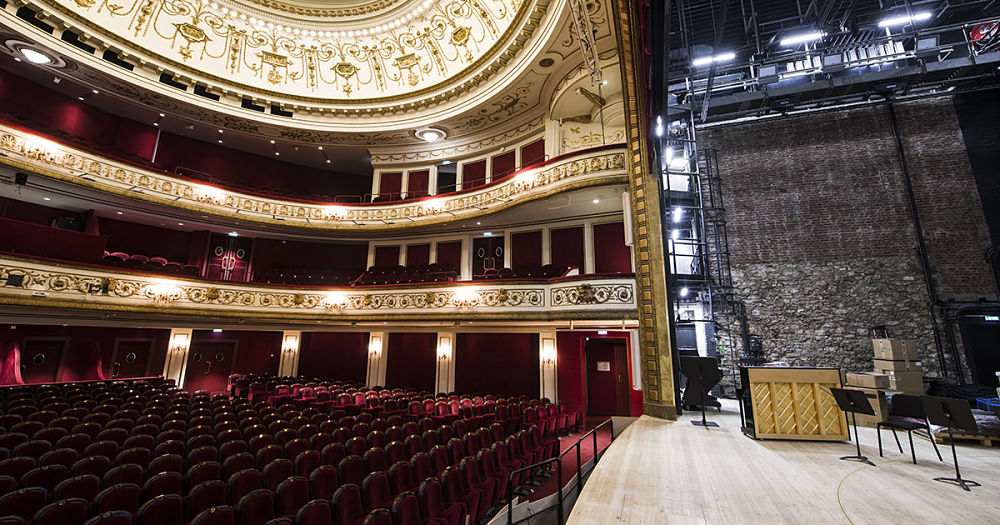
Le théâtre Marigny est situé place Marigny, dans les jardins des Champs-Élysées, à l’angle de l’avenue des Champs-Élysées et de l’avenue de Marigny, dans le 8e arrondissement de Paris.
Origine du théâtre Marigny
Après la révolution de 1848, un petit théâtre, appelé « le Château d’enfer », dirigé par Lacaze, y présentait des spectacles de « physique amusante, fantasmagorie et curiosité » – en réalité, de la prestidigitation.
Cette modeste attraction dut fermer ses portes, mais Jacques Offenbach obtint le droit de l’utiliser, la jugeant idéale en vue de l’Exposition universelle de 1855. Après des travaux, il y inaugura le 5 juillet 1855 le Théâtre des Bouffes-Parisiens, bientôt rebaptisé Bouffes d’été, car la troupe d’Offenbach y trouvait refuge l’hiver au Bouffes d’hiver, rue Monsigny (ce théâtre devait conserver le nom de Bouffes-Parisiens jusqu’à aujourd’hui).
La mode des « panoramas »
Après une succession de propriétaires, le théâtre fut démoli en 1881 pour laisser place en 1883 à un « panorama » construit par Charles Garnier, l’architecte de l’Opéra de Paris. En 1885, on pouvait y admirer les dioramas *Paris à travers les âges*, en huit toiles de Theodor Josef Hubert Hoffbauer (1839-1922), et *Jérusalem* d’Olivier Pichat.
La naissance du théâtre Marigny
Le Panorama fut transformé en théâtre à rotule en 1894 par l’architecte Édouard Niermans. Dirigé par Abel Deval à partir de 1910, le théâtre continua à produire des spectacles à succès. Il fut agrandi et modernisé en 1925 par son nouveau directeur, Léon Volterra, déjà à la tête du Théâtre de Paris et de l’Eden.
La compagnie Renaud-Barrault
En 1946, il confia la direction du théâtre à son épouse, Simone Volterra, qui fit appel à d’anciens membres de la Comédie-Française pour former une troupe « maison » autour de Jean-Louis Barrault : naissait la compagnie Renaud-Barrault.
En 1954, Jean-Louis Barrault fit aménager une seconde petite salle dans le théâtre, le Petit-Marigny.
Enfin, de 1966 à 1978, la direction fut assurée par l’actrice Elvire Popesco, assistée par Hubert de Malet et Robert Manuel. Jean Bodson leur succéda et entreprit d’importants travaux de rénovation, ainsi que la transformation totale de la seconde salle en un petit théâtre de 311 places, la salle Gabriel, rebaptisée quelques années plus tard salle Popesco.
Évolution récente du théâtre Marigny
La concession du théâtre (les murs appartenant à la Ville de Paris) est accordée en 2000 au groupe Artemis de François Pinault. La gestion en est confiée à Robert Hossein de 2000 à 2008, puis à Pierre Lescure à partir de 2008.
Fermé depuis juillet 2013, des travaux de réhabilitation doivent être menés à son terme, après lesquels le groupe Fimalac remplace le groupe Vinci. La direction artistique du lieu est confiée à Jean-Luc Choplin, ancien directeur du théâtre du Châtelet, qui recentre sa programmation sur le théâtre musical. La réouverture a lieu en novembre 2018 avec l’adaptation scénique du film musical de Jacques Demy et Michel Legrand, *Peau d’âne*.
L’émission télévisée « Au théâtre ce soir »
Le théâtre Marigny a accueilli, de 1966 à 1988, l’émission télévisée « Au théâtre ce soir », ainsi que plusieurs cérémonies des Molières.
Petite histoire d’un événement insolite
Le 1er juin 1938, Ödön von Horváth, dramaturge et écrivain allemand, mourut devant le théâtre, tué par une branche de marronnier arrachée par une tempête. En 1998, une plaque en hommage à Ödön von Horváth fut apposée par son éditeur, Thomas Sessler Verlag, sur la façade gauche du théâtre Marigny (Paris 8e).