Rond-Point Theater, history of original entertainments, creations and essays
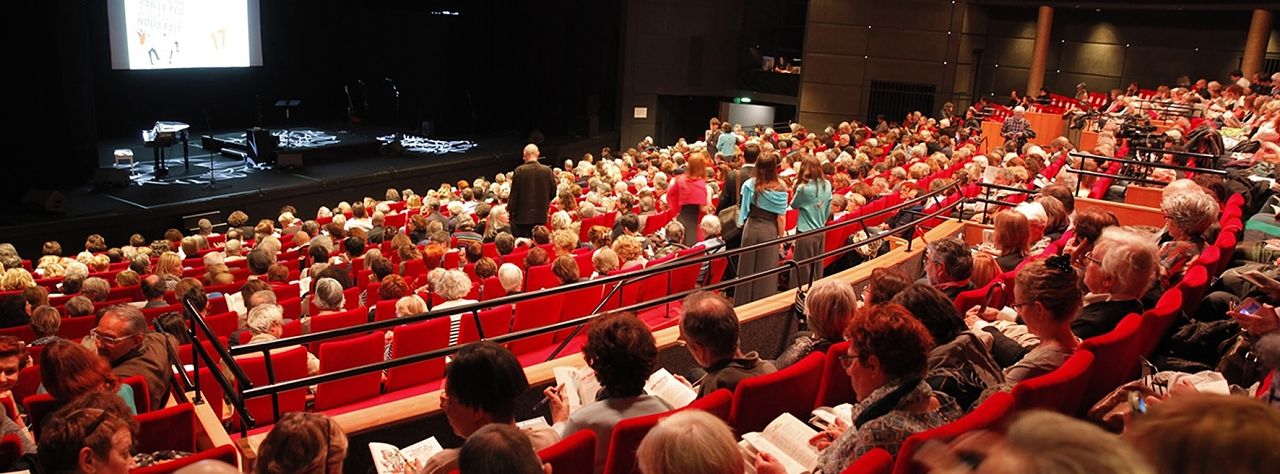
The Rond-Point Theater is located a few steps away from the Champs-Élysées garden and not far away of Champs-Elysées Theater.
Inaugurated in 1839, the "rotunda of Hittorffest" (circular pavilion topped by a dome) was integrated into the buildings of the Universal Exhibition of 1855 and then destroyed the following year.
The evolution of Rond-Point theater: the "National Panorama" and then the "Mirror Palace"
The Rotunda is replaced by a "Panorama". This is a large 360 degree painting, which was produced mainly between the very end of the 18th century and the beginning of the 20th century. Developed on the interior wall of a rotunda, it gives the illusion of reality through the effects of perspective and trompe-l'oeil. The building that houses it was also called panorama or sometimes cyclorama.
A new panorama, called Panorama National, was built by the architect Gabriel Davioud at the corner of the "Avenue d'Antin" (now Avenue Franklin-D.-Roosevelt) and the Champs-Élysées. The painter Jean-Charles Langlois (1789-1870) was the artistic director of the establishment, which was inaugurated on August 1st 1860.
In December 1893, the Rotunda of the National Panorama became the Palais des Glaces (Hall of Mirrors - deforming mirors), one of the most popular attractions in Paris during the Belle Époque and remained in operation until the end of the 1970s.
The theatrical vocation of the Rond-Point Theater
In 1981, Madeleine Renaud and Jean-Louis Barrault's company had to leave the former Gare d'Orsay where the Orsay Museum, as we know it today, was to be built. The Renaud-Barrault Company then moved to the Rond-Point Theater. The rotunda was emptied and refurbished. The theater opened its doors in March 1981 with a show by Jean-Louis Barrault, L'Amour de l'amour, based on texts by Apulée, La Fontaine and Molière.
From 1981 to 1991 the Rond-Point Theater presented contemporary works (Marguerite Duras, Nathalie Sarraute, Samuel Beckett, Yukio Mishima) as well as traditional shows from the Far East (Ramayana from Thailand, Javanese Opera, Music)
The new era of the Rond-Point theater: contemporary creation
Since 2002, the theater has been directed by Jean-Michel Ribes, who has made it a mecca for contemporary creations by committing himself to producing and presenting only living authors. The theater has 3 rooms: Salle Renaud-Barrault, Salle Jean Tardieu and Salle Roland Topor.
The Théâtre du Rond-Point is equally subsidized by the French Ministry of Culture and the Paris City Council.
Vents contraires: a "subsidiary" of the Théâtre du Rond-Point
In May 2010, Jean-Michel Ribes and Jean-Daniel Magnin launched Ventscontraires.net, the first European online media supported by a cultural theater. The initial idea was to create a "4th virtual room" where artists who cannot be seen on the stages of the Rond-Point (writers, cartoonists, video artists...) could intervene, in the spirit of joyful subversion that has animated this theater for 13 years now.
To know more about it
Continue on avenue de Sèvres to the Champs Elysées, go down to avenue de Marigny, on the left.